
Silverfish can already be established in a building, enter through openings, or arrive with stored materials. They do not normally emerge through drain pipes. Finding the source means inspecting sheltered places, moisture, and paper or food storage rather than treating only the room where one became visible.
Key takeaways
A tapered wingless insect with three long rear filaments may be a silverfish. Check sheltered storage, moisture, and incoming items. Sink sightings do not prove a drain source, and development is slower than an overnight infestation.
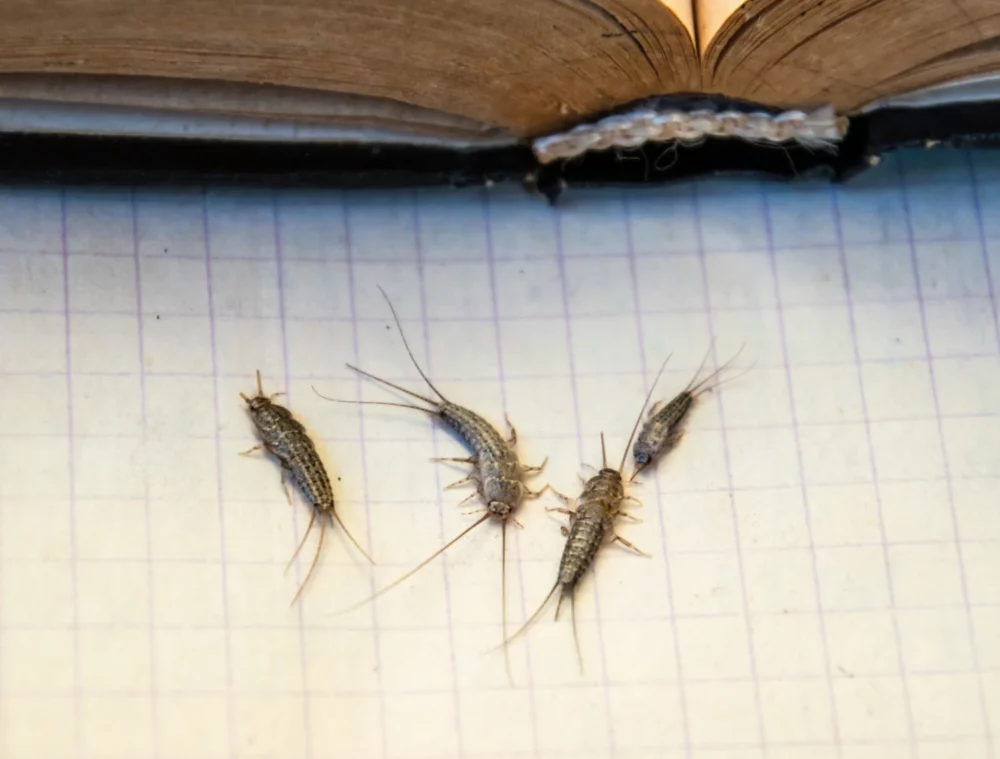
Silverfish-like insects beside an open book.
Identification and origins
Silverfish are wingless insects with long antennae, a tapered body, and three rear filaments. Common silverfish have a silvery, scaled appearance. Firebrats are related but often mottled; they prefer warmer conditions. Species differ, so not every bristletail-like insect belongs to one humidity-dependent household species.
Their presence does not identify one geographic source for your home. Insects may have occupied a concealed building space before discovery, arrived with belongings, or moved through an opening. A recent sighting is not necessarily a recent introduction. Photograph the body and rear filaments before choosing a product.
Entry routes and transported materials
Look at accessible foundation or wall gaps, utility penetrations, door thresholds, and openings connecting storage areas. A small gap can connect a sheltered habitat to an occupied room. In a multi-unit building, persistent sightings may require management to assess shared voids and moisture.
Boxes, books, paper, and stored belongings can provide shelter and can transport insects. Inspect newly delivered or long-stored items in a well-lit area before shelving them. A damaged package or a silverfish nearby does not prove the supplier caused the infestation. Keep packaging away from damp corners and avoid bringing old cardboard into long-term storage when a clean sealed container is practical.
Construction materials are another potential route, but a newly finished building may also contain hidden moisture or suitable shelter. Inspect the actual conditions instead of concluding that every silverfish arrived with lumber.
Food, shelter, and moisture
Silverfish feed on a range of starchy or protein-containing materials, including some paper products, adhesives, fabric sizing, and stored foods. Review what silverfish eat when damage appears in books, packaging, or a pantry. Tiny feeding damage needs identification because other pests can affect the same materials.
Many household silverfish favor moisture, while firebrats tolerate warmer and drier sites. There is no universal 75-percent humidity threshold that identifies all species or establishes when treatment is required. A leak or persistent condensation is worth correcting independently of insect activity.
Dark, undisturbed spaces protect insects and make them harder to detect. Inspect accessible cabinet backs, baseboard edges, storage containers, and shelving with a flashlight. Reduce clutter enough to see and monitor those edges rather than relying on a spray into an unseen void.
Where to inspect in each room
| Area | Check | Practical response |
|---|---|---|
| Bathroom | Leaks and condensation; accessible shower stalls, cabinets and gaps around pipes | Repair moisture faults and monitor edges |
| Basement or lower storage | Damp stored paper and books; accessible storage containers, wall and pipe gaps | Dry the area and improve organized storage |
| Attic | Accessible stored paper and bindings; hot summer attics can also shelter firebrats | Arrange safe inspection; avoid unsafe void access |
| Kitchen | Dry cereal, flour, pasta and pet-food packaging; cabinets and accessible pipe gaps | Inspect food and store it securely |
| Laundry area | Condensation and leaks; accessible pipe gaps, storage containers, corners and edges | Maintain ventilation and fix water faults |
Use the table to target an inspection, not to assume the insect is breeding in every listed room. A solitary sighting in a bathtub may represent an insect that wandered away from its shelter.
Outdoor sources and the drain myth
Some silverfish relatives occupy outdoor protected sites, and openings can connect those sites to a building. Outdoor survival and cold tolerance vary by species and microhabitat; do not assume every Florida insect dies at one winter temperature. Sealing a suitable opening helps, but it will not remove insects already established indoors.
UC IPM explains that silverfish found in sinks or tubs typically fell in and cannot climb the smooth surface; they did not come up through the drain. Inspect surrounding cracks and nearby damp shelter. If you see fuzzy flying insects instead, investigate a drain-fly problem; different insects can share the same bathroom without having the same source.
Prevention that supports monitoring
Repair leaks, improve appropriate ventilation, and dry damp stored materials. Measure moisture where a problem is suspected rather than aiming at a made-up universal insect threshold. Correct roof or plumbing faults through the appropriate tradesperson.
Seal suitable cracks and utility gaps without blocking required airflow or drainage. Vacuum accessible debris and crevices, remove unnecessary paper clutter, and use sound containers for vulnerable food or collections. Inspect belongings before moving them between rooms or into another unit.
Place labeled monitoring traps in protected locations away from children and pets. Record date and location, and compare catches over time. Monitoring helps locate activity and assess changes; a few empty traps do not prove all concealed insects have disappeared. For valuable books or textiles, ask a conservation professional about storage and treatment before applying products.
Established activity: biology and the next decision
Silverfish hatch from eggs into young that resemble small adults, then molt as they grow. They do not have a fly-like pupal stage and continue molting after maturity. Egg hatching and growth into an adult are different intervals. UC IPM reports common silverfish eggs hatching in about 19–32 days, compared with about 14 days for firebrat eggs. In colder environments, eggs can remain dormant for up to six weeks and hatch when temperatures rise. UC separately describes silverfish development into adults taking as little as 60 days above 75°F or as long as 500 days below 50°F; those temperature-specific observations are not one timetable for every building. Adults can be long-lived. This explains why established shelter may keep producing sightings without an explosive overnight reproductive cycle.
For silverfish management, begin with identification, source correction and monitoring. A persistent infestation, inaccessible harborages or damage to valuable collections warrants qualified assessment. If a pesticide is proposed, ask why it fits the identified species and location and follow the label. Fogging an occupied room or dusting books is not a substitute for finding the protected source.
Look for feeding evidence as well as live insects. UC describes scraping of paper surfaces, with feeding on paper or fabric producing separate irregular holes. Delicate, dust-like scales around a damaged item and fecal debris can support the identification when considered with a specimen. Discoloration may involve fungi associated with feeding damage; a brown mark alone does not prove silverfish. Check nearby bindings, pasted paper, stored fabrics and accessible edges for the same pattern, then protect valuable material and inspect the hiding sites around it.
Sources and further guidance
Frequently asked questions
-
Can silverfish come from new construction materials?
They can arrive with transported materials, but a sighting in new construction does not establish that route. Check packaging, stored items, and hidden moisture.
-
Do silverfish spread from apartment to apartment?
Movement through shared gaps or transported belongings is possible. Persistent multi-unit activity should be discussed with building management so connected sources can be checked.
-
How fast do silverfish multiply once they're inside?
Egg hatching and growth into an adult are different intervals. UC IPM reports common silverfish eggs hatching in about 19–32 days. It separately describes development into adults taking as little as 60 days above 75°F or as long as 500 days below 50°F. These temperature-specific observations are not a timetable for every building. Young resemble small adults and molt as they grow.
-
Are silverfish more common in certain climates?
Species and shelter matter. Many silverfish favor moisture, while firebrats prefer warmer sites; inspect actual conditions instead of assigning one climate or humidity rule to all.
-
Can silverfish survive outdoors during winter?
Outdoor survival depends on species, shelter, and temperature. Indoor protected sites may remain suitable even when outside conditions change.
-
Should I call a professional for silverfish or try DIY first?
Start with identification, moisture repair, storage changes, and monitoring. Seek assessment for persistent activity, inaccessible sources, or collection damage; not every solitary silverfish requires pesticide service.
Get help with your pest concern.
Tell us what you are seeing. Our team can discuss the concern and the next step.
- Share your concern and contact details.
- Our team contacts you to discuss available service.
- Ask for a written scope and quote before work.
Where can we reach you?
Our team will call to confirm the next step.
By submitting, you’re asking On Demand Pest Control to contact you about this request.
↗ Prefer to call? (954) 947-0805
Vincent founded On Demand Pest Control in 2017 and is a Florida Certified Operator in all four state categories. He treats pest control as a systematic problem to solve, not a symptom to spray. Read Vincent’s full bio →