
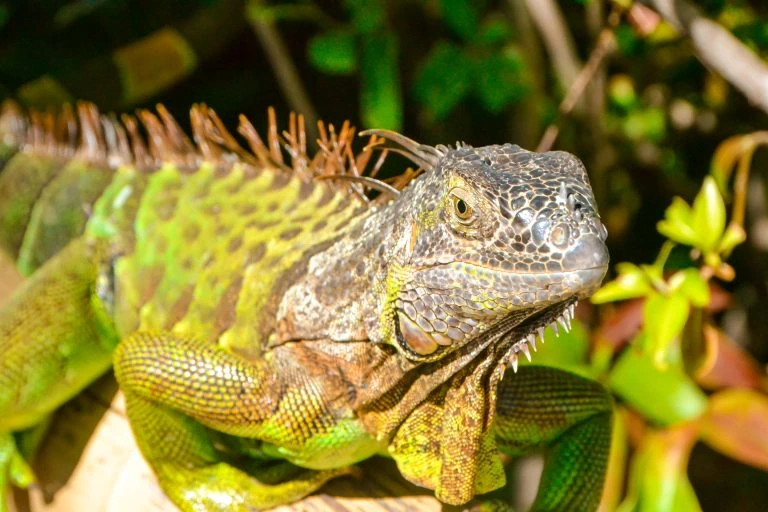
Learn how ectothermy shapes iguana basking, cold-weather behavior and safe property decisions.
Yes—iguanas are ectothermic. They depend strongly on outside heat sources to regulate their body temperature. “Cold blooded” is familiar shorthand, but it does not mean their blood is always cold or that their body exactly matches the air temperature.
What ectothermic means for an iguana
A green iguana can warm in sunlight and cool in shade. Unlike a mammal, it does not maintain a stable warm body mainly through metabolic heat production. Its own metabolism still produces heat; the important distinction is that environmental heat plays the dominant role in its temperature regulation.
The University of Michigan Animal Diversity Web green iguana account describes basking as important for raising body temperature and aiding digestion. That helps explain why an iguana can appear inactive at one time and move normally later. Our iguana facts about thermoregulation provide related background.
Body temperature is not the weather forecast
The air temperature reported for a neighborhood is only one part of an animal’s thermal environment. Direct sunshine, shade, the surface it rests on and shelter all affect heat exchange. An iguana on a sunlit seawall can experience different conditions from one resting in shaded vegetation nearby.
UF/IFAS describes iguanas basking on docks, sidewalks, seawalls and other open surfaces. These observations explain recurring locations; they do not prove a precise body temperature or offer a safe approach window. A resting animal can still respond defensively if disturbed.
Why cold iguanas sometimes fall from trees
Green iguanas are not cold hardy, as FWC’s species profile explains. In sufficiently cold conditions, their movement and grip can be impaired. An animal roosting above the ground may lose its hold and fall. An immobile iguana is not necessarily dead, and recovery should never be assumed either.
There is no single air-temperature reading that proves every iguana will fall, recover or die. Exposure duration, local shelter, the animal’s condition and the temperatures actually experienced all affect the outcome. A precise lethal threshold or an exact number of freezing hours would overstate what these sources establish.
Keep a distance from fallen animals and keep children and pets away. Do not pick one up, take it indoors or try to warm it. Our guide to falling iguanas in Florida addresses that situation separately.
Daily activity: basking, feeding and shelter
Green iguanas are primarily diurnal: their usual activity occurs during daylight. A morning sighting on a bright surface may be basking rather than a sign that the animal is injured. Activity can change with weather and available shelter, so no universal hour tells you when a property is clear.
Behavioral temperature regulation includes choosing warmer or cooler locations. The Animal Diversity Web account also describes temperature-associated color changes and a role for the dewlap in heat exchange. These are biological behaviors, not a reason to infer that every dark iguana is cold or every pale one is overheated.
For homeowners, the useful pattern is location and recurrence. Note safe-distance sightings, recurring basking areas and nearby damage rather than trying to determine the animal’s body temperature. See wild iguana temperament and behavior for why calm appearance does not make handling safe.
Cold weather does not replace property assessment
A cold event can affect individual iguanas, but one cold morning cannot establish that a neighborhood population has disappeared. Nor can these species profiles predict a rebound within a fixed number of breeding seasons. A report of fewer sightings is not a population count.
FWC describes established green-iguana populations mainly in South Florida and cautions that northern sightings can be escaped or released animals rather than established populations. Do not turn that distinction into a climate forecast or a promise of permanent cold-weather control.
Safe next steps after a weather change
If you notice repeated iguana activity, record its location without approaching animals. Look for observable impacts such as vegetation loss or burrow openings near structures; do not assume weather caused or solved them. Burrows near seawalls and foundations warrant appropriate assessment, regardless of whether an iguana is visible that day.
Ask On Demand Pest Control about an assessment of iguana activity and property-specific options. For green iguanas, FWC’s current guidance includes anti-cruelty protections, landowner permission for removal on private property, a prohibition on relocation and release, and permit requirements for live possession for eradication and control. Cold-stunning does not suspend those rules.
Frequently Asked Questions
-
Are iguanas cold blooded like all reptiles?
Yes, iguanas are ectothermic and rely strongly on environmental heat to regulate body temperature. That does not mean their blood is always cold or that every reptile has identical physiology or temperature limits.
-
What temperature is too cold for iguanas to survive?
No single air-temperature cutoff reliably predicts survival for every iguana. Species, exposure duration, shelter and individual condition matter. FWC describes green iguanas as not cold hardy; an immobile animal should not be assumed dead.
-
Why do iguanas fall from trees during cold snaps?
Cold conditions can impair a green iguana's movement and grip, causing a tree-roosting animal to fall. Some may recover, but a distant observer cannot determine its condition. Keep people and pets away and do not handle or warm it.
-
Do iguanas come out at night?
Green iguanas are primarily active during daylight and commonly rest at night. Weather and local conditions affect activity, so nighttime does not guarantee that an animal cannot move or react defensively.
-
How do iguanas warm up so quickly in the morning?
Basking allows green iguanas to absorb environmental heat. They select exposed locations and can change position or move between sun and shade; the rate of warming varies rather than following one fixed morning schedule.
-
Does cold weather permanently reduce iguana populations in Florida?
A cold event may affect individual iguanas, but it does not demonstrate that a local population has disappeared permanently. The cited profiles do not establish a fixed rebound time or a statewide population prediction.

Vincent founded On Demand Pest Control in 2017 and is a Florida Certified Operator in all four state categories. He treats pest control as a systematic problem to solve, not a symptom to spray. Read Vincent’s full bio →
Get help with an iguana concern.
Tell us what you are seeing. Our team can discuss the concern and the next step.
- Share your concern and contact details.
- Our team contacts you to discuss available service.
- Ask for a written scope and quote before work.
Where can we reach you?
Our team will call to confirm the next step.
By submitting, you’re asking On Demand Pest Control to contact you about this request.
↗ Prefer to call? (954) 947-0805