
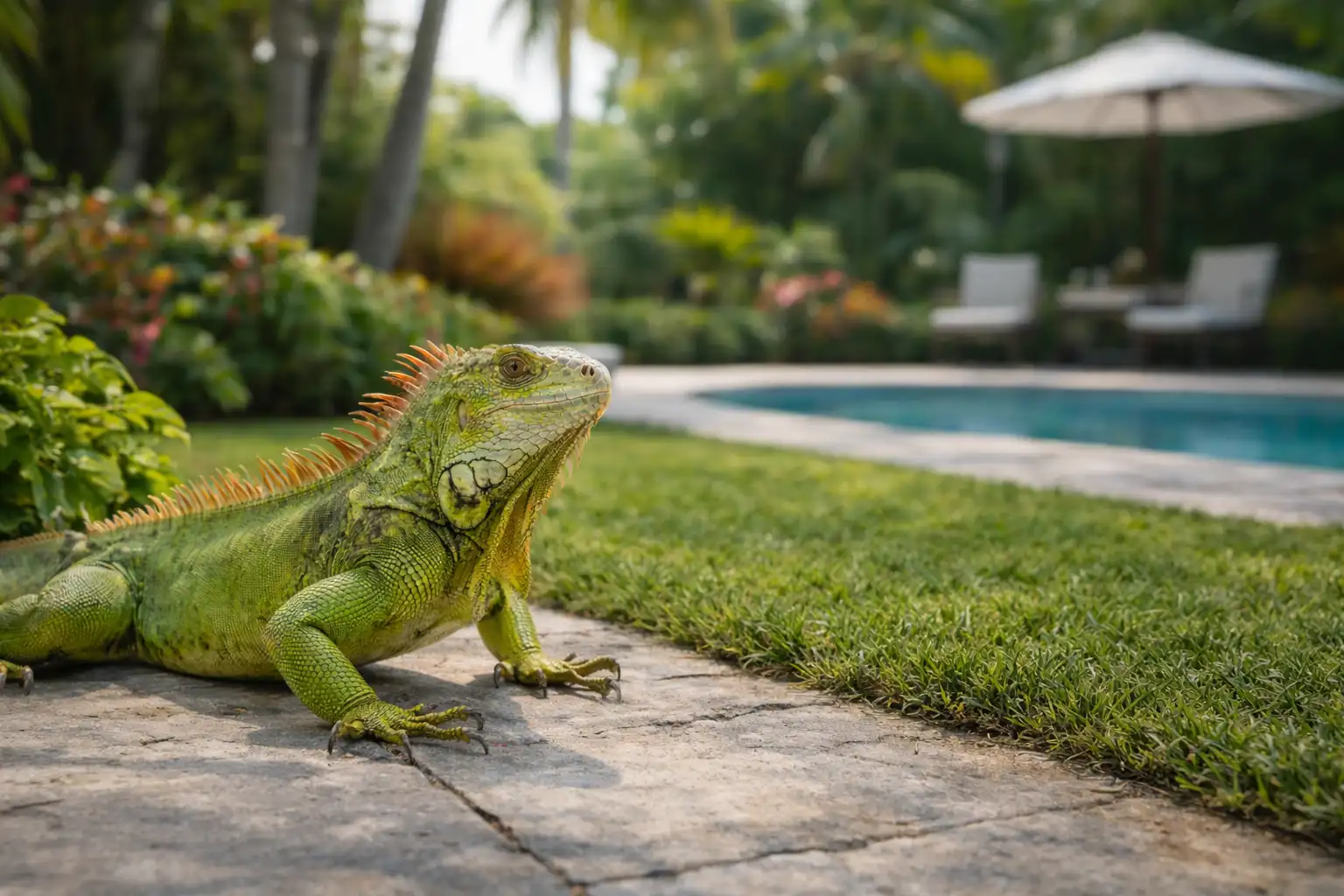
At a glance: Yes, iguanas are lizards, and lizards are reptiles. “Iguana” is a more specific name within that larger group, not an alternative to “lizard.” In Florida, identifying the species matters more than applying the broad label: a green iguana, an anole and a monitor are different animals with different concerns.
An iguana’s size, back spines and long tail can make it seem unlike the small lizards on a porch. Those differences do not remove it from the lizard group. This guide explains the classification clearly, then connects it to the practical task of recognizing a large Florida reptile without assuming every green animal is an iguana.
Yes: Iguanas Are Both Lizards and Reptiles
The terms fit inside one another. An iguana is a kind of lizard; a lizard is a kind of reptile. Asking whether it is one or the other creates a choice that biology does not require. For a related explanation of whether an iguana is a reptile, start with the same nested relationship.
| Level | Green iguana placement | Meaning |
|---|---|---|
| Animal | Animalia | The broad animal kingdom |
| Reptile | Reptilia | Includes several reptile lineages |
| Scaled reptile order | Squamata | Includes lizards and snakes |
| Family | Iguanidae | The iguana family in the classification used here |
| Genus and species | Iguana iguana | The scientific name used by FWC for the green iguana |
Taxonomic arrangements and species totals can change as research develops. A fixed count of all iguana or lizard species is unnecessary to answer the question. The University of Michigan’s Animal Diversity Web places Iguana iguana in Squamata and Iguanidae. Our overview of iguana facts about species classification is a companion topic, not a substitute for species identification.
Lizard is not shorthand for small
Lizards vary greatly in size, diet, shape and behavior. Four legs, scales, eyelids and visible ear openings help describe familiar lizards, but they are not an exception-free checklist for every species. Some lizards lack legs; many geckos do not have movable eyelids. Classification is based on ancestry and anatomical evidence, not a yard animal passing a few visual tests.
Why a Green Iguana Looks Different From an Anole
FWC describes the green iguana’s dorsal spikes, ringed tail, dewlap and prominent adult male jowls. Males can exceed five feet in total length, including the tail. These features are useful together, but not every feature belongs exclusively to iguanas. Anoles also have dewlaps, and other lizards can have crests.
UF/IFAS specifically notes that knight anoles and brown basilisks can be mistaken for iguanas in South Florida. A green color or throat fan is therefore insufficient. Do not infer that a lizard is harmless, invasive or eligible for removal from its color alone.
Diet differs, but there are exceptions
Green iguanas eat primarily leaves, flowers, shoots and fruits, while many small backyard lizards eat insects. FWC also reports animal material in green iguana diets, including insects and tree snails in juveniles and occasional eggs or dead animals in adults. Different iguana species have different habits. “All iguanas only eat plants” and “all other lizards eat meat” are both misleading.
Comparing Large Florida Lizards
UF/IFAS identifies green iguanas, black spiny-tailed iguanas and Mexican spiny-tailed iguanas as established in South Florida. They are distinct species, not merely color forms of one animal. Other large introduced lizards, including tegus and Nile monitors, also occur in Florida; that does not mean they occur at every neighborhood or property.
| Animal | Helpful clues | Important caution |
|---|---|---|
| Green iguana | Back spikes, long banded tail, dewlap; adults need not be green | Use multiple features rather than color alone |
| Spiny-tailed iguana | Prominent spiny tail scales | Different species should not be grouped solely by dark color |
| Knight anole | Large green anole with a throat fan | A dewlap does not prove it is an iguana |
| Brown basilisk | Crested lizard that can occur in the same areas | A crest alone is not diagnostic |
| Monitor or tegu | Different head and body proportions from a green iguana | Ask for species confirmation rather than approaching to inspect |
Photograph the animal from a distance with the head, body and tail visible. Note its location and approximate size without chasing it. The published guide to types of iguanas in Florida offers a focused next read.
Do Iguanas Behave Like Other Lizards?
Green iguanas bask to gain heat, climb and swim, and use visual displays such as head bobbing or dewlap extension. Adult males can defend territories against other males. Territorial behavior is not unique to iguanas; anoles also use displays and defend space. There is no sound basis for ranking every small lizard as solitary and every iguana as unusually social or aggressive.
UF/IFAS notes that iguanas generally avoid people but can defend themselves when caught or cornered. Read about iguanas’ unpredictable temperament as a reminder not to treat apparent calmness as permission to touch a wild animal. Keep pets away and avoid testing its reaction.
Iguanas are not dinosaurs
A crest and long tail can look prehistoric, but a green iguana is a squamate lizard, not a dinosaur. “Reptile” is a broad evolutionary term; it does not mean every reptile belongs to the same branch. Superficial resemblance is no more a classification test here than green coloration is a species test in a yard.
Why Species Identification Matters at Home
A small anole on a fence does not present the same feeding or burrowing concerns as a repeatedly visiting green iguana. FWC documents green iguana damage to vegetation and infrastructure through feeding and burrowing. Those are possible impacts, not automatic consequences of a sighting. Record actual damage before attributing it to an animal.
Reptiles can carry Salmonella, even when they appear healthy. Avoid touching animals or droppings and wash hands after contact with contaminated materials. CDC identifies children under five, adults over 65 and people with weakened immune systems as groups at greater risk. Size or classification does not make handling risk-free.
Broad labels do not decide the legal response
FWC lists green iguanas as Prohibited species and provides specific rules for removal and live possession. It allows humane killing on private property with landowner permission, subject to anti-cruelty law. Captured green iguanas cannot be relocated and released elsewhere in Florida; possessing live captured animals for eradication and control requires a permit. Other species need their own rule check.
Consult current FWC guidance rather than applying a green iguana rule to every lizard. If species or safe next steps remain uncertain, seek qualified identification. The published iguana removal page provides a place to ask about an assessment, without assuming any specific treatment or guaranteed result.
Frequently Asked Questions
-
Are all iguanas considered lizards?
Yes. Iguanas are lizards, and lizards are reptiles. The green iguana, Iguana iguana, belongs to the scaled reptile order Squamata and the family Iguanidae in the classification used here. Exact species totals depend on current taxonomy and are not needed to establish that relationship.
-
What is the main difference between an iguana and a regular lizard?
An iguana is a type of lizard, so there is no separate category called a regular lizard. Green iguanas differ from familiar small anoles in size and in their combination of back spikes, long ringed tail and prominent dewlap. Those traits vary among iguana species and are not all exclusive to iguanas.
-
Is an iguana more closely related to a snake or a lizard?
An iguana is itself a lizard. Both lizards and snakes belong to Squamata, but it is misleading to treat all other lizards as one equally close comparison group. Iguanas belong to their own branch within that diverse order; relatedness depends on the particular lineage being compared.
-
Can you tell an iguana apart from a monitor lizard?
A green iguana's back spikes, dewlap and long ringed tail provide useful clues, while monitors have a different body and head shape. Do not approach an animal to inspect its teeth or tongue. Take a distant photograph showing the head, body and tail and seek qualified identification if uncertain.
-
Why do iguanas look so different from other Florida lizards?
Green iguanas are much larger than many familiar anoles and have a distinctive combination of back spikes, dewlap and tail features. Florida also has other large lizards, and UF/IFAS notes that knight anoles and basilisks can be mistaken for iguanas. Size and green coloration alone do not identify a species.
-
Are iguanas dinosaurs?
No. Iguanas are squamate lizards, not dinosaurs. Their crests and long tails can create a prehistoric appearance, but resemblance does not establish evolutionary classification.
Get help with an iguana concern.
Tell us what you are seeing. Our team can discuss the concern and the next step.
- Share your concern and contact details.
- Our team contacts you to discuss available service.
- Ask for a written scope and quote before work.
Where can we reach you?
Our team will call to confirm the next step.
By submitting, you’re asking On Demand Pest Control to contact you about this request.
↗ Prefer to call? (954) 947-0805