
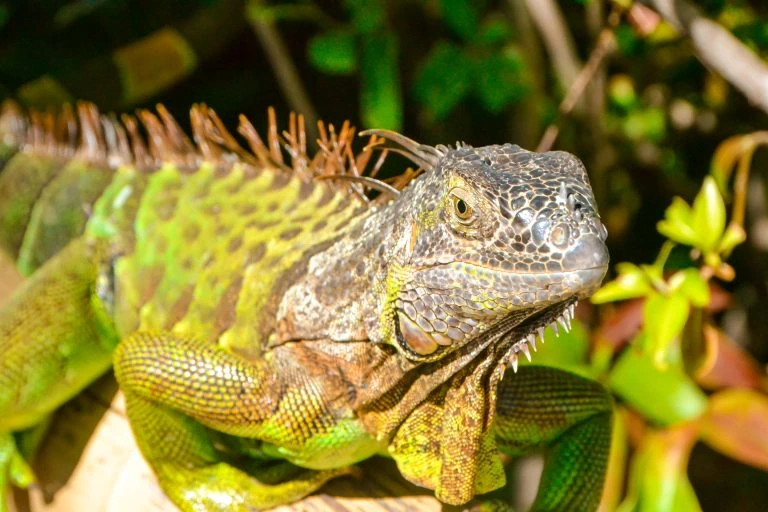
Iguanas are introduced, not native, to Florida. Pet-associated releases helped establish green iguanas, while present-day sightings and county maps should not be mistaken for statewide population counts.
Iguanas are not native to Florida. The green iguanas commonly seen on South Florida seawalls belong to an introduced species, not to a reptile population that naturally occurred here before human introductions. Being familiar, breeding successfully, or appearing in a natural-looking setting does not change that history. Understanding the distinction helps explain both their presence and Florida’s management approach.
The story is more specific than “tropical lizards moved north.” Green iguanas came through human activity, established breeding populations, and now use both developed and natural habitats. Other introduced iguana species have different origins and distributions. Our complete guide to iguanas in Florida gives a broader overview; this article focuses on native range, introduction history, and what those terms mean for a Florida sighting.
What “Native” Means—and What It Does Not
A native species occurs within its natural geographic range without an introduction by people. A nonnative species occurs outside that range following human-assisted movement. An established nonnative species has a self-sustaining population: its presence no longer depends on new animals arriving from captivity. Invasive adds another important element—harm, or the potential for harm, to the environment, economy, or human quality of life.
These labels answer different questions. “Native” concerns origin; “established” concerns reproduction; “invasive” concerns effects. An iguana born in a Florida nest is locally born but still belongs to a nonnative species. Decades of successful reproduction do not make the species native. Likewise, an escaped captive lizard seen once is not automatically proof of an established breeding population in that neighborhood.
Florida does have native lizards. The presence of those reptiles is not evidence that the large introduced iguanas are native. Common names and older, broader uses of “iguana family” can blur taxonomic distinctions, so species identification is more useful than treating every lizard as an iguana. A small native lizard in a garden and a large green iguana on a dock need not have the same origin or management status.
Where Green Iguanas Come From
FWC describes the green iguana’s native range as extending from Central America through tropical parts of South America and some eastern Caribbean islands. That is a geographic description, not a claim that every Caribbean island naturally has the species. Introductions also occur outside Florida, and an animal being present on an island does not by itself establish whether it is native there.
In their native range, green iguanas use a variety of habitats rather than just deep rainforest. UF/IFAS describes their close association with permanent water and their strong swimming ability. They spend time in trees and shrubs and also on the ground. Access to vegetation, suitable temperatures, basking sites, and shelter helps explain why a landscaped waterfront neighborhood can support them even though it looks different from a tropical forest.
Green iguanas are primarily plant eaters. FWC lists leaves, shoots, blossoms, and fruit, including plants also used in Florida gardens. This overlap matters: an introduced animal does not need a perfectly preserved version of its original habitat if a new environment supplies the resources it uses. A canal edge with trees, sunny surfaces, and ornamental growth can provide several resources in a relatively small area.
Other Introduced Iguanas Have Their Own Histories
Green iguanas are not interchangeable with spiny-tailed iguanas. UF/IFAS identifies green, black spiny-tailed, and Mexican spiny-tailed iguanas in its discussion of South Florida landscape problems. The spiny-tailed species belong to Ctenosaura rather than Iguana, and their natural ranges are in Mexico and Central America. Their behavior, foods, and local occurrence should be discussed separately.
An animal’s color is not enough to establish that distinction. Adult green iguanas may be brown, gray, or orange rather than bright green; juvenile and adult appearances can differ. A dark animal is therefore not automatically a black spiny-tailed iguana or a Cuban rock iguana. Species-specific head, body, and tail features provide better evidence than a single color seen from across a canal.
This also means a green-iguana rule should not be extended casually to every large lizard. The introduction history of one species does not prove the legal status or distribution of another. Before making a management decision, obtain reliable identification, particularly when a reptile looks unlike the animals usually seen in the area.
How Green Iguanas Reached Florida
The exotic pet trade is central to the documented introduction history. UF/IFAS reports that green iguanas were documented in the Miami area in the early 1960s and describes a deliberate release by a pet dealer in 1964. FWC identifies early reports in Hialeah, Coral Gables, and Key Biscayne. These records anchor the history without requiring an invented year-by-year population timeline.
Additional intentional and accidental releases of captive animals likely contributed to the spread. A small juvenile sold as a pet becomes a much larger adult with more demanding care needs, which helps explain why abandonment is a concern. However, an explanation of that pathway is not proof that a particular canal population came from one named owner, shipment, hurricane, or pet shop.
Florida’s ports and international commerce are relevant to the state’s broader nonnative-reptile problem. They should not be used to assert that green iguanas at a specific location arrived in fruit crates or lumber without a supporting record. The documented pet-associated releases are enough to explain why human introduction—not natural migration into Florida—is the central issue here.
From Introduced Animals to Breeding Populations
An introduction succeeds only if enough animals survive and reproduce. South Florida offers warm periods, vegetation, shelter, and many modified habitats. UF/IFAS notes that green iguanas thrive in human-modified landscapes and also occur in natural habitats such as mangroves and pinelands. Establishment is therefore not confined to a pet’s immediate escape location.
Canals matter because they connect usable habitat. FWC describes the extensive man-made canal system as an ideal dispersal corridor. An iguana can use the water and adjacent banks while moving among basking locations, cover, and feeding opportunities. A property boundary is not necessarily a biological boundary, which helps explain repeated sightings in adjoining waterfront yards.
Reproduction can contribute to local persistence, but egg production should not be confused with a statewide population estimate. Eggs do not all become surviving adults, and survival varies. Predators, vehicles, habitat conditions, and cold weather can affect different life stages. Claims that Florida has no iguana predators or that every nest creates dozens of future breeding adults overstate what the evidence supports.
Where Established Green Iguanas Occur
FWC describes populations along the Atlantic coast in Broward, Martin, Miami-Dade, Monroe, and Palm Beach counties, and along the Gulf coast in Collier and Lee counties. This gives a useful regional picture without claiming that every neighborhood in those counties has equal activity. Waterfront habitat, development, food, and local introduction history all influence where animals are observed.
Reports farther north require careful interpretation. FWC notes that some northern reports likely represent escaped or released captive animals and that green iguanas are not cold hardy. A dot on a sighting map is evidence of a report, not necessarily proof that the animal bred there or that a permanent colony exists. Our guide to where iguanas live across Florida by region can help orient a regional question, but it should not be read as a census.
At a property scale, direct observation is more informative than county-wide labels. An iguana repeatedly feeding in the same planting bed, basking on a seawall, or entering a canal provides evidence of local use. Unexplained leaf damage or a hole in the bank has other possible causes. Record what you actually see rather than attributing every problem to the species because it is known from the county.
Why a Statewide Iguana Total Is Hard to Defend
The authoritative sources used here do not provide a comprehensive current count of Florida’s green iguanas. Without a statewide survey and a clear method, a claim of hundreds of thousands or millions gives an impression of certainty it has not earned. Counts from one canal, park, or removal program cannot simply be multiplied across the state.
Visible activity also changes with weather, time of day, habitat, and observation effort. Seeing fewer iguanas on a cool morning does not prove a population decline; seeing several on a sunny bank does not show how many are concealed elsewhere. Useful management decisions can still be made from documented recurring activity and damage without pretending to know the exact statewide total.
Native Range, Invasive Effects, and Responsible Response
Being nonnative does not by itself explain every environmental effect. FWC documents landscape feeding, burrowing that can damage infrastructure, and specific ecological concerns. For example, green iguanas consuming nickerbean can affect a host plant used by the endangered Miami blue butterfly. Our discussion of iguanas’ invasive status and impact in Florida looks more closely at those impacts.
Florida’s current green-iguana policy should be checked with FWC. Its species page describes green iguanas as prohibited and explains applicable management conditions, while animal-cruelty protections still apply. This is not a blanket permission covering every iguana species or every location, and this article is not an instruction for trapping, transporting, or killing wildlife.
If activity is recurring, document it from a safe distance and ask about assessment of the species, entry routes, and property concerns. Keep children and pets away from wild reptiles and avoid feeding them. CDC notes that reptiles can carry Salmonella even when they appear healthy; wash hands after relevant contact and keep animal contamination away from food areas. The useful takeaway is not an alarming population number: these are introduced animals whose identity, local activity, and documented effects should guide the response.
Frequently Asked Questions
-
Are there iguanas in Florida that are actually native species?
No iguana species discussed here is native to Florida. Green iguanas and the established spiny-tailed iguanas are introduced. Florida has native lizards, but locally born offspring of introduced iguanas do not make those species native.
-
How many iguanas are in Florida right now?
The authoritative sources reviewed here do not provide a comprehensive current statewide count. Numbers from one canal, park, or removal program cannot establish a Florida total. A statewide estimate requires a survey method and defined date, not extrapolation from conspicuous local sightings.
-
Where are iguanas in Florida most commonly found?
FWC describes established green iguanas in several South Florida Atlantic and Gulf coast counties, including Miami-Dade, Broward, Palm Beach, Monroe, Martin, Collier, and Lee. Local presence varies; canal banks, vegetation, basking sites, and shelter can be useful habitat. This is not a county density ranking.
-
Could iguanas eventually spread across all of Florida?
Cold limits their distribution, and FWC notes that some northern reports likely represent escaped or released captive animals. A sighting is not proof of a breeding population. The reviewed evidence does not establish a future statewide range or support a specific climate forecast.
-
When did iguanas first become a problem in Florida?
FWC records green iguanas in the Miami area during the 1960s, and UF/IFAS describes pet-associated introductions. Establishment and subsequent effects developed over time; the evidence does not provide one universal year when every Florida community began experiencing problems.
-
Are wild iguanas in Florida dangerous to people?
Wild iguanas can injure people if approached, cornered, or handled. CDC also notes that reptiles can carry Salmonella even when healthy. Keep distance, avoid feeding or handling them, and seek an assessment if recurring activity creates a property concern.

Vincent founded On Demand Pest Control in 2017 and is a Florida Certified Operator in all four state categories. He treats pest control as a systematic problem to solve, not a symptom to spray. Read Vincent’s full bio →
Get help with your pest concern.
Tell us what you are seeing. Our team can discuss the concern and the next step.
- Share your concern and contact details.
- Our team contacts you to discuss available service.
- Ask for a written scope and quote before work.
Where can we reach you?
Our team will call to confirm the next step.
By submitting, you’re asking On Demand Pest Control to contact you about this request.
↗ Prefer to call? (954) 947-0805