
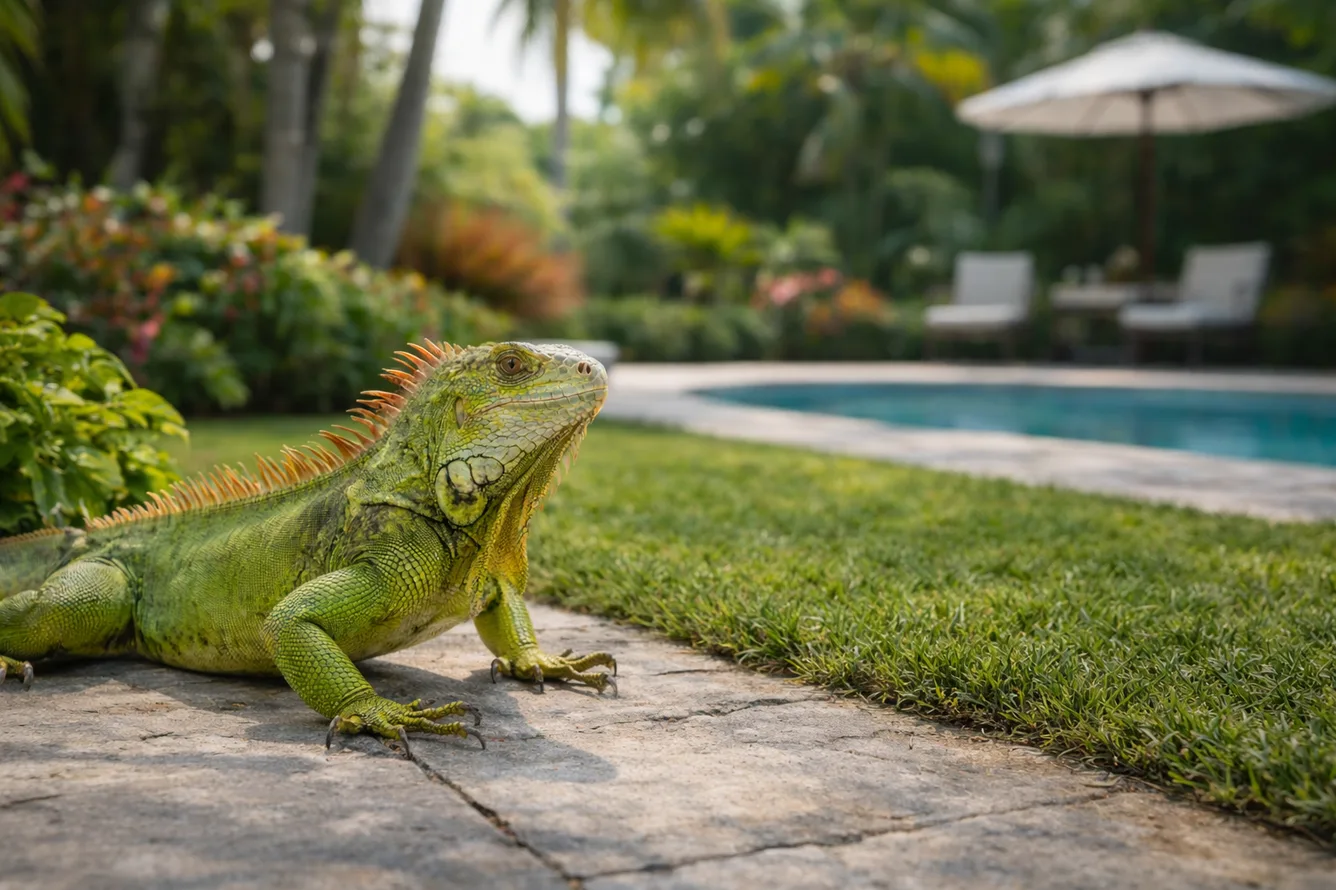
Published green-iguana lifespan figures are reference estimates, not a measured Florida neighborhood average or a way to age a visitor.
The short answer, with the right limits
Green iguanas can live for years, but an exact typical lifespan for wild Florida animals is not established by the references reviewed here. FWC’s green-iguana profile gives up to 10 years in the wild and 19 years in captivity. The University of Michigan’s Animal Diversity Web account describes wild animals as thought to live about eight years and notes captive survival beyond 20 years.
These are species reference figures, not a Florida-wide cohort study. They should not be combined into a precise “8–15 years in Florida” claim. Our general iguana lifespan guide provides companion context across settings.
Average age, maximum lifespan and a sighting are different
An average describes a defined group and depends on which animals were counted. A maximum describes an unusually long-lived individual. A report about adults that have already survived their vulnerable early life is different from a life expectancy measured from hatching. Those measures are not interchangeable.
Nor can a homeowner reliably age a wild iguana from a single photograph. Body size, tail condition and color do not form a validated age chart. Seeing a large animal for several seasons shows repeated presence, not its birth date or even that every sighting is the same animal.
Why captivity is not a Florida field estimate
Captive animals may receive controlled housing and veterinary care, while free-ranging animals face variable weather, injury and other hazards. But captivity does not automatically confer a long life: inappropriate husbandry can also shorten it. Species accounts that report long captive survival are not proof that a Florida canal-side animal will live that long.
A comparison should therefore identify its setting and source, rather than claim a guaranteed five- or ten-year advantage. The key facts about green iguanas describe the species without turning captive longevity into a local survival promise.
What can interrupt a wild green iguana’s life
UF/IFAS discusses predators, vehicle collisions and cold-related risks in Florida. These are meaningful hazards, but the reference does not supply a homeowner-ready ranking of causes of death or a county-specific survival rate. Cold temperatures also limit distribution; that does not make every winter fatal.
Injury, illness and access to suitable habitat can affect an individual. Avoid converting these general influences into an exact lifespan based on landscaping, canal proximity or county. A protected-looking location is not a guarantee of longevity.
Reproduction does not require a lifespan calculation
FWC reports that females typically reach reproductive maturity at two to four years. UF/IFAS also describes a southern Florida study in which females could mature as early as 24 months. These statements describe different kinds of evidence and are not a promise that every female breeds at a fixed age.
Our guide to iguana breeding season in Florida explains the separate breeding topic. Multiplying a assumed number of eggs by an assumed number of adult years does not produce a measured lifetime reproductive output or a property’s future population.
What longevity means for a homeowner
Repeated iguana activity warrants attention because animals can remain present over time and nearby habitat may support new visitors. You do not need to know an animal’s exact age before documenting plant damage, recurring droppings or burrows. Record dates and locations rather than claiming the same animal has lived on the property for a decade.
Keep the species distinction clear. Green-iguana figures should not be assigned to black or Mexican spiny-tailed iguanas without their own evidence. A confident identification is more useful for discussing a property issue than an invented age.
Green iguanas are a Florida Prohibited species. FWC’s current rules restrict possession and acquisition as pets; limited permitted exceptions are not general permission to collect wild animals. Do not capture, transport or release an iguana elsewhere yourself. Contact FWC about applicable requirements and a qualified professional about a property-specific concern.
CDC reptile hygiene guidance explains that reptiles can carry Salmonella even when they look healthy. Keep children and pets away from the animal and contaminated areas. If accidental contact occurs, wash hands thoroughly with soap and running water. Do not bring a wild iguana into the home.
Contact On Demand Pest Control to discuss recurring activity and property-specific options. This guide does not promise a fixed treatment timeline or permanent elimination.
Sources and Further Reading
FWC green-iguana profile; UF/IFAS green-iguana reference; Animal Diversity Web green-iguana account; FWC prohibited-species rules; CDC reptile and amphibian guidance. Sources checked October 3, 2026.
Frequently Asked Questions
-
How long do green iguanas live in the wild in Florida?
The reviewed references do not establish an exact Florida-wide typical lifespan. FWC gives up to 10 years in the wild, while Animal Diversity Web describes wild green iguanas as thought to live about eight years. These reference estimates are not a measured neighborhood average.
-
How long can an iguana live without food or water?
There is no responsible universal survival countdown. Condition, temperature and other circumstances matter, and this article does not recommend testing deprivation or using it as a control method. A captive animal’s health concern belongs with a reptile veterinarian.
-
Do cold snaps in Florida significantly reduce iguana lifespans?
Severe cold can immobilize or kill green iguanas, but the reviewed sources do not quantify how much a typical Florida individual’s lifespan is reduced. A still animal is not proof of death; do not handle or warm it.
-
What is the lifespan of iguana species other than the green iguana in Florida?
Green-iguana figures cannot be assigned to black or Mexican spiny-tailed iguanas. The reviewed evidence does not establish a reliable Florida wild-lifespan range for those species, so no matching range is claimed here.
-
Why do captive iguanas live longer than wild iguanas?
Appropriate housing and veterinary care can reduce some hazards, but improper captive care can also shorten life. Captive longevity records do not establish a fixed lifespan advantage over Florida wild animals.
-
At what age do green iguanas start reproducing in Florida?
FWC reports females typically reach reproductive maturity at two to four years. UF/IFAS cites southern Florida research reporting female maturity as early as 24 months. Individual timing varies; maturity does not by itself establish lifetime egg production.
Get help with an iguana concern.
Tell us what you are seeing. Our team can discuss the concern and the next step.
- Share your concern and contact details.
- Our team contacts you to discuss available service.
- Ask for a written scope and quote before work.
Where can we reach you?
Our team will call to confirm the next step.
By submitting, you’re asking On Demand Pest Control to contact you about this request.
↗ Prefer to call? (954) 947-0805