
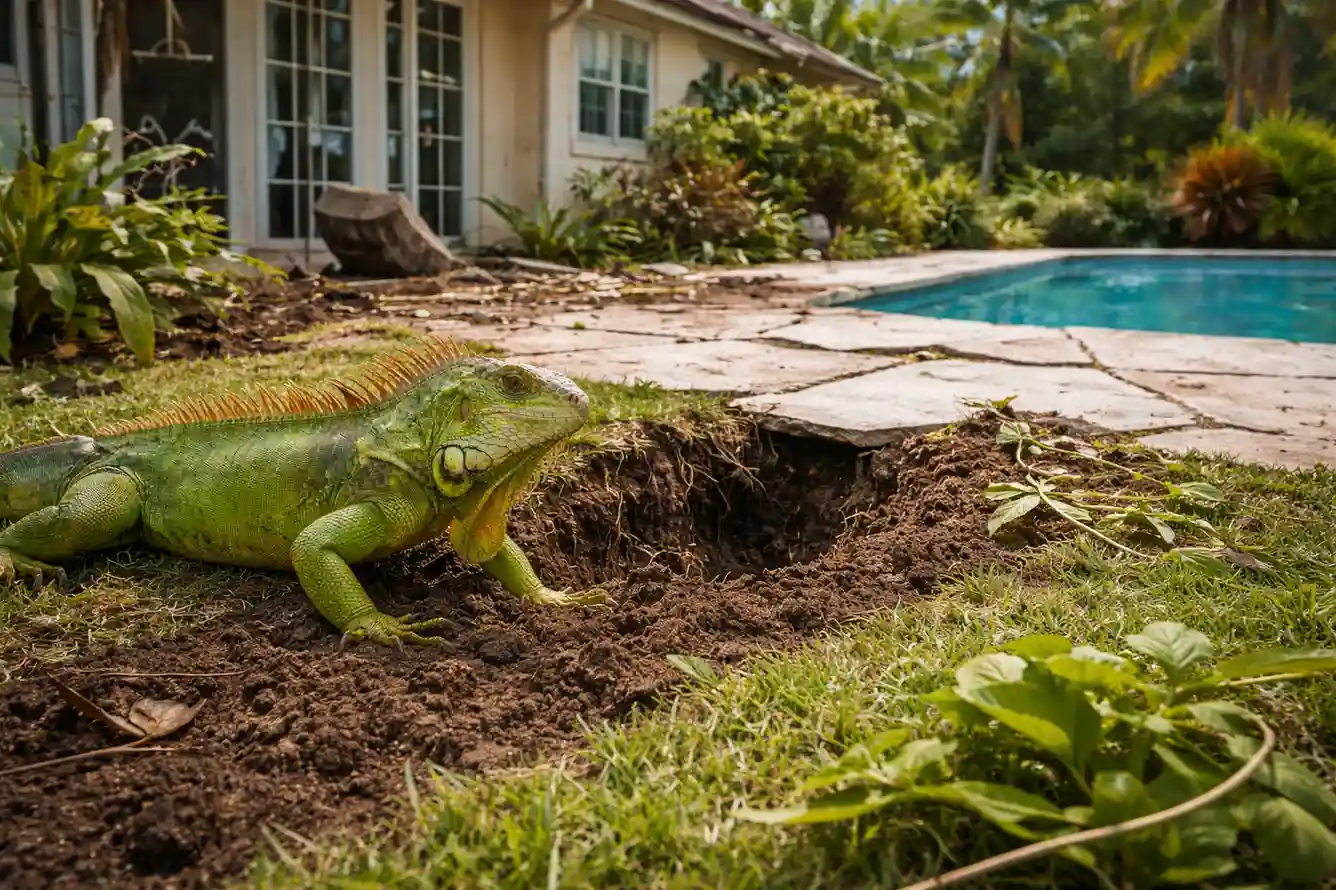
Understand green iguana weight references, species differences and why length alone cannot predict pounds.
An iguana’s weight depends on its species, sex, age and condition—not just its length. For green iguanas, Florida’s wildlife agency describes males weighing up to 17 pounds and females usually not exceeding seven pounds. Those are reference limits, not an average for every animal in a Florida yard.
Green iguana weight: read the numbers correctly
The Florida Fish and Wildlife Conservation Commission’s green iguana profile distinguishes male and female size. A mature male can be substantially heavier than a female, even when both look long. The tail contributes considerably to total length, so a five-foot animal is not necessarily a heavy-bodied male.
Published descriptions also use different populations and measurements. A species reference may report a broad adult mass range without separating sexes; a Florida profile may emphasize the upper size of males and females. Combining these into a single “typical” yard-iguana weight would hide important differences. Use species-specific reference figures as context, not as a remote weighing method.
- Adult male green iguana: FWC reports weight up to 17 pounds.
- Adult female green iguana: FWC says females usually do not exceed seven pounds.
- Young green iguana: much smaller than a mature adult; no reliable yard-specific growth timetable can be inferred from appearance.
- Other iguana species: green-iguana figures cannot be transferred to spiny-tailed iguanas.
Species matters before size comparisons
UF/IFAS identifies green iguanas, black spiny-tailed iguanas and Mexican spiny-tailed iguanas among the established iguanas of South Florida. These are different species, not simply small and large versions of the same lizard. It also notes that basilisks and large anoles can be mistaken for iguanas.
Do not assign a species from estimated weight alone. Body features and a clear photograph taken from a safe distance are more useful than guessing pounds. Our iguana identification guide explains the visible features; the full size and weight breakdown by species provides broader size context.
Hatchlings and growth are not a fixed calendar
Iguanas hatch from eggs; they are not born as miniature adults with a universal starting weight. University of Michigan’s Animal Diversity Web describes a 12-gram green-iguana hatchling in its species account. That is a species-reference example, not a promise that every hatchling weighs exactly 12 grams, and it does not establish a weight for black spiny-tailed hatchlings.
Age, nutrition and conditions affect development. Sex differences become more useful as animals mature, but an observer cannot work backward from a large body to an exact birthday. A “pounds per year” growth rule for Florida’s wild iguanas would require evidence beyond these profiles. For a related discussion, see our green iguana growth chart and size facts.
Why length cannot reliably predict pounds
A long intact tail and a shortened or regrown tail create different total lengths without necessarily reflecting comparable body mass. A photograph also changes apparent scale: perspective, distance and the absence of a dependable reference object can make an animal look far bigger than it is.
A thin and a robust individual can have similar lengths. Sex, body condition and reproductive state add further uncertainty. Avoid rules such as “three feet equals eight pounds.” Do not approach or catch a wild iguana to obtain measurements. For pet-health concerns, an experienced reptile veterinarian can evaluate actual weight and condition. Reports about the biggest iguana on record and how large they grow should not be treated as the expected size of a local sighting.
Property damage is not a weight test
FWC and UF/IFAS document landscaping damage and burrows that can contribute to erosion or undermine infrastructure. Neither provides a weight threshold at which one animal will collapse a seawall. The location of a burrow, soil condition and existing structural problems matter more to a property decision than a guessed animal weight.
Record where activity is occurring, whether plant damage is recurring and whether holes are near a foundation, sidewalk or seawall. Keep people and pets away from suspect structural areas and seek an appropriate inspection. Ask On Demand Pest Control about property-specific iguana concerns rather than waiting until an animal reaches an assumed problem size.
Frequently Asked Questions
-
How much does a full-grown green iguana weigh?
FWC describes adult male green iguanas weighing up to 17 pounds and females usually not exceeding seven pounds. These are reference size limits, not a universal average or a guarantee for a particular animal.
-
How much does a baby iguana weigh at birth?
Iguanas hatch from eggs. The University of Michigan Animal Diversity Web green-iguana account describes a 12-gram hatchling, but that reference example is not a universal hatchling weight and should not be applied to other iguana species.
-
Do male iguanas weigh more than females?
Adult male green iguanas are generally larger than females; FWC gives different male and female weight descriptions. Individual size and condition vary, so sex cannot be confirmed by a weight guess alone.
-
How fast do iguanas gain weight in Florida?
There is no reliable pounds-per-year rule for wild Florida iguanas established by the sources reviewed here. Species, age, nutrition and conditions affect growth, and appearance cannot establish an exact growth rate.
-
Does iguana weight affect the damage they cause to property?
Burrowing and feeding can damage property, but guessed weight does not measure structural risk. FWC documents burrow-related erosion and undermining; burrow location and the condition of the structure matter more than an assumed weight threshold.
-
How can I estimate the weight of an iguana in my yard?
A safe-distance photograph can help with identification but cannot reliably establish weight. Total length includes the tail, and body condition, sex and perspective affect estimates. Do not approach or capture a wild animal to measure it.
Get help with an iguana concern.
Tell us what you are seeing. Our team can discuss the concern and the next step.
- Share your concern and contact details.
- Our team contacts you to discuss available service.
- Ask for a written scope and quote before work.
Where can we reach you?
Our team will call to confirm the next step.
By submitting, you’re asking On Demand Pest Control to contact you about this request.
↗ Prefer to call? (954) 947-0805