
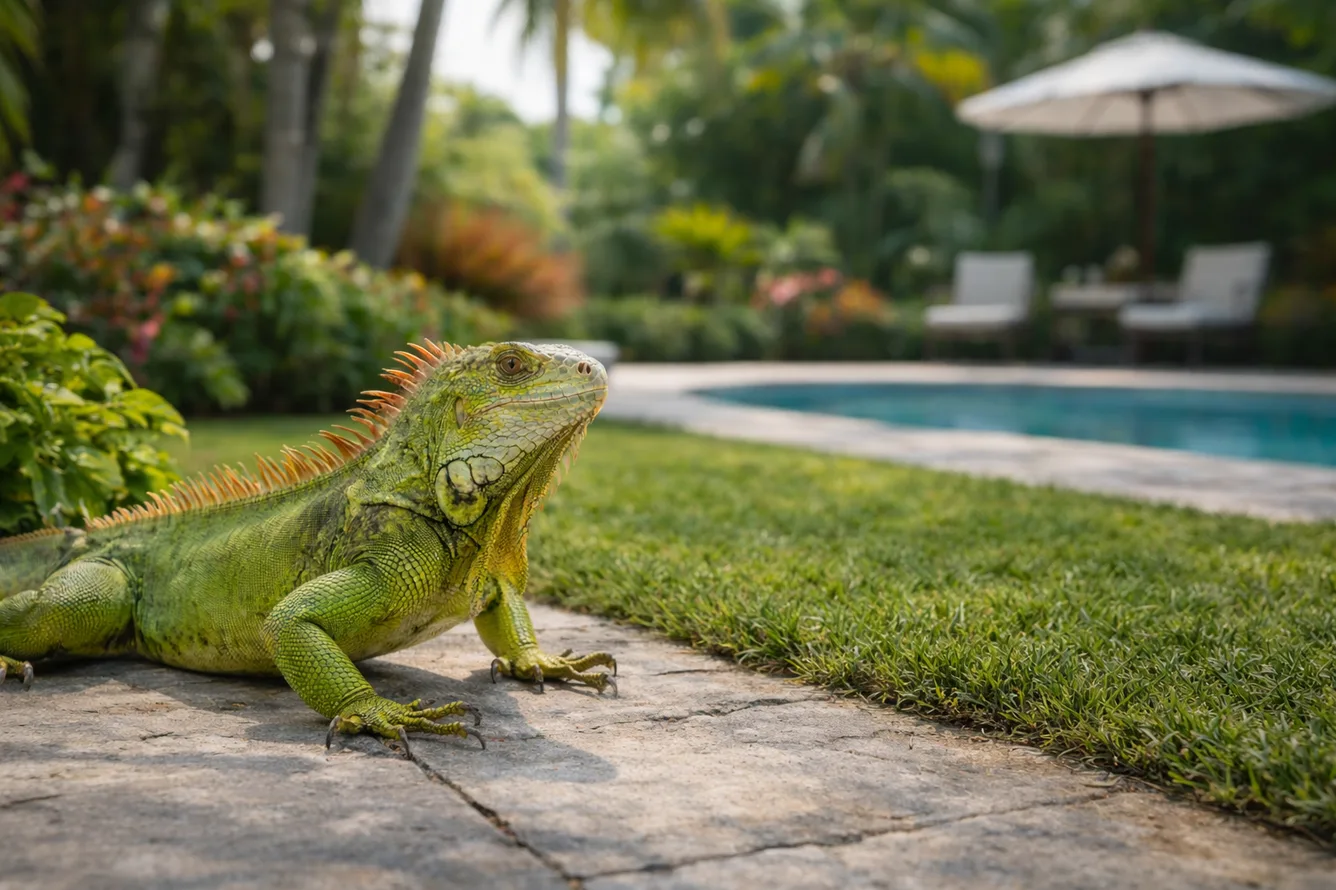
Key Takeaways
- The iguana third eye, called the parietal eye, is a real photosensory organ located on top of the head between the two main eyes.
- This organ detects changes in light and shadow, helping iguanas sense aerial predators like hawks and eagles before they strike.
- The parietal eye plays a critical role in regulating circadian rhythms, hormone production, and thermoregulation in iguanas.
- You cannot see the iguana's third eye easily — it appears as a small, pale, scale-like spot on the crown of the skull.
- Understanding how the third eye works explains why iguanas are so difficult to approach from above, which matters for removal and trapping strategies.
- The third eye does not form images like a normal eye — it only senses light intensity and movement overhead.
The iguana third eye is one of the most fascinating and misunderstood features of these large invasive lizards. If you've ever tried to sneak up on an iguana sunning itself on a seawall or fence, you may have noticed it bolts before you even get close — even when you approach from directly above. That seemingly supernatural awareness comes from a specialized sensory organ sitting right on top of its skull. This article breaks down exactly what the parietal eye is, how it functions, why it evolved, and what it means for homeowners dealing with iguanas on their property. You'll also learn how this third eye connects to iguana behavior patterns you see every day in South Florida yards.
What Is the Iguana Third Eye?
The iguana third eye is formally known as the parietal eye (sometimes called the pineal eye). It sits on the midline of the skull, roughly between and slightly behind the two primary eyes. Unlike the main eyes, the parietal eye doesn't look like an eye at all from the outside. It appears as a small, translucent or pale-colored scale — almost like a tiny, slightly raised dot on the top of the iguana's head.
Despite its humble appearance, the parietal eye is a genuine photosensory organ. It has a rudimentary lens, a cornea-like covering, and a retina connected to the pineal gland in the brain. However, it cannot form detailed images. Think of it less as a camera and more as a sophisticated light meter.
How the Parietal Eye Differs From Normal Eyes
The iguana's two main eyes work the way you'd expect. They process color, detect motion, judge distance, and create detailed visual images of the environment. The third eye iguana enthusiasts often marvel at does none of those things. To fully appreciate the parietal eye's role, it helps to understand the overall size and anatomy of iguanas, since the organ's position and visibility vary considerably across different life stages and body sizes.
Here's how the two systems compare:
- Main eyes: Full-color vision, image formation, depth perception, wide field of view
- Parietal eye: Light/dark detection only, shadow sensing, no image formation, upward-facing only
The parietal eye is wired differently in the brain, too. Rather than connecting to the visual cortex, it feeds information to the pineal gland and hypothalamus — brain structures responsible for hormones, body clocks, and physiological regulation.
How Does the Iguana 3rd Eye Work?
The iguana 3rd eye functions primarily as a light-sensing and shadow-detecting organ. It sits beneath a thin, semi-transparent scale that allows photons to reach the photoreceptive cells underneath. These cells respond to changes in light intensity — particularly sudden drops in brightness, like the shadow cast by a bird of prey swooping overhead.
Light Detection and Shadow Sensing
When a shadow passes over the iguana's head, the parietal eye registers the change almost instantaneously. This triggers a rapid flight response. The iguana doesn't need to see what's causing the shadow. The mere detection of a sudden light change from above activates survival instincts.
This is why iguanas are notoriously hard to catch from above. Even when an iguana appears completely still and unaware, its third eye is actively monitoring overhead light conditions. A hand reaching down, a net swooping in, or a bird diving from altitude all produce the same trigger — a shadow crossing the parietal eye.
Connection to the Pineal Gland
The parietal eye's neural connection to the pineal gland is perhaps its most important function. The pineal gland produces melatonin, the hormone that regulates sleep-wake cycles. Through the third eye, the iguana's brain receives constant data about:
- Day length (photoperiod)
- Time of day based on light angle and intensity
- Seasonal shifts in sunlight duration
This information drives some of the iguana's most important biological processes, including breeding cycles, metabolic rate, and daily activity patterns.
Why Do Iguanas Have a Third Eye?
The parietal eye isn't unique to iguanas. Many reptile species have one, along with some amphibians and even a few fish. However, iguanas have one of the most well-developed parietal eyes in the reptile world, and there are strong evolutionary reasons for this.
Predator Detection From Above
Iguanas evolved in environments where aerial predation was a constant threat. Hawks, eagles, and large predatory birds posed — and still pose — the greatest danger to iguanas, especially juveniles basking in exposed locations. The third eye iguana anatomy reflects millions of years of evolutionary pressure from above.
An iguana basking on a tree branch has limited ability to scan the sky with its main eyes without constantly moving its head. The parietal eye solves this problem. It provides continuous overhead monitoring without requiring any head movement or visual attention. This passive surveillance system gives iguanas a critical survival edge.
Thermoregulation Benefits
As cold-blooded animals, iguanas depend on external heat sources to regulate their body temperature. They spend significant portions of their day basking in direct sunlight. The parietal eye helps them gauge light intensity and solar position, which directly influences basking behavior.
Research suggests the parietal eye helps iguanas determine:
- When to move into sunlight
- When body temperature is approaching dangerous levels
- How much UV exposure they've received
- When to seek shade
This thermoregulatory function is especially important in South Florida, where intense tropical sun can cause overheating. Iguanas need to balance warming up with avoiding heat stress, and the parietal eye acts as an internal solar gauge.
Circadian Rhythm Regulation
The iguanas third eye plays a central role in maintaining healthy circadian rhythms. By constantly measuring ambient light levels throughout the day, the parietal eye feeds the pineal gland the data it needs to keep the iguana's internal clock synchronized with the 24-hour light-dark cycle.
This affects:
- Sleep timing: Iguanas are diurnal, and the parietal eye helps signal when to become active and when to roost
- Feeding patterns: Appetite and digestive activity follow circadian cues
- Hormone cycling: Reproductive hormones fluctuate based on photoperiod data processed through the parietal eye
Where Exactly Is the Third Eye Located?
Finding the parietal eye on an iguana requires knowing exactly where to look. It sits on the dorsal (top) surface of the head, along the midline of the skull, positioned between and slightly posterior to the two main eyes.
How to Spot It
If you're observing an iguana from above — say, one basking on your pool deck or fence — you may be able to identify the parietal eye as:
- A small, slightly lighter-colored scale compared to surrounding scales
- A circular or oval marking roughly 2-4 millimeters in diameter on adult iguanas
- A slightly translucent spot that may appear almost iridescent in direct light
On green iguanas, the most common species in Florida, the parietal eye is often easiest to see on juveniles because their head scales are smaller and the translucent patch stands out more clearly against the bright green skin. The surrounding iguana skin texture and shedding patterns can also influence how visible the parietal scale appears at different times of year.
Skull Anatomy Supporting the Third Eye
Beneath the surface scale, the iguana's skull has a small opening called the parietal foramen. This hole in the bone allows the photoreceptive tissue to sit close to the skin surface while remaining connected to the brain via nerve fibers. The opening is a distinctive feature of iguana skull anatomy and can even be identified on skeletal specimens.
How the Iguana Third Eye Affects Behavior
Understanding the parietal eye helps explain several iguana behaviors that Florida homeowners encounter regularly. These aren't random quirks — they're direct responses driven by the third eye's sensory input.
Why Iguanas Are Hard to Approach From Above
If you've ever tried to reach down toward a basking iguana, you've experienced the parietal eye in action. Even iguanas that seem completely relaxed will flee the moment a shadow crosses their head. This is why overhead netting or top-down grabbing techniques are often ineffective for iguana capture.
Professional iguana trappers account for this by approaching from the side or below when possible. The main eyes can be distracted or obscured, but the parietal eye is much harder to fool because it responds to any light change from above.
Basking Orientation Patterns
Iguanas don't bask randomly. They position themselves to maximize sun exposure while keeping their parietal eye oriented skyward. You'll often notice iguanas lying flat with their heads level — this position optimizes both heat absorption and overhead threat detection simultaneously.
In areas with frequent overhead cover, like under tree canopies with shifting leaf shadows, iguanas may appear more restless. The constant shadow play triggers micro-alerts from the parietal eye, keeping the animal in a heightened state of awareness.
Seasonal Behavior Changes
The parietal eye's role in photoperiod detection drives significant seasonal behavioral shifts. In South Florida, where day length varies less dramatically than in northern climates, these changes are subtle but real:
- Breeding season timing: Iguanas begin mating behaviors in response to increasing day length detected by the parietal eye
- Feeding intensity: Appetite increases during longer days as the iguana's metabolism ramps up
- Territorial aggression: Males become more aggressive during peak breeding season, a cycle initiated partly by photoperiod signals
Do All Iguanas Have a Third Eye?
Yes. Every species within the family Iguanidae possesses a parietal eye. This includes all the iguana species commonly found in Florida:
- Green iguanas (Iguana iguana) — the most widespread invasive species in South Florida
- Black spiny-tailed iguanas (Ctenosaura similis) — fast, aggressive, and increasingly common
- Mexican spiny-tailed iguanas (Ctenosaura pectinata) — found in localized populations
The size and visibility of the parietal eye can vary slightly between species, but the organ's function remains consistent across all iguana types. Juvenile iguanas have fully functional parietal eyes from hatching, which is critical because young iguanas face even greater predation risk than adults.
Other Reptiles With Parietal Eyes
Iguanas aren't alone in possessing this organ. Other reptiles with parietal eyes include:
- Bearded dragons
- Monitor lizards
- Tuataras (which have the most developed parietal eye of any living reptile)
- Many species of skinks and chameleons
However, the iguana's parietal eye is among the most well-studied due to the animal's size, accessibility, and abundance in research settings.
What the Iguana Third Eye Means for Homeowners
If you're dealing with iguanas on your South Florida property, the parietal eye has practical implications you should understand.
Trapping and Removal Challenges
The third eye makes iguanas exceptionally alert to overhead threats. This means:
- Overhead traps are less effective than ground-level or side-approach traps
- Hand-capture attempts from above trigger instant flight responses
- Drones or other overhead deterrents may startle iguanas temporarily but don't provide lasting control
Professional iguana removal specialists understand parietal eye function and design their approach strategies around it. They use techniques that minimize overhead shadow casting and exploit the limitations of the iguana's main eyes instead.
Deterrent Implications
Some homeowners attempt to use visual deterrents like fake predator birds mounted on poles. While these may provide short-term results, iguanas quickly learn that a stationary object doesn't produce the dynamic shadow changes that trigger the parietal eye's alarm response. Moving deterrents — like reflective tape or spinning devices — may be marginally more effective because they create flickering light patterns.
However, no visual deterrent alone provides reliable long-term iguana control. The parietal eye is a survival tool honed over millions of years, and iguanas adapt quickly to artificial stimuli that don't pose real danger.
Why Professional Removal Works Better
Understanding iguana sensory biology — including the third eye — is one reason professional trappers succeed where DIY methods often fail. The remarkable adaptations iguanas have developed over millions of years, including the parietal eye, mean that professionals must combine knowledge of iguana anatomy, behavior, and sensory capabilities to develop effective capture strategies. They know that approaching an iguana isn't just about being quiet. It's about managing light, shadow, angle of approach, and timing.
If iguanas are causing damage to your landscaping, seawalls, or structures, working with experienced removal professionals gives you the best chance of effective, humane population control on your property.
The Science Behind the Iguana Parietal Eye
For those interested in the deeper biology, the iguana parietal eye has been the subject of significant scientific research. Studies have revealed that the organ's photoreceptive cells are structurally similar to the rod cells found in the retinas of the main eyes, but they're adapted specifically for detecting light intensity rather than forming images.
Melatonin Production Pathway
The parietal eye feeds light data to the pineal gland through a dedicated neural pathway. When light levels drop (signaling nightfall), the pineal gland increases melatonin production. When light levels rise (signaling dawn), melatonin production decreases. This cycle governs the iguana's sleep-wake pattern with remarkable precision.
In iguanas exposed to artificial lighting conditions — such as those living near well-lit commercial properties or street lights — this cycle can become disrupted. Researchers have observed that iguanas in heavily urbanized areas sometimes show altered activity patterns, potentially linked to light pollution interfering with parietal eye signaling.
Evolutionary Age of the Parietal Eye
The parietal eye is an ancient adaptation. Fossil evidence suggests that parietal foramina — the skull openings associated with the third eye — have been present in reptilian lineages for over 200 million years. Some extinct species, including certain dinosaurs, likely had functional parietal eyes as well.
In modern iguanas, the third eye represents a living link to these ancient sensory systems. It's a reminder that the iguanas now thriving in Florida backyards carry biological equipment refined over hundreds of millions of years of evolution.
Frequently Asked Questions
-
Can you see the iguana third eye with the naked eye?
Yes, but it's subtle. The parietal eye appears as a small, pale, slightly translucent scale on top of the iguana's head between the two main eyes. On adult green iguanas, it's roughly 2-4 millimeters across. You'll need to look closely, and it's easiest to spot in bright, direct sunlight.
-
Does the iguana 3rd eye actually see images?
No. The parietal eye cannot form images or detect color the way the main eyes do. It functions strictly as a light and shadow sensor. It detects changes in overhead light intensity, which helps the iguana sense predators from above and regulate its internal biological clock.
-
Do baby iguanas have a functional third eye?
Yes. The parietal eye is fully functional from the moment an iguana hatches. This is crucial for survival because baby iguanas face intense predation pressure from birds, snakes, and other predators. The third eye gives hatchlings an immediate overhead warning system.
-
Why does my iguana run away when I reach over it?
Your shadow crossing the iguana's parietal eye triggers an automatic flight response. The third eye evolved specifically to detect sudden drops in overhead light — the same pattern created by a diving bird of prey. Even a tame iguana may flinch or flee when a shadow passes over its head from above.
-
Is the iguana third eye the same as the pineal gland?
Not exactly. The parietal eye and pineal gland are separate structures, but they're closely connected. The parietal eye is the external photoreceptor that sits beneath the skull's surface. The pineal gland is an internal brain structure that receives signals from the parietal eye and produces melatonin based on that light data.
-
Do all lizards have a third eye like iguanas?
Many lizard species have a parietal eye, but not all. It's most common and well-developed in iguanas, bearded dragons, and tuataras. Some lizard families have lost the structure over evolutionary time. Among Florida's invasive reptiles, iguanas have one of the most prominent and well-studied parietal eyes.