
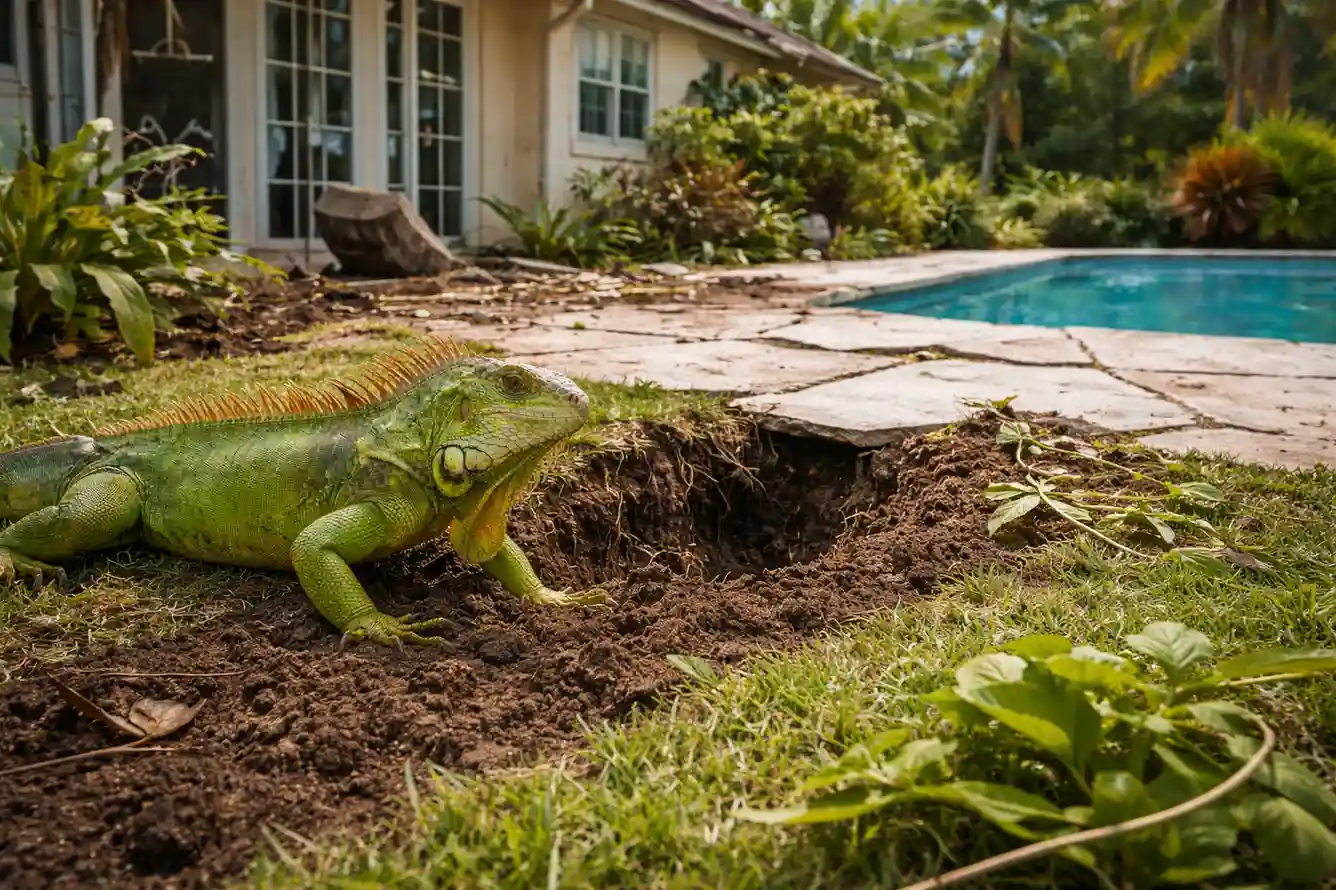
Keys iguanas: habitat, property damage and native wildlife. Identify the animal, document recurring activity and use qualified site-specific advice rather than unsupported precision.
What an Iguana Sighting in the Keys Tells You
Green iguanas are established in Monroe County, according to the Florida Fish and Wildlife Conservation Commission. Their presence in the Florida Keys is therefore not simply a rumor about an occasional escaped pet. But a sighting on your fence does not establish how many animals live on your island, whether numbers are increasing, or which species caused damage elsewhere on your property.
Begin with identification and the location of recurring activity. Our overview of the statewide iguana problem in Florida provides broader context. Keys residents also need to distinguish private-property concerns from wildlife management on parks, refuges and other protected land.
Identify the Species Before Interpreting the Problem
Green iguanas have a long tail, dorsal spines and a throat flap called a dewlap. Adults do not have to be bright green: FWC describes brown, nearly black and seasonally orange or pink individuals. UF/IFAS identifies green iguanas and two spiny-tailed species as established in South Florida. That regional list is not proof that every species occurs on every Keys island.
Compare the full animal rather than color alone. A distant dark lizard could require a closer photograph for identification, not a confident label. Use our guide to iguana species found in the Florida Keys and beyond alongside official references. Photograph from a safe distance; do not approach to inspect scales or pull an animal from shelter.
Why Island Habitat Matters
Green iguanas can live in trees, shrubs and disturbed ground. Sunlit seawalls and docks offer basking surfaces, while vegetation provides food and cover. FWC describes them as excellent swimmers that tolerate fresh and salt water. These traits help explain why water does not automatically isolate a property from iguana activity.
They do not prove the route by which an individual reached a particular island. Escaped or released pets contributed to Florida introductions; attributing a Keys colony to a specific swimming journey requires evidence. Likewise, warm conditions are not evidence of continuous breeding or immunity from cold weather. Avoid assigning a local population count or a forecast from casual observations. The regional map of iguana populations in Florida is background about distribution, not an island-by-island census.
A Documented Keys Conservation Concern
The ecological issue extends beyond eaten garden flowers. FWC reports that green iguanas at Bahia Honda State Park consumed nickerbean, a host plant of the endangered Miami blue butterfly. Damage to a host plant matters because the butterfly depends on that plant during its life cycle. This is a specific documented example, not evidence that every iguana directly preys on butterflies or that the same damage has been measured throughout the Keys.
FWC also discusses tree-snail remains found in green iguanas at Bill Baggs Cape Florida State Park. That observation is from outside the Keys and should not be relabeled as a Keys study. Keep the location attached to any conservation claim. If you observe feeding or suspected damage in a park or refuge, report the location to its managing staff rather than changing vegetation or attempting removal.
Separate Property Damage From Structural Diagnosis
Feeding can damage ornamental plants, fruit and vegetables. Burrowing can erode soil around seawalls, sidewalks and foundations; both FWC and UF/IFAS describe this risk. Droppings may also accumulate on docks, boats, pool platforms and decks. These are reasons to investigate recurring activity, not reasons to assume that every crack is caused by an iguana.
- Record the location and date of sightings and visible feeding damage.
- Note holes and displaced soil without reaching inside or filling an unidentified opening.
- Keep people away from unstable edges or visibly damaged structures.
- Have a qualified structural professional assess seawall movement or foundation concerns.
An animal assessment and a structural assessment answer different questions. Removing an iguana does not itself restore lost soil or certify a seawall as safe.
Health Precautions and Responsible Next Steps
Reptiles can carry Salmonella even when they look healthy. CDC explains that contact with contaminated environments can transmit germs without directly touching the animal. Keep children and pets away from droppings and wash hands with soap and running water after accidental contact with contaminated surfaces. A pool contamination concern should be referred to a qualified pool professional rather than treated with an improvised chemical dose.
Do not feed iguanas. Discuss plant protection and site-appropriate landscape changes with a qualified professional, especially where native plants or protected habitat are involved. For a Keys service inquiry, provide the exact island and property location and confirm coverage before assuming an appointment is available. On Demand Pest Control can discuss the concern and service availability; this article does not promise islandwide coverage, fixed pricing or permanent elimination.
Private Property Is Not Permission for Every Site
FWC classifies green iguanas as prohibited nonnative wildlife. Its current guidance allows humane killing on private property with landowner permission, subject to anti-cruelty law, and says a permit is required to possess live captured green iguanas for eradication and control. Captured animals cannot be relocated and released elsewhere in Florida. These rules are not instructions to handle an animal yourself.
The agency’s separate authorization for designated Commission-managed lands is not blanket permission for all Keys parks, beaches, refuges or neighboring lots. Confirm the land manager and applicable rules before arranging work. A qualified wildlife professional should assess species, lawful handling and the site’s access restrictions.
Frequently Asked Questions
-
How did iguanas first arrive in the Florida Keys?
Escaped or released pets contributed to Florida introductions. FWC documents established green iguanas in Monroe County, but its profile does not identify a single arrival route for every Keys colony. Claims about specific swimming or rafting journeys need separate evidence.
-
Are iguanas in the Keys dangerous to people or pets?
Iguanas generally avoid people, but UF/IFAS describes bites, scratches and tail strikes when they are caught or cornered. Keep pets from chasing them. Reptiles and contaminated environments can also carry Salmonella; avoid contact and wash hands after accidental exposure.
-
Can the iguana population in the Keys ever be fully eradicated?
The sources used here do not establish whether eradication across the Keys is achievable. A property-level assessment can identify recurring activity and damage, but it should not be presented as a guarantee of permanent elimination or a regional population outcome.
-
How much does professional iguana removal cost in the Keys?
No verified Keys-wide price range is available in the sources reviewed. Ask for a property-specific quote based on location, access, observed activity and the proposed scope, and confirm whether the provider serves your island.
-
Do iguanas in the Keys carry diseases?
Reptiles can carry Salmonella even when they appear healthy. FWC notes transmission through water or surfaces contaminated with feces; CDC recommends handwashing after contact with reptiles or their environments. This does not mean every individual has been tested or carries the same infection risk.
-
What time of year are iguanas most active in the Keys?
Activity depends on conditions at the site, including warmth and available basking areas. The sources reviewed do not establish a single Keys-wide peak season. Record the dates and times of recurring sightings rather than assuming year-round activity or breeding is constant.
Sources and Further Reading
FWC green iguana profile provides current Florida distribution, impacts and policy context. UF/IFAS landscape guidance supports behavior and damage descriptions; its older control-policy text is not used instead of current FWC rules. CDC reptile health guidance supports hygiene precautions.
Get help with an iguana concern.
Tell us what you are seeing. Our team can discuss the concern and the next step.
- Share your concern and contact details.
- Our team contacts you to discuss available service.
- Ask for a written scope and quote before work.
Where can we reach you?
Our team will call to confirm the next step.
By submitting, you’re asking On Demand Pest Control to contact you about this request.
↗ Prefer to call? (954) 947-0805