
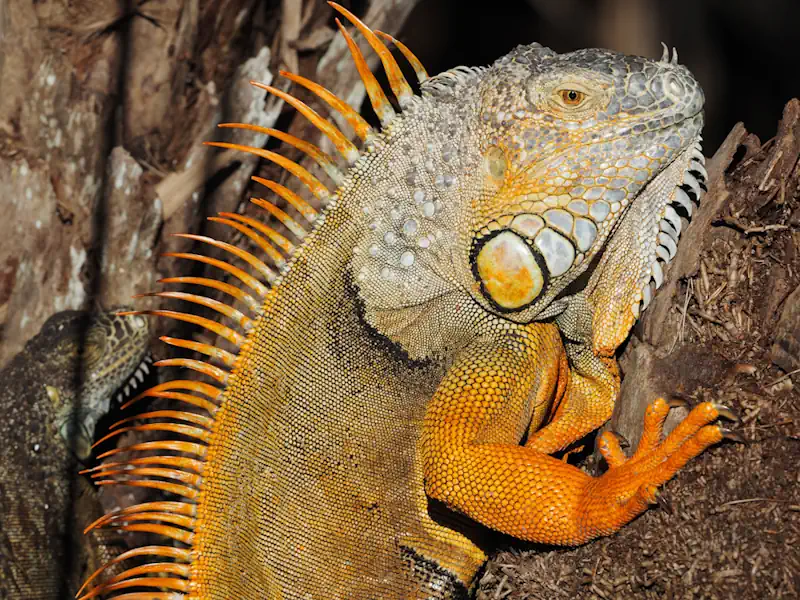
Green-iguana appearance can vary with age, temperature and social or reproductive state. Color alone cannot identify illness, aggression or a growing property population.
Green iguanas can look very different over time, but they do not become a new species when their color changes. FWC describes green iguanas that are green, brown or nearly black, and notes that some adults develop orange or pink coloration at certain times of year. Bright-green young animals and darker adults can therefore belong to the same species.
For a Florida homeowner, color is a clue rather than a diagnosis. It cannot by itself establish an animal’s sex, health, temperament or the number of iguanas using a property. This guide separates documented variation from common assumptions, explains how light and observation affect what you see, and shows which details are more useful than a color label.
Can Iguanas Change Color Like Chameleons?
The useful answer is that green iguanas show color variation, but should not be described as changing to match every background on demand. A lizard appearing different on separate days is not evidence that it consciously selected a camouflage pattern. Nor does it establish the speed or cellular mechanism of the change.
Online explanations often borrow details about chameleon skin and apply them to iguanas. That is not a reliable shortcut. The FWC profile used here establishes the observed range of green-iguana coloration; it does not supply a measured minute-by-minute color-change rate or an iguana-specific study of skin-cell structures.
There is no universal minute-by-minute color-change rule, and one pigment explanation cannot explain every observed shade. It is more accurate to distinguish long-term appearance differences from a change you actually observed in the same individual under comparable conditions.
Start With the Species, Not the Color Name
The name green iguana is not a requirement that every adult remain green. FWC’s green-iguana profile describes a row of spikes along the neck, back and upper tail, dark tail rings, and a prominent throat fan called a dewlap. Mature males can develop heavy jowls and a larger dewlap than females.
These structures give an observer more to work with than hue alone. An orange or dark individual with the same identifying anatomy may still be a green iguana (Iguana iguana). A green animal without those features might be another lizard entirely.
Other Florida Lizards Can Be Mistaken for Iguanas
UF/IFAS distinguishes green iguanas from black and Mexican spiny-tailed iguanas, and notes that basilisks and large anoles are sometimes called iguanas by residents. Some of these animals can overlap in general appearance or occupy similar surroundings. Calling all large lizards iguanas can lead to incorrect conclusions about diet, shelter and legal status.
The guide to different types of iguanas is a useful companion. Photograph visible body features from a safe distance if identification is needed. Do not move closer, capture the animal or turn it over to obtain a better view.
Why Juveniles and Adults May Look Different
FWC says hatchling and young green iguanas usually have bright-green coloration. Adult coloration is more variable. An observer who sees a small green lizard one week and a large brown iguana the next may be seeing animals of different ages rather than a dramatic change in one animal.
Size and location do not prove individual identity. Several iguanas can use the same wall, tree or garden, and a repeated sighting at one spot does not show that the same animal returned. This is especially important when comparing photos taken weeks apart.
Young iguanas also should not be used as a census. Seeing juveniles confirms that young animals are present, but it does not reveal how many eggs were laid, where a nest is, or whether the property population is growing. Movement from adjacent habitat is another possibility.
Orange and Pink Adults: What FWC Actually Documents
FWC specifically notes that some adult green iguanas can take on orange or pink coloration at certain times of year. That supports a seasonal appearance discussion. It does not mean every orange animal is a breeding male, every male becomes orange, or a particular color proves the exact stage of reproduction.
Color can be considered alongside adult body features and observed displays, but those observations still have limits. A visible throat fan or heavy jowls may help identify an adult male; a single hue is less informative. An animal does not have to appear orange to be capable of feeding on plants, burrowing or defending itself.
The companion article about iguanas that turn orange during breeding season discusses that appearance. Do not apply a fixed Florida breeding calendar solely from color. FWC’s statement about October-November mating explicitly refers to the species’ native range, and cannot be treated as a statewide Florida schedule.
Dark Color, Temperature and the Limits of Visual Diagnosis
Green iguanas are ectotherms: external conditions influence their body temperature and activity. UF/IFAS describes them basking in open areas, and FWC notes that they are not cold hardy. Those facts explain why weather and access to basking sites matter to their behavior.
They do not make every dark animal a thermometer. FWC includes brown and nearly black within the species’ normal descriptive range. A dark-looking iguana on a cool day may also have appeared that way on a warm one. Shadow, wet skin, the viewing angle or a photograph’s exposure can influence its apparent color.
Look at the conditions, but do not use color alone to decide an animal is cold-stunned, overheated or sick. If an iguana is motionless after cold weather, do not touch or bring it inside to test whether it is alive. Appearance and stillness do not establish that handling is safe.
Why a Phone Photo Can Exaggerate a Change
Sunlight, shade and reflected light can affect a photo. A phone may automatically change exposure or white balance between frames. Bright foliage around an animal can also make one image look greener than another. Comparing two photos without considering those conditions can produce an apparent color shift that is partly photographic.
For a useful record, note the date, location and whether the animal was in direct sun or shade. Preserve the unfiltered original image. This is documentation, not a reason to keep approaching the animal until the colors look right.
Color Does Not Tell You Whether an Iguana Is Aggressive
UF/IFAS reports that iguanas generally avoid people but defend themselves when caught or cornered. That is a more useful predictor of a risky encounter than a color category. A green animal can react defensively; a brightly colored animal is not necessarily attacking.
FWC describes the dewlap as a communication structure that can repel rivals or warn predators. A conspicuous display should prompt distance, but a lack of display should not invite handling. Avoid following, surrounding or feeding wildlife to provoke a response for a photograph.
Keep children and pets from approaching any wild iguana, whatever its shade. The practical safety rule does not change because an animal is yellow, orange, green or brown. Teeth, claws and the tail remain relevant even when its appearance seems attractive or unusual.
Can Color Reveal Illness?
A color change is not a diagnosis. Dark skin alone does not diagnose dehydration, a pale patch does not establish a fungal infection, and gray coloration does not identify a particular nutritional disorder. Several explanations can overlap, and a short observation cannot replace an examination.
If a captive pet has a concerning appearance or behavior change, contact a veterinarian experienced with reptiles. If the concern involves a wild animal, avoid handling it and ask the appropriate wildlife professional or agency for advice. These are different situations, and guidance for a pet enclosure should not be imported into a wild encounter.
Normal-looking reptiles can carry germs. CDC guidance notes that reptiles can carry Salmonella while appearing healthy and clean. A vivid color is neither a certificate of health nor proof that touching the animal or contaminated surfaces is safe.
Color Is Not a Population or Damage Measurement
A group containing green juveniles and darker adults can reflect age variation. It does not, by itself, prove a recent population increase. Likewise, several orange animals do not establish how many females, eggs or nests are nearby. To understand recurring activity, record sightings over time rather than infer a count from color.
Property impacts should be evaluated directly. FWC documents landscape feeding, burrows that can affect infrastructure, and droppings around outdoor surfaces. These concerns are real regardless of appearance, but they still require site-specific evidence. A leaf missing near an iguana is not the same as observing that iguana feeding.
Keep the descriptions separate: what the animal looked like, what it was doing, and what changed on the property. A record saying an orange iguana was resting near a garden is different from a record of that animal visibly eating the plants. The distinction helps avoid unnecessary or misdirected work.
A Useful Observation Checklist
- Record the location and date, including whether the animal was in sun or shade.
- Photograph the whole visible animal from a safe position, not just an unusually colored patch.
- Look for a dewlap, dorsal spines and tail pattern without approaching.
- Describe behavior plainly: resting, walking, feeding or displaying.
- Document actual property effects separately from the sighting.
- Keep children and pets away and do not offer food to hold the animal in place.
This approach produces information an assessor can use. It also avoids turning an educational question into a contact event. If identification remains uncertain, say that it is uncertain rather than forcing the photo into a color-named category.
What to Do About Recurring Iguana Activity
A color shift alone is not a reason to intervene. Recurring feeding, droppings in a frequently used area or suspected burrows near infrastructure are more practical reasons to request an assessment. Structural deterioration should also be evaluated on its own merits; color cannot establish what caused a crack or erosion.
Do not dig into a suspected nest, close an occupied opening or move a wild iguana elsewhere. FWC identifies green iguanas as invasive, subject to humane requirements and landowner permission for removal. Captured animals cannot be relocated and released in Florida, and a permit is required for live possession for eradication and control.
Ask On Demand Pest Control about available iguana assessment and removal options if repeated activity is affecting the property. Bring the dated observations rather than a conclusion based only on color. The goal is to understand the actual animal and concern, not to treat every change of shade as proof of aggression, illness or a growing population.
Temperature, Social State and Hormones Can Influence Color
The University of Michigan’s Animal Diversity Web species account describes green-iguana color varying with temperature, mood, health and social status. It explains darker morning coloration as helping absorb sunlight and lighter coloration in hot midday conditions as reducing heat absorption. This provides a biological explanation for changes beyond the normal differences between individuals.
The account also links some male variation to sex hormones and describes orange or gold coloration around courtship. Together with FWC’s description of seasonally orange or pink adults, that supports a cautious explanation of why the same green iguana might look different over time. It does not supply a Florida-wide clock for every animal or make color a stand-alone test of reproductive status.
More than one influence can operate at once. An animal may be warming, interacting with another iguana and appearing under different light in the same observation. Separating those influences from a distant photograph is difficult, so a useful description names the circumstances instead of announcing a single proven cause.
The biology and the observation limits belong together. Color variation is real; the uncertainty lies in diagnosing the exact reason for one animal’s shade. A homeowner can understand the possible roles of temperature and social behavior without approaching the animal, conducting a warming experiment or treating it as a chameleon demonstration.
For example, two sightings of a similar-sized lizard on one wall establish repeated use of the area. They do not establish that one animal changed from green to orange overnight. By recording the scene and visible anatomy, you can preserve both possibilities: genuine individual color variation and different animals appearing in the same place. Neither possibility requires touching the lizard to investigate.
Frequently Asked Questions
-
Can iguanas change color like chameleons?
Green iguanas show color variation, including changes associated with temperature and social or reproductive state, but they should not be described as matching arbitrary backgrounds on demand. Details about chameleon skin or color-change speed cannot simply be applied to iguanas. Color is a clue, not a precise diagnosis.
-
Why is the iguana in my yard turning black?
FWC includes brown and nearly black within the green iguana's appearance range. Temperature can influence coloration, but darkness alone does not prove cold stress, illness or aggression. Lighting and the identity of the animal also matter. Do not handle or warm a wild iguana to test the explanation.
-
Why do iguanas turn orange in Florida?
FWC notes that some adults develop orange or pink coloration at certain times of year. Animal Diversity Web also describes orange or gold coloration in some males around courtship. Not every orange animal has an identical reproductive status, and color alone does not establish a Florida-wide breeding calendar.
-
Does iguana color indicate what species it is?
Color can help describe an animal but is not reliable by itself for species identification. Green iguanas may be green, brown or nearly black, and other lizards may be misidentified as iguanas. Compare visible body features, including the dewlap, dorsal spines and tail pattern, from a safe distance.
-
Can a sick iguana change color differently than a healthy one?
Health can influence appearance, but color alone cannot diagnose an illness. Dark, pale or patchy skin has multiple possible explanations. A concerning change in a captive pet belongs with a reptile-experienced veterinarian; a wild-animal concern should be referred for suitable wildlife advice without handling.
-
Should I be concerned if iguanas on my property are changing colors?
A color change alone does not prove danger or a growing population. Record actual recurring activity, visible plant feeding, droppings or suspected burrows near infrastructure. Keep people and pets away from wild animals and ask for assessment if a specific property concern is developing.

Vincent founded On Demand Pest Control in 2017 and is a Florida Certified Operator in all four state categories. He treats pest control as a systematic problem to solve, not a symptom to spray. Read Vincent’s full bio →
Get help with your pest concern.
Tell us what you are seeing. Our team can discuss the concern and the next step.
- Share your concern and contact details.
- Our team contacts you to discuss available service.
- Ask for a written scope and quote before work.
Where can we reach you?
Our team will call to confirm the next step.
By submitting, you’re asking On Demand Pest Control to contact you about this request.
↗ Prefer to call? (954) 947-0805