
Key Takeaways
- A six foot iguana is not a myth — mature male green iguanas in South Florida routinely reach five to six feet from snout to tail tip.
- Most of that impressive length comes from the tail, which accounts for roughly two-thirds of the animal's total measurement.
- South Florida's warm, humid climate and year-round food supply create ideal conditions for iguanas to reach maximum size.
- Iguanas of this size cause serious property damage, including collapsed seawalls, destroyed landscaping, and undermined foundations.
- Removing a large iguana safely requires professional trapping — animals this size can deliver powerful bites, tail whips, and deep claw scratches.
If you have spotted a six foot iguana sunning itself on your pool deck or perched along a canal wall, you are not imagining things. South Florida is home to one of the densest populations of invasive green iguanas anywhere in the Western Hemisphere, and the biggest males grow to genuinely startling proportions. These are not the small, darting lizards you swat away from your screen door. A full-grown iguana at five or six feet long — sometimes even pushing toward 7 foot big iguana territory — weighs upward of 15 to 20 pounds, commands serious space, and can cause real damage to your yard, your home's infrastructure, and even your family's safety. This guide breaks down exactly how big do iguanas get in the wild, why South Florida produces such oversized specimens, and what you should do when one takes up residence on your property.
How Large Does a Six Foot Iguana Actually Get?
When most people hear "six foot iguana," they picture a dinosaur-sized beast. The reality is dramatic enough on its own, but understanding iguana proportions helps set the right expectations.
A green iguana (Iguana iguana) measuring six feet from snout to tail tip typically has a body — head to base of the tail — of roughly 18 to 22 inches. The remaining four feet or so is pure tail. That tail is muscular, laterally compressed, and serves as both a swimming rudder and a defensive weapon.
Body Weight at Six Feet
At the six-foot mark, a healthy male green iguana usually weighs between 14 and 20 pounds. However, some exceptionally well-fed specimens in South Florida have been documented closer to 25 pounds. Females rarely reach six feet; they typically max out between three and four feet total length.
Can Iguanas Grow Even Larger Than Six Feet?
Yes. While six feet is already at the upper end of the normal range, reports of 7 foot big iguana sightings surface periodically in Miami-Dade, Broward, and Palm Beach counties. The biggest iguana on record has exceeded six and a half feet. Black spiny-tailed iguanas (Ctenosaura similis) don't reach the same length but are stockier and faster, adding to the diversity of large invasive lizards in the region.
Several factors determine whether an iguana reaches these exceptional sizes:
- Sex — Males grow significantly larger than females
- Species — Green iguanas outgrow other Florida iguana species in overall length
- Food availability — Abundant tropical vegetation fuels rapid growth
- Absence of predators — Few natural threats allow iguanas to live long enough to reach maximum size
- Climate — Consistent warmth means year-round feeding and growth with no winter dormancy
Why South Florida Produces Unusually Large Iguanas
South Florida's environment is essentially a growth laboratory for green iguanas. Understanding why helps explain the six foot iguana phenomenon and why these animals keep getting bigger.
Year-Round Tropical Climate
Green iguanas are native to Central and South America, where temperatures remain warm throughout the year. South Florida — particularly the coastal strip from Key West through Fort Lauderdale and up to West Palm Beach — mirrors that native habitat almost perfectly. Average winter temperatures rarely dip below 60°F for extended periods, and summer highs hover between 85°F and 95°F with high humidity.
This warmth matters because iguanas are cold-blooded. Their metabolism, digestion, and growth rate all depend on ambient temperature. In cooler climates, iguanas slow down, eat less, and grow slowly. In South Florida, they eat and grow nearly every day of the year.
Unlimited Food Supply
South Florida landscaping reads like an iguana buffet menu. Hibiscus, bougainvillea, orchids, mangoes, papayas, ficus hedges, and dozens of other ornamental and fruit-bearing plants provide a constant food source. Iguanas are primarily herbivorous, and the sheer diversity and availability of vegetation in residential and commercial landscapes means they never run short of calories.
An iguana that eats daily and digests efficiently — thanks to warm temperatures — simply keeps growing. Year after year, that animal adds length and mass until it reaches the genetic ceiling for its species, often right around six feet for males.
Lack of Natural Predators
In their native range, iguanas face predation from large raptors, jaguars, caimans, and large snakes. South Florida has some predators — hawks, raccoons, and the occasional alligator — but nothing that consistently hunts adult iguanas above three feet. Once an iguana reaches a certain size, it effectively has no predators left in the Florida ecosystem.
This means more iguanas survive to adulthood, and those adults live longer. A green iguana can live 15 to 20 years in the wild under favorable conditions. That gives them ample time to reach — and maintain — six foot iguana proportions. These are among the adaptations that allow iguanas to grow so large in a place like South Florida, where the combination of warmth, food, and safety from predators is unmatched.
Where Are Six Foot Iguanas Most Commonly Seen?
Large iguanas are not evenly distributed across Florida. They concentrate in specific habitats and regions where conditions are optimal.
Canals and Waterways
If you live along a canal in Broward or Miami-Dade County, you have almost certainly seen large iguanas basking on the banks. Canal systems provide everything a big iguana needs: sun-warmed concrete or rock surfaces for basking, water for escape and thermoregulation, and lush vegetation along the banks for food. Some of the largest iguanas reported in South Florida come from canal-side properties.
Residential Yards and Pool Areas
Iguanas are drawn to irrigated residential landscapes. Sprinkler systems keep plants green and growing even during dry spells, which means consistent food. Pool decks, patios, and seawalls provide ideal basking surfaces. Homeowners in neighborhoods like Coral Gables, Plantation, Boca Raton, and Key Biscayne regularly report iguanas in the four-to-six-foot range lounging in their yards.
Commercial Properties and Parks
Golf courses, botanical gardens, marinas, and commercial properties with extensive landscaping also harbor large iguana populations. These areas often have limited foot traffic in certain zones, giving iguanas the undisturbed space they need to grow large.
The Florida Keys
The Florida Keys present a unique situation. The warm, island environment with limited development in some areas and abundant native vegetation supports thriving iguana populations. Six foot iguana sightings are common from Key Largo through Key West.
What Damage Can a Six Foot Iguana Cause?
A small iguana nibbling your garden is annoying. A six foot iguana or larger animal taking up residence is a genuine property threat. Here is what these large reptiles can do.
Structural Damage From Burrowing
Large iguanas dig extensive burrows — sometimes several feet deep and many feet long. They excavate along foundations, seawalls, pool decks, and retaining walls. Over time, these burrows undermine structural integrity. Collapsed seawalls and cracked foundations are documented consequences of iguana burrowing activity in South Florida.
A six foot iguana digs bigger burrows than a smaller animal, and dominant males often maintain multiple burrow systems across their territory.
Landscape Destruction
At this size, an iguana consumes a significant volume of plant material daily. Homeowners report:
- Entire hibiscus hedges stripped of flowers and leaves
- Fruit trees — mango, papaya, banana — defoliated or stripped of developing fruit
- Ornamental gardens destroyed overnight when a large iguana moves in
- Vegetable gardens raided repeatedly
Health and Safety Risks
Iguanas of any size carry Salmonella bacteria on their skin and in their droppings. A six foot iguana produces proportionally larger and more frequent droppings, often in pool areas, on docks, and on patios. This creates a health hazard, particularly for families with young children, elderly residents, or immunocompromised individuals.
In addition, a cornered or startled iguana at six feet is physically capable of causing injury. Their tails deliver painful whip strikes that can leave welts and bruises. Their claws are sharp and can lacerate skin. Their bite — while not venomous — can crush fingers and cause wounds that require medical attention.
How to Identify a Six Foot Iguana by Species
Not every large lizard in South Florida is a green iguana. Knowing what you are looking at helps determine the right approach.
Green Iguana (Iguana iguana)
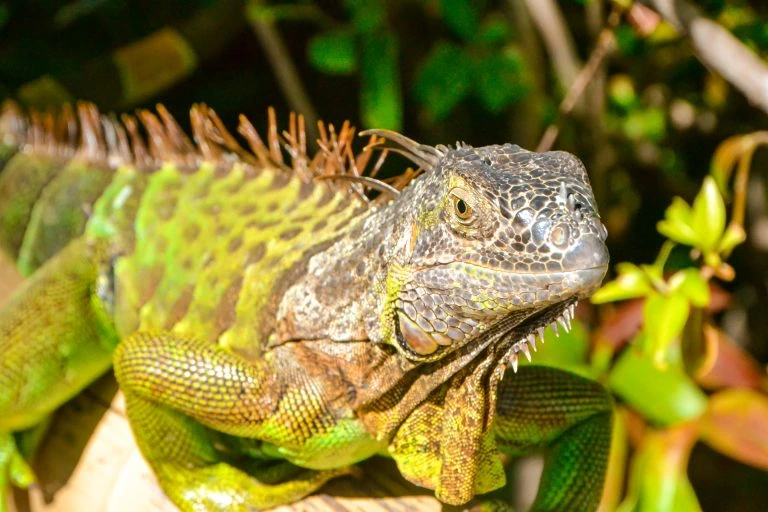
This is the species most likely to reach six feet. Key identification features include:
- Bright green coloration in juveniles, shifting to gray-green, orange, or brownish tones in mature adults
- A prominent dewlap (throat fan) under the chin
- A row of large, rounded subtympanic scales below the ear
- A dorsal crest of tall spines running from neck to tail
- Long, banded tail
Mature males during breeding season often turn vivid orange, which makes them even more conspicuous.
Black Spiny-Tailed Iguana (Ctenosaura similis)
This species tops out around four and a half feet, so it rarely reaches six foot iguana dimensions. However, it is stocky, aggressive, and fast. It has a darker coloration, prominent spiny tail rings, and is more likely to eat insects, small animals, and bird eggs alongside vegetation.
Mexican Spiny-Tailed Iguana (Ctenosaura pectinata)
Found in smaller numbers in Florida, this species resembles the black spiny-tailed iguana and rarely exceeds four feet. It is not the species responsible for six-foot sightings.
What Should You Do If a Six Foot Iguana Is on Your Property?
Finding a large iguana on your property can be intimidating. Here is a practical action plan.
Do Not Attempt to Handle It
A six foot iguana is a powerful animal. It can scratch, bite, and tail-whip with enough force to cause injury requiring medical attention. Do not corner it, grab it, or attempt to chase it off with a broom or garden tool. Startled iguanas often flee toward water — and may run directly at you if you are between them and their escape route.
Document the Sighting
Take photos or video if you can do so safely. Note where on your property the iguana was seen, what time of day, and whether you have seen it before. This information helps removal professionals assess the situation.
Secure Your Yard
While waiting for professional help, reduce the attractiveness of your property:
- Remove fallen fruit from beneath trees
- Trim back dense vegetation that provides cover
- Cover or screen pools and hot tubs to prevent iguana droppings in the water
- Fill in any burrow entrances you find along foundations or seawalls (temporarily) to encourage the iguana to relocate
Contact a Professional Removal Service
Iguanas above four feet should be handled by experienced trappers. Professionals use specialized equipment — snares, heavy-duty traps, and protective gear — to capture and remove large iguanas humanely and legally. In Florida, iguanas are classified as invasive and non-protected, meaning they can be legally removed from private property year-round. However, state law requires that removal be done humanely.
Professional services also assess your property for burrow damage, recommend habitat modifications, and can set up ongoing management plans if you live in a high-density area.
Can You Prevent Iguanas From Reaching This Size on Your Property?
Prevention is always easier than removal. While you cannot control iguana populations across your entire neighborhood, you can make your property less hospitable.
Habitat Modification
Remove or reduce the food sources iguanas depend on. This includes:
- Replacing iguana-favorite plants (hibiscus, orchids, impatiens) with species they avoid (oleander, citrus, milkweed, pigeon plum)
- Harvesting fruit promptly rather than letting it fall and rot
- Keeping grass trimmed short so iguanas have fewer hiding spots
Physical Barriers
Sheet-metal wraps around tree trunks prevent iguanas from climbing into canopy areas where they roost. Mesh or hardware cloth over garden beds can protect vulnerable plants. Seawall caps with smooth surfaces discourage basking.
Consistent Deterrence
Iguanas are creatures of habit. If your property is consistently inhospitable — no easy food, limited basking sites, regular human activity — they will move to a neighbor's yard instead. This does not eliminate the problem regionally, but it protects your specific property.
The Difference Between a Six Foot Iguana and a 7 Foot Big Iguana
The jump from six feet to seven feet is significant in iguana biology. Most green iguanas in South Florida top out between five and six feet. Reaching seven feet requires a combination of optimal genetics, unlimited food, zero predation pressure, and many years of uninterrupted growth.
Reports of 7 foot big iguana specimens are rare but not unheard of. These are almost always older males — likely 10 to 15 years old — living in undisturbed habitats with abundant vegetation. They are typically found along remote canal stretches, in large parks, or on private estates with extensive tropical landscaping.
At seven feet, these animals can weigh over 20 pounds. Their burrows are deeper, their territorial range is wider, and their impact on local vegetation and property infrastructure is proportionally greater.
Whether your unwanted visitor measures five, six, or seven feet, the response is the same: professional assessment, humane removal, and habitat modification to prevent reoccurrence.
Understanding Iguana Growth Rates in South Florida
Knowing how quickly iguanas grow helps you understand why early intervention matters.
Hatchling to Juvenile (Year 1)
Green iguana hatchlings emerge from eggs at roughly 6 to 9 inches long. In South Florida's warm climate, they grow rapidly — often reaching 18 to 24 inches within their first year. At this stage, they are vulnerable to predation by hawks, raccoons, and even domestic cats.
Juvenile to Sub-Adult (Years 2-3)
By their second year, iguanas typically reach 2.5 to 3.5 feet. Males begin to show more robust head shapes and developing dewlaps. Growth remains rapid because the animal is still converting most of its caloric intake into body mass.
Sub-Adult to Full-Grown (Years 3-7)
This is when the dramatic growth happens. Males push past four feet, then five feet, and the largest individuals reach six feet by age five to seven. Growth slows after this point but does not stop entirely. An iguana in its prime will continue adding small increments of length for several more years.
Mature Adult (Years 7+)
After age seven or so, growth is minimal. The animal has reached or nearly reached its genetic maximum. However, it may continue to add weight and girth. These are the six foot iguana individuals that homeowners find most alarming — heavy-bodied, slow-moving, and firmly established on your property.
The takeaway for homeowners: a two-foot iguana in your yard today could be a six-foot problem within three to four years if left unchecked.
Frequently Asked Questions
-
Are six foot iguanas dangerous to pets?
Yes. A six foot iguana can injure a dog or cat with its tail, claws, or bite if the animal feels cornered or threatened. Small dogs are particularly vulnerable. Keep pets supervised in yards where large iguanas have been spotted, and do not allow dogs to chase or corner an iguana.
-
How much does a six foot iguana weigh?
A six foot green iguana typically weighs between 14 and 20 pounds, though some well-fed specimens in South Florida exceed 20 pounds. Weight varies based on diet, health, and whether the animal is a gravid (egg-carrying) female, although females rarely reach six feet.
-
Is it legal to kill a six foot iguana on my property in Florida?
Florida classifies green iguanas as invasive and non-protected. Property owners can remove them from their property year-round without a permit. However, state law requires that removal and euthanasia be conducted humanely. For an animal this large, professional removal is strongly recommended.
-
How do I know if the iguana in my yard is actually six feet long?
Estimate total length by comparing the iguana to nearby objects of known size — fence posts, pool tiles, or patio furniture. Remember that roughly two-thirds of the total length is tail. If the body alone (head to tail base) is 18 inches or more, the total length including the tail likely approaches or exceeds five feet.
-
Can a six foot iguana damage my seawall or foundation?
Absolutely. Large iguanas dig burrows that can extend several feet underground and run parallel to foundations, seawalls, and pool decks. Over time, these burrows erode soil and undermine structural integrity. Seawall collapse caused by iguana burrowing is a documented and costly problem in South Florida waterfront properties.
-
What attracts six foot iguanas to residential properties?
Large iguanas are drawn to properties that offer food (tropical plants, fruit trees, vegetable gardens), basking surfaces (pool decks, seawalls, driveways), water access (pools, canals, ponds), and shelter (dense vegetation, rock piles, burrow-friendly soil). Reducing these attractants is the most effective long-term deterrent.