
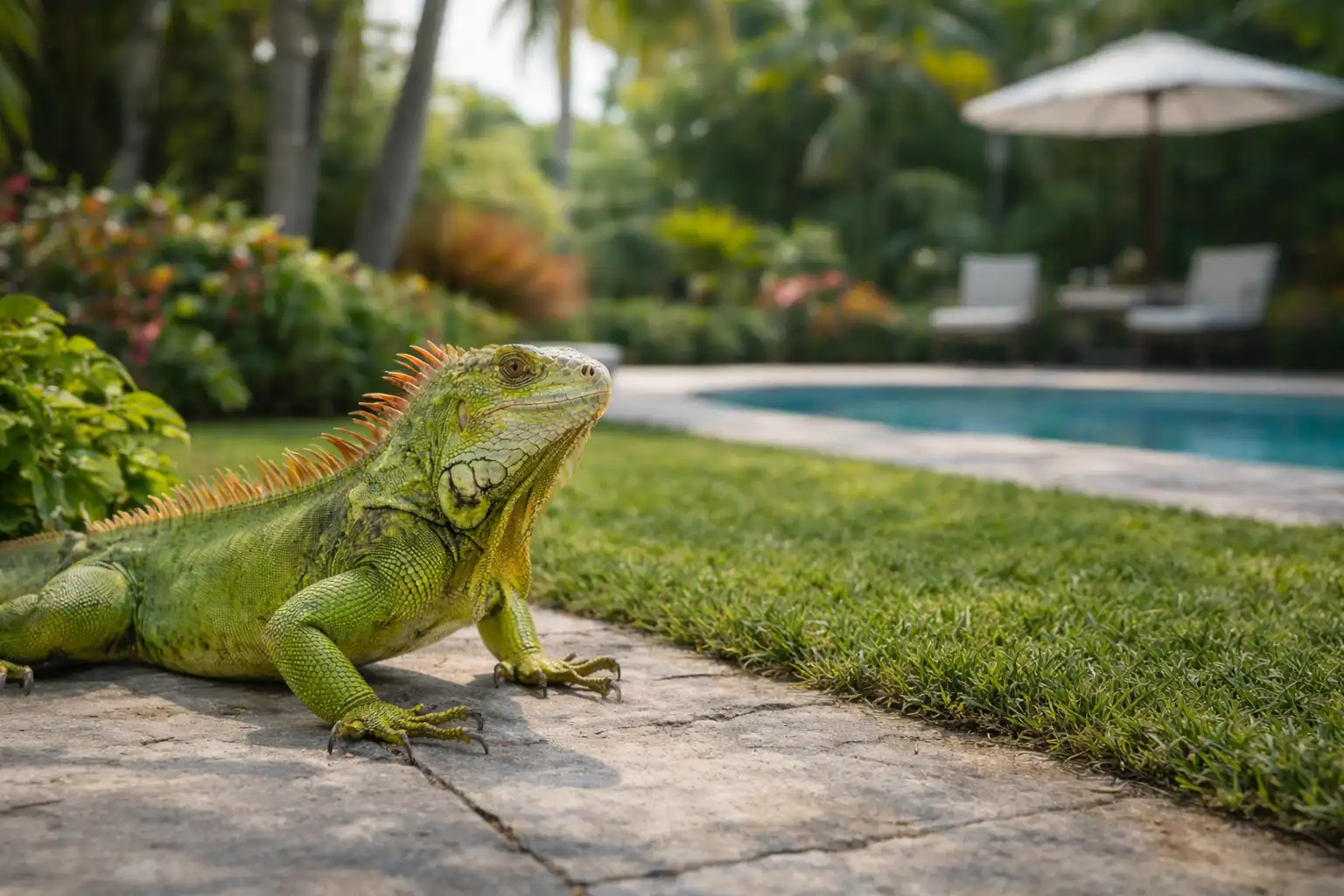
Key Takeaways
- Iguana adaptations include powerful limbs for climbing, salt-excreting nasal glands, and a parietal "third eye" that detects predators from above.
- Their ability to hold their breath for up to 30 minutes lets them travel through canal systems across South Florida neighborhoods.
- Iguana camouflage shifts with age, mood, and temperature, helping them blend into Florida's lush subtropical landscape.
- Rapid reproduction — females lay 20 to 70 eggs per clutch — fuels exponential population growth every breeding season.
- South Florida's year-round warmth, abundant vegetation, and lack of natural predators create near-perfect conditions for iguanas to flourish.
- Understanding iguana characteristics is the first step toward protecting your property and landscape from ongoing damage.
Iguana adaptations are the reason these large, bright-green reptiles have conquered South Florida's suburbs, canals, and coastlines with stunning speed. Originally native to Central and South America, green iguanas arrived in Florida through the exotic pet trade and found an environment that mirrors their tropical homeland almost perfectly. Their bodies are built for survival — equipped with specialized anatomy, flexible diets, and behavioral strategies that let them outcompete native wildlife and resist most casual removal efforts. If you have ever wondered why iguanas seem impossible to control in your yard, the answer lies in millions of years of evolutionary fine-tuning. This article breaks down every major adaptation — physical, behavioral, and reproductive — so you can understand exactly what makes these invasive lizards so successful and what that means for your property.
Physical Iguana Adaptations Built for a Tropical Environment
Green iguanas did not become one of the most successful invasive species in Florida by accident. Their bodies are a collection of finely tuned physical traits that make South Florida feel like home. Understanding iguana size, weight, and anatomy helps explain just how imposing these animals become as they mature.
Powerful Limbs and Sharp Claws
Iguanas possess long, muscular limbs tipped with razor-sharp claws. These claws grip bark, stucco, screen enclosures, and concrete with ease. An iguana can scale a royal palm in seconds or climb the side of a two-story home without hesitation. This climbing ability gives them access to roosting spots, fruit-bearing trees, and elevated basking surfaces that other ground-dwelling reptiles cannot reach.
Their hind legs are especially strong. When threatened, an iguana launches off a branch or seawall and sprints at speeds up to 21 miles per hour. That burst of acceleration makes them difficult to catch by hand, which is one reason professional trapping methods are more effective than chasing them across your yard.
A Tail Designed for Defense and Balance
An iguana's tail accounts for roughly two-thirds of its total body length. It serves multiple purposes:
- Balance while climbing trees and navigating narrow branches
- Swimming propulsion through canals and retention ponds
- Self-defense — a tail whip from a full-grown iguana can break skin and leave bruises
The tail also functions as a fat reserve. During periods of stress or limited food, iguanas draw on energy stored in their tails to sustain themselves. In addition, iguanas can drop their tails when grabbed by a predator. The severed tail continues to thrash, distracting the threat while the iguana escapes. The tail regenerates over several months, though the replacement is typically shorter and lacks the original banding pattern.
Salt-Excreting Nasal Glands
One of the lesser-known iguana characteristics is their cranial salt gland. This specialized gland sits near the nostrils and filters excess salt from the bloodstream. Iguanas expel the concentrated salt by sneezing — those white crusty deposits you see on pool decks and patio furniture are dried salt secretions.
This adaptation is critical because it allows iguanas to eat plants with high mineral content, drink brackish water near coastal areas, and survive in environments where freshwater sources are inconsistent. In South Florida, where saltwater intrusion affects many coastal landscapes, this trait gives iguanas a survival edge that most other herbivorous reptiles lack.
How Iguana Camouflage Helps Them Avoid Detection
Iguana camouflage is more sophisticated than a simple green hide. Their coloring is dynamic, context-dependent, and remarkably effective in South Florida's dense vegetation.
Color-Shifting Skin
Young iguanas display vibrant, electric green scales that blend seamlessly into tropical foliage — hibiscus hedges, ficus trees, and palm fronds. As iguanas mature, their coloring often shifts toward olive, gray-green, or even brownish tones that match tree bark and soil. During breeding season, dominant males turn bright orange or reddish-gold, which serves as a mating signal rather than camouflage.
Temperature also influences color. Cooler mornings produce darker skin tones that absorb more solar radiation, while warm afternoons may lighten the scales. This thermoregulatory color change has a secondary camouflage benefit: darker iguanas resting on dark branches in early morning shade are nearly invisible to both predators and homeowners.
Freeze-and-Hold Behavior
Iguanas do not rely on color alone. When they sense a threat, their first instinct is to freeze completely. A motionless iguana pressed against a tree trunk or nestled in a shrub becomes incredibly difficult to spot. Their textured, ridged scales break up their outline, mimicking bark and leaf patterns. This behavioral camouflage is especially effective against aerial predators like hawks, but it also explains why homeowners often fail to notice iguanas in their yards until the population is already well established.
Juvenile Camouflage Advantage
Baby iguanas face the greatest predation risk, so their camouflage is the most refined. Hatchlings measure only six to nine inches and sport the most vivid green coloring of any life stage. They tend to stay high in dense canopy cover during their first year, rarely descending to ground level where cats, raccoons, and birds could catch them. This treetop strategy, combined with near-perfect color matching, gives juvenile iguanas a survival rate that far exceeds what their small size would suggest.
Iguana Characteristics That Support Dietary Flexibility
A rigid diet would limit any invasive species. Iguanas avoid that trap through dietary adaptations that let them eat almost anything green — and sometimes things that are not green at all.
Herbivorous Dentition With Surprising Range
Iguanas have small, serrated teeth designed for shearing leaves, flowers, and fruit. Their dental structure lets them consume a remarkable variety of South Florida vegetation:
- Hibiscus flowers and leaves
- Bougainvillea blossoms
- Mango, papaya, and banana fruits
- Orchids and bromeliads
- Vegetable garden crops like squash, tomatoes, and leafy greens
- Ornamental shrubs and rose bushes
This broad palate means that nearly every residential landscape in South Florida functions as a buffet. Iguanas do not need to search far for food — your garden provides everything they require.
Opportunistic Protein Intake
While primarily herbivorous, iguanas occasionally eat insects, snails, bird eggs, and even small lizards. Juveniles consume proportionally more protein than adults, which accelerates their growth rate during the most vulnerable phase of life. This dietary flexibility means iguanas can supplement their nutrition when plant resources are temporarily limited — after a hurricane strips foliage, for example, or during a winter cold snap that damages tropical plants.
Efficient Gut Fermentation
Iguanas possess a specialized hindgut fermentation system. Symbiotic bacteria in their large intestine break down cellulose from fibrous plant material, extracting maximum nutrition from leaves that other reptiles could not digest efficiently. This fermentation process is similar to what occurs in the digestive systems of horses and rabbits. It allows iguanas to thrive on low-quality food sources when preferred plants are unavailable, making them extraordinarily resilient during seasonal shifts.
Behavioral Adaptations That Drive Iguana Success
Beyond physical traits, iguana behavior plays a massive role in their dominance across South Florida.
Aquatic Mobility
Iguanas are powerful swimmers. Their laterally compressed tails propel them through water with surprising speed and agility. They can hold their breath for up to 30 minutes, allowing them to dive beneath the surface to escape predators or travel through canal systems connecting neighborhoods, golf courses, and parks.
South Florida's extensive network of canals, retention ponds, and waterways acts as a highway system for iguanas. A population on one side of a neighborhood can colonize the other side within days simply by swimming through the canal. This aquatic mobility makes containment extremely difficult and explains why iguana populations expand so rapidly across connected communities.
Thermoregulation and Basking Behavior
As cold-blooded reptiles, iguanas depend on external heat sources to regulate their body temperature. South Florida's average annual temperature of 75°F provides ideal basking conditions for roughly 350 days per year. Iguanas position themselves on rocks, seawalls, sidewalks, rooftops, and dock pilings each morning, absorbing solar radiation to reach their preferred operating temperature of 85–95°F.
This thermoregulatory strategy also explains the phenomenon of falling iguanas during rare cold snaps. When temperatures drop below 45°F, iguanas enter a torpid state, lose their grip on tree branches, and fall to the ground. However, this cold sensitivity is less of a population control than it appears. Most iguanas recover once temperatures rise, and South Florida's brief cold events rarely last long enough to cause widespread mortality.
Territorial Displays and Social Hierarchy
Male iguanas establish territories through head-bobbing, dewlap extension, and lateral body compression — postures that make them appear larger and more threatening. Dominant males claim the best basking spots, the most productive feeding areas, and access to multiple females. These territorial iguana characteristics drive subordinate males to disperse into new areas, which accelerates the geographic spread of the population.
Females also display site fidelity. They return to the same nesting areas year after year, often digging burrows in sandy soil, canal banks, or foundation perimeters. This predictable nesting behavior concentrates egg-laying activity in locations that are often dangerously close to homes, sidewalks, and infrastructure.
Reproductive Adaptations That Fuel Population Explosions
Iguana reproductive biology is one of the most critical factors behind their invasive success. Their breeding strategy overwhelms any natural population control South Florida's ecosystem can provide.
High-Volume Egg Production
A single female green iguana lays between 20 and 70 eggs per clutch, with larger females producing clutches on the higher end of that range. It is worth appreciating how large iguanas can actually grow to understand why the biggest females are capable of producing such substantial clutches. Females reach sexual maturity at two to three years of age, meaning a hatchling born this spring could be producing her own eggs within 24 months.
Communal Nesting
Female iguanas frequently nest communally, digging burrows near one another in favorable soil. A single canal bank or garden bed can contain hundreds of eggs from multiple females. This concentration of nests increases hatching success because the combined digging activity loosens soil, improves drainage, and creates optimal incubation conditions for the group.
Rapid Juvenile Growth
Under South Florida's warm conditions and abundant food supply, juvenile iguanas grow at an accelerated rate. Hatchlings that emerge at roughly six inches can reach two feet within their first year, and reports of iguanas reaching six feet in length illustrate just how dramatically these animals can develop over time. This rapid growth shortens the window of vulnerability to predators and means that population rebounds occur quickly even after removal efforts. A property cleared of adult iguanas can be recolonized by fast-growing juveniles from neighboring areas within a single season.
Sensory Iguana Adaptations That Enhance Survival
Iguanas possess a sensory toolkit that goes well beyond basic reptilian vision and hearing.
The Parietal (Third) Eye
Located on top of the skull between the two primary eyes, the parietal eye is a photosensitive organ covered by a translucent scale. It does not produce detailed images. Instead, it detects changes in light and shadow overhead. This third eye alerts iguanas to approaching aerial predators — hawks, ospreys, and owls — triggering an immediate freeze or flight response before the threat is close enough to strike.
The parietal eye also plays a role in regulating circadian rhythms and seasonal hormone cycles. It helps iguanas calibrate their basking duration and may influence the timing of breeding behavior. This is a genuinely unusual adaptation that gives iguanas an extra layer of predator awareness that most prey animals lack.
Excellent Color Vision
Iguanas see in full color across a wide spectrum, including ultraviolet wavelengths invisible to humans. UV vision helps them assess the ripeness of fruit, evaluate the health of potential mates based on skin coloration, and navigate through dense canopy where subtle color differences indicate viable pathways. In a landscape as chromatically rich as South Florida's tropical vegetation, this visual acuity is a significant survival advantage.
Vibration and Sound Detection
While iguanas lack external ear openings, they possess a tympanic membrane (eardrum) on each side of the head. They detect low-frequency sounds and ground vibrations, which alert them to approaching footsteps — human, canine, or otherwise. This explains why iguanas often bolt before you see them: they felt you coming through the ground before your eyes ever locked on them.
Why South Florida Is the Perfect Habitat for Iguanas
Understanding iguana adaptations in isolation only tells half the story. The other half is the environment those adaptations were designed for — and South Florida matches it almost perfectly.
Climate Parallels to Native Range
South Florida's subtropical climate mirrors the coastal lowlands of Central America and the Caribbean where green iguanas evolved. Average temperatures, humidity levels, rainfall patterns, and photoperiod cycles are nearly identical. An iguana released in Miami-Dade County experiences no meaningful environmental adjustment. It is, from a biological perspective, already home.
Abundant Food Year-Round
South Florida's landscaping culture — tropical ornamentals, fruit trees, flowering shrubs — provides an uninterrupted food supply. Unlike temperate climates where deciduous trees drop their leaves and food becomes scarce in winter, South Florida's vegetation remains lush and productive twelve months a year. Iguanas never face a seasonal food shortage.
Limited Natural Predators
In their native range, iguanas contend with large raptors, boa constrictors, caimans, and jaguarundis. South Florida lacks most of these predators. While hawks, raccoons, and domestic pets take some juveniles, no consistent predation pressure exists to control the adult population. The absence of natural checks allows iguana numbers to grow unchecked until human intervention occurs.
Infrastructure That Supports Expansion
Canals, seawalls, rock piles, bridge supports, and residential foundations provide basking platforms, nesting sites, and travel corridors that iguanas exploit with remarkable efficiency. South Florida's built environment does not hinder iguana populations — it actively supports them. Every new canal, retaining wall, or backyard rock garden is potential iguana habitat.
What Iguana Adaptations Mean for Your Property
All of these adaptations translate into real consequences for South Florida homeowners. Iguanas dig burrows that undermine seawalls, sidewalks, and foundations. They strip ornamental landscapes of flowers and fruit. Their droppings contaminate pool decks, docks, and patios. Their burrowing near canal banks can compromise structural integrity over time.
Because iguana adaptations make them so resilient, casual deterrence methods — motion-activated sprinklers, ultrasonic devices, or garden netting — rarely provide lasting results. The animals are too smart, too mobile, and too numerous to be discouraged by minor obstacles. Effective iguana management requires an understanding of the very traits covered in this article: their climbing ability, aquatic mobility, reproductive output, camouflage, and sensory awareness.
Professional removal that accounts for these iguana characteristics — targeting nesting sites, travel corridors, and food sources simultaneously — produces far better results than reactive, one-at-a-time approaches. If you are dealing with a persistent iguana problem, knowing what you are up against is the essential first step.
Frequently Asked Questions
-
What are the most important iguana adaptations for survival?
The most impactful iguana adaptations include their powerful climbing limbs, salt-excreting nasal glands, laterally compressed swimming tail, and parietal third eye. Together, these traits allow iguanas to exploit a wide range of habitats, escape predators through multiple pathways, and maintain physiological balance in coastal subtropical environments like South Florida.
-
How does iguana camouflage work in South Florida?
Iguana camouflage relies on color-matching skin that shifts with age, temperature, and mood. Young iguanas display vivid green coloring that blends into tropical foliage, while adults develop olive or grayish tones matching tree bark. Combined with their freeze-and-hold behavior, this makes them very difficult to spot in dense landscaping until populations grow large.
-
Why can't cold weather control iguana populations in Florida?
While iguanas enter a torpid state when temperatures drop below 45°F, South Florida's cold snaps are typically brief — lasting hours rather than days. Most iguanas recover fully once temperatures rise. Their reproductive rate also means populations bounce back quickly, with each surviving female capable of producing 20 to 70 eggs the following spring.
-
Do iguanas have any natural predators in South Florida?
South Florida lacks the large raptors, boa constrictors, and caimans that control iguana populations in Central and South America. Hawks, raccoons, and domestic cats take some juveniles, but no predator consistently threatens adult iguanas. This absence of natural population control is a key reason iguana numbers continue to grow.
-
How do iguanas spread so quickly through neighborhoods?
Iguanas use South Florida's canal systems as travel corridors, swimming between neighborhoods while holding their breath for up to 30 minutes. Their climbing ability lets them scale fences and walls. Territorial behavior pushes subordinate males into new areas, and communal nesting concentrates reproduction in favorable sites, seeding new populations rapidly.
-
What iguana characteristics make them hard to remove?
Their speed (up to 21 miles per hour), climbing agility, aquatic mobility, sharp sensory awareness, and camouflage all make iguanas difficult to catch. They detect ground vibrations and overhead shadows before most people get close. High reproductive output means that removing individuals without addressing nesting sites and food sources leads to rapid recolonization.