
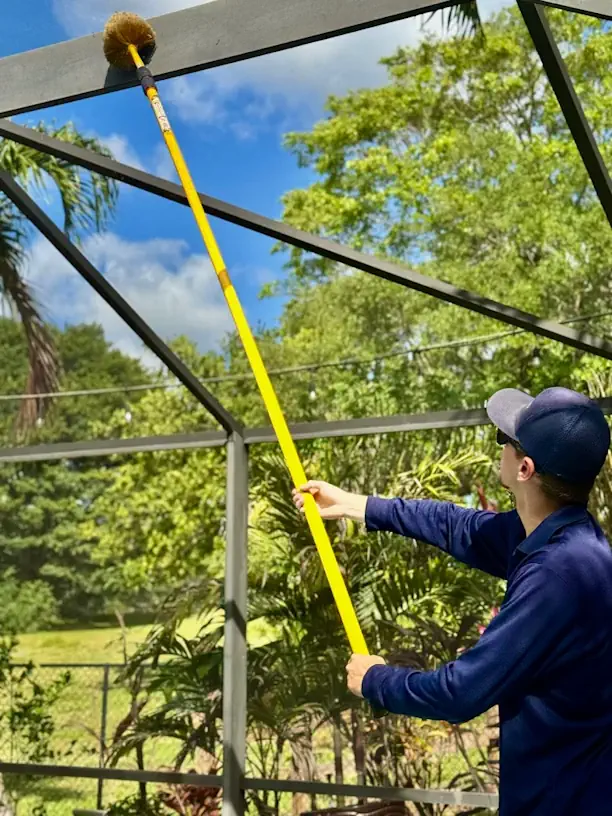
Davie homeowners should compare the pest, inspection findings and written scope before choosing visits every two months or quarterly. Monitoring, repairs and coordinated treatment can matter more than the interval by itself.
Choosing pest control in Davie starts with identifying the pest and the conditions supporting it—not choosing a calendar first. Two homes on the same street can need different responses because one has an active infestation, a plumbing leak, or shared building access while the other has only occasional outdoor sightings. A recurring maintenance visit is also different from the follow-up work required for a specific infestation.
First clarify what “bi-monthly” means
The term is ambiguous: it can mean twice a month or once every two months. This comparison uses every two months, not twice monthly. Quarterly means every three months. Ask the provider to write the interval and actual visit dates into the proposal. Neither interval is a universal treatment recommendation, and neither tells you which pests, locations, or follow-up visits the agreement covers.
Key points before choosing a schedule
Confirm the pest, document current activity, and inspect food, water, shelter, and access conditions. Ask whether the proposal separates initial treatment from ongoing maintenance. An active indoor problem may require prompt diagnosis and pest-specific follow-up rather than waiting for the next routine appointment. A shorter recurring interval does not by itself prove faster elimination, lower total cost, or better results.
Property conditions to inspect in Davie
At the Davie property, review garage traffic and door closure before assuming a pesticide problem. Check whether thresholds and sweeps leave accessible openings, and note when workers or other insects appear at that transition. Inspect utility penetrations only where safely accessible; concealed electrical or structural spaces belong with qualified professionals.
Outside, look for vegetation touching the building and irrigation overspray wetting the structure. Record the condition and arrange appropriate correction rather than treating plant contact as proof of a nest. Food storage and spill cleanup inside the garage may also belong in the inspection. These source-property concerns give a concrete basis for comparing monitoring needs without inventing Davie prevalence, seasonal rates or a preferred interval.
Every-two-month visits: questions to ask
A provider may propose this interval when ongoing monitoring or recurring activity warrants it. Ask what the technician will inspect at each visit, which pest-specific measures are planned, how observations change treatment, and when results will be reassessed. Do not assume that six routine visits a year replace an initial infestation program or that every visit requires pesticide application. The agreement should explain access, appointment scheduling, and what happens when activity returns between visits.
Quarterly visits: questions to ask
A three-month interval means four scheduled visits across a full year, but the service scope still matters more than the count. Ask whether inspection, targeted treatment when needed, and prevention recommendations are included. A home with few sightings and corrected entry or moisture problems may have different monitoring needs from a home with active indoor pests. An inspection—not this article—should determine whether the proposed interval suits the property. Ask how urgent problems are reported and whether additional work has separate terms.
Compare proposals without a false “best fit” score
| Situation | What to establish | Decision to discuss |
|---|---|---|
| Repeated ants or roaches indoors | Species, sources, previous treatments and activity locations | Initial response and follow-up before routine maintenance |
| Condo or shared-wall home | Travel routes and access to common areas | Coordination with management and neighboring spaces |
| Few sightings in a stable home | Entry conditions and monitoring needs | Whether recurring service and the proposed interval are warranted |
| Activity near sinks or after irrigation | Leak, water access, outdoor nests and species | Correct the condition as part of the pest plan |
Recurring ants: why identification comes before frequency
An ant trail can connect an outdoor nest to food indoors, or it can come from a nest in a protected building space. Visible workers are only part of the problem. Ghost ants, white-footed ants, bigheaded ants, and carpenter ants have different biology; “sugar ant” is not a reliable species identification. Note appearance and locations, and request professional ant identification when the signs are uncertain. Sweet-seeking behavior does not establish whether an ant can bite or sting. Winged ants need identification and an emergence-location record rather than an automatic schedule change. Do not assume every small ant should receive the same ant bait or that killing the trail establishes colony control.
Moisture, kitchens, bathrooms, and drain-area sightings
In the garage and adjacent rooms, keep stored food and pet food closed to reduce ant food attractants, remove accessible residue and inspect visible moisture. Trace reported workers from the threshold or utility opening without opening concealed spaces. Compare kitchen food and water sources with bathroom moisture and routes when workers appear beyond the garage; the room alone does not locate a nest. Treatment should address the identified pest and label-permitted location, not an assumed universal ant bait; protect children, pets and food-contact areas.
Condos, seasonal occupancy, and outdoor living areas
Turn the Davie inspection into assigned maintenance tasks: who trims contact vegetation, checks the door sweep, adjusts verified irrigation overspray and repairs an accessible utility gap? Preserve designed drainage and ventilation when planning repairs. Routine pest service does not automatically include any of those trades or repairs.
Monitor the same garage threshold and exterior contact points after correction. Distinguish occasional visitors near an open door from recurring activity in a closed interior space. That record helps the provider discuss initial response, ongoing observation and the written procedure for new activity between appointments. It does not justify blanket treatment of every outdoor sighting.
A practical decision process—not “start short, then step down”
Start with the pest and garage or landscape route actually reported. Document access and resources, then correct verified conditions. Request a proposal that separates an active infestation response from routine every-two-month or quarterly maintenance. Compare inspection areas, covered pests, response terms and total quoted charges on the same basis.
Agree on what will be observed at the next review and who reports renewed indoor activity. More scheduled visits do not by themselves establish better control, and a quiet interval does not automatically require a step-down. Frequency changes should follow inspection findings and the written agreement, not a universal Davie formula.
Do not mistake a changed trail after cinnamon or baking soda for established colony control. Record what was used and whether live activity continues before comparing service frequency. A temporary reduction in visible workers does not show that queens, brood or connected nests were reached, and remedy articles do not supersede pesticide labels.
A labeled diatomaceous-earth ant product requires permitted placement and insect contact; exposed-worker effects are not whole-colony proof. Borax-containing ant baits also depend on the actual formulation and label rather than a homemade recipe. An educational guide does not establish a service guarantee or show that either recurring interval is right for this property.
Questions to take to your provider
What was identified, and what evidence supports that identification? Which areas will be inspected? What must the household or building manager correct? Does the proposal cover the reported pest or require separate work? Are return visits included, and under what conditions? What preparation and reentry instructions apply to any product used? Ask for written answers rather than assuming a price, guarantee, or treatment method from the plan name.
Evidence and practical limits
This guide uses EPA integrated pest management principles and EPA pesticide precautions. Species details are grounded in UF/IFAS profiles for bigheaded ants, ghost ants, and white-footed ants where relevant. Local setting examples are inspection prompts, not prevalence statistics. No price, guarantee, or service interval is promised here.
Frequently Asked Questions
-
Is bi-monthly pest control worth it in Davie, FL?
Only an inspection and the actual proposal can establish value for your property. An every-two-month interval gives more scheduled visits than quarterly, but garage access, corrected irrigation and the identified pest still determine what work is needed.
-
Can quarterly pest control keep ants away?
Quarterly spacing alone cannot keep ants absent. Identification, correction of accessible resources and routes, appropriate treatment when warranted and follow-up terms all matter. Ask what happens if activity is reported before the next scheduled visit.
-
What’s the best schedule if I only see pests occasionally?
No single schedule follows from occasional sightings. Record which pest appears and whether it is indoors, at the garage or near vegetation. Correct accessible conditions and discuss a monitoring threshold before committing to a recurring interval.
-
How do I decide what plan I need?
Compare written inspection findings with covered pests and areas, initial treatment, monitoring frequency, between-visit response, exclusions and quoted charges. Specify household tasks such as trimming contact vegetation or repairing a door sweep; do not choose solely by the plan name. For related assistance, see Davie pest control.

Vincent founded On Demand Pest Control in 2017 and is a Florida Certified Operator in all four state categories. He treats pest control as a systematic problem to solve, not a symptom to spray. Read Vincent’s full bio →
Get help with your pest concern.
Tell us what you are seeing. Our team can discuss the concern and the next step.
- Share your concern and contact details.
- Our team contacts you to discuss available service.
- Ask for a written scope and quote before work.
Where can we reach you?
Our team will call to confirm the next step.
By submitting, you’re asking On Demand Pest Control to contact you about this request.
↗ Prefer to call? (954) 947-0805