
Table of Contents
ToggleKey Takeaways
- Fire ants cannot join a black ant colony because each colony uses unique chemical signals to identify members.
- Black ants will attack and kill any fire ant that attempts to enter their nest.
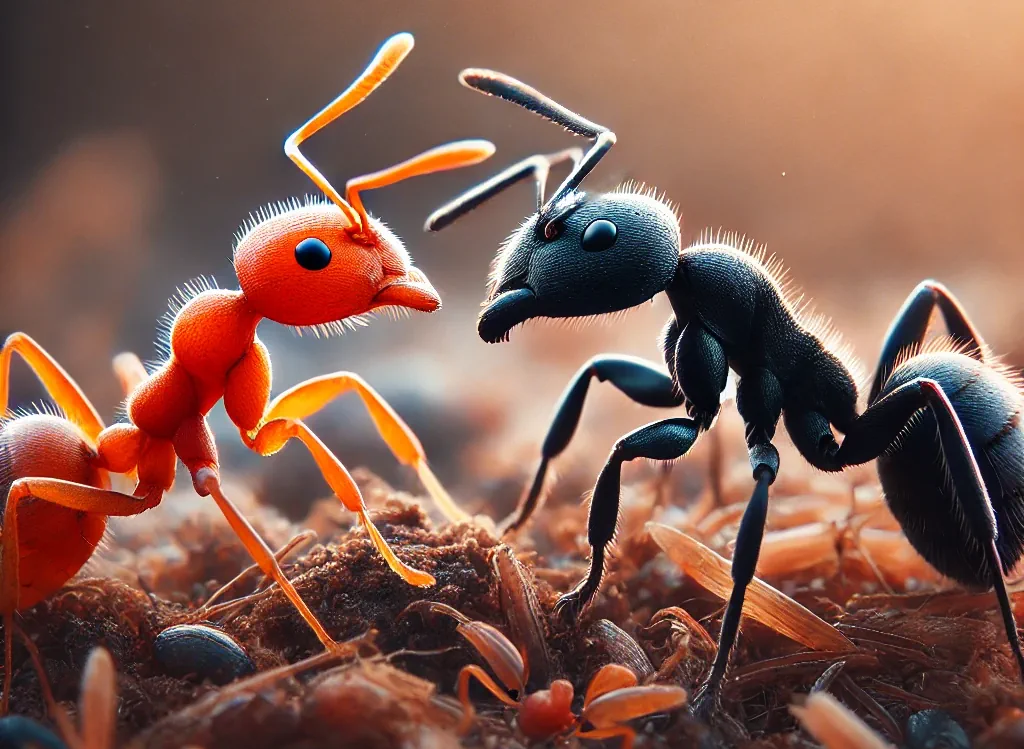
- Fire ants and black ants are natural enemies that compete aggressively for territory and food sources.
- Colony recognition in ants depends on cuticular hydrocarbons — a chemical fingerprint unique to each colony.
- If fire ants and black ants are both present on your property, you likely have a significant pest problem that needs professional attention.
Whether a fire ant can join a black ant colony is a question that fascinates homeowners and nature enthusiasts alike. You might have noticed different ant species foraging near each other in your yard and wondered if they ever mix. The short answer is no — a fire ant cannot successfully infiltrate or join a black ant colony. Ant societies are far more exclusive than they appear. Each colony operates like a tightly guarded fortress, using chemical signals to distinguish friend from foe. In this guide, you’ll learn exactly why interspecies adoption doesn’t happen, how ant colonies recognize intruders, what occurs when fire ants and black ants clash, and what these interactions mean for pest control around your home.
Why a Fire Ant Cannot Join a Black Ant Colony
Ant colonies are not open communities. They are closed social systems where every member carries a specific chemical identity. A fire ant (Solenopsis invicta) trying to enter a black ant colony would be detected almost immediately and treated as a hostile invader.
The reason comes down to biology. Fire ants and black ants belong to entirely different species. Their body chemistry, behavior, and communication methods are incompatible. Even ants of the same species from a different colony are typically rejected. A fire ant attempting to join a foreign black ant colony faces an even more extreme barrier — it’s like trying to speak a language that doesn’t exist in the host colony’s world.
Understanding how ant colony structure works helps explain why this rejection is so absolute. Every colony member has a role, a chemical identity, and a place in the social hierarchy. An outsider disrupts all of it.
How Do Ant Colonies Recognize Intruders?
Ants rely on a sophisticated chemical recognition system to tell colony members apart from outsiders. This system revolves around compounds called cuticular hydrocarbons (CHCs) — waxy substances coating every ant’s exoskeleton.
Cuticular Hydrocarbons: The Colony's Chemical ID
Each ant colony produces a unique blend of cuticular hydrocarbons. These compounds form a chemical fingerprint shared by every member. When two ants meet, they touch antennae to “read” each other’s CHC profile. If the profile matches, the ant is accepted. If it doesn’t, the ant is attacked.
Fire ants carry a completely different CHC profile than black ants. The mismatch is so severe that there’s no possibility of confusion. A guard ant at a black ant nest entrance would immediately recognize a fire ant as foreign and sound the alarm.
The Queen's Role in Colony Identity
Queen ants play a central role in establishing colony identity. The queen’s pheromones influence the colony’s CHC blend, ensuring all her offspring carry a matching chemical signature. Since a fire ant was born to a fire ant queen, its chemical identity is fundamentally incompatible with any black ant colony.
Even if a fire ant somehow avoided detection for a few moments, it would never receive the queen’s pheromonal cues needed to function as a colony member. Without those signals, it cannot perform tasks, communicate, or integrate into the social structure.
What Happens When Fire Ants Meet Black Ants?
When fire ants encounter black ants in the wild, the result is almost always conflict. These two groups are natural competitors, and their interactions tend to be aggressive — sometimes lethally so.
Territorial Warfare Between Species
Fire ants are notoriously aggressive. They defend their territory fiercely and actively expand into areas occupied by other ant species. When fire ants establish nests near black ant colonies, they often displace or destroy them over time.
Black ants, depending on the species, may fight back or simply relocate. Smaller black ant species like tiny black ants (Monomorium minimum) are typically outmatched by fire ant aggression. Larger species may put up more resistance, but fire ants’ sheer numbers and venomous stings give them a significant advantage.
Resource Competition
Beyond direct combat, fire ants and black ants compete intensely for food and nesting sites. Both species forage for similar resources — sugary substances, protein sources, and moisture. When fire ants move into an area, they often monopolize food trails and eliminate competing colonies.
This competition is one reason homeowners in Florida sometimes notice a sudden shift in the ant species present in their yard. A thriving black ant population can seemingly disappear once fire ants establish a foothold nearby.
Can Any Ant Species Live Together in One Colony?
While fire ants and black ants can never coexist in a single colony, nature does offer some rare exceptions to the rule of colony exclusivity. However, these exceptions are extremely specific and don’t apply to fire ant and black ant interactions.
Supercolonies and Unicolonial Species
Some ant species, like Argentine ants, form massive supercolonies where workers from different nests freely intermingle. This happens because genetically related colonies share nearly identical CHC profiles. However, this cooperation occurs only within the same species — never between species like fire ants and black ants.
Social Parasitism
A few rare ant species practice “social parasitism,” where a queen infiltrates another species’ colony and tricks workers into raising her offspring. These cases involve highly specialized evolutionary adaptations — chemical mimicry that takes millions of years to develop. Fire ants have not evolved this capability with black ants, so this scenario doesn’t apply.
Temporary Tolerance in Foraging
You might occasionally see fire ants and black ants foraging near each other without fighting. This isn’t cooperation — it’s simply two groups exploiting the same food source simultaneously. As soon as one group feels threatened or the resource becomes scarce, conflict erupts. Don’t mistake proximity for peaceful coexistence.
Fire Ants vs. Black Ants: Key Differences
Understanding the differences between fire ants and black ants helps explain why integration is impossible. These species differ in nearly every biological and behavioral category.
| Characteristic | Fire Ants | Black Ants |
|---|---|---|
| Color | Reddish-brown to dark red | Dark brown to black |
| Size | 1/8 to 3/8 inch | 1/16 to 1/8 inch (varies by species) |
| Sting | Painful, venomous sting | Mild bite, rarely noticeable |
| Aggression Level | Highly aggressive | Generally docile |
| Nest Type | Large visible mounds | Small, often hidden nests |
| Colony Size | 100,000 to 500,000+ workers | 5,000 to 50,000 workers |
These fundamental differences make the idea of a fire ant joining a black ant colony biologically impossible. The species operate on entirely different behavioral programs, and their chemical communication systems are mutually unintelligible.
What Multiple Ant Species on Your Property Means
If you’re seeing both fire ants and black ants around your home, it tells you something important about your property’s conditions. Multiple ant species competing for space indicates abundant food, water, and nesting opportunities.
Signs of a Growing Ant Problem
Seeing different ant species indoors and outdoors suggests your property offers conditions that attract many types of ants. Common attractants include:
- Exposed food or sugary spills in the kitchen
- Moisture issues in bathrooms or around foundations
- Mulch, leaf litter, or debris near the house
- Cracks in the foundation or gaps around doors and windows
Addressing these common ant attractants in your home is the first step toward reducing ant activity from all species.
Why Fire Ant Presence Is Especially Concerning
Fire ants are an aggressive and invasive pest in Florida that pose real health risks. Their stings cause painful welts, and some people experience severe allergic reactions. Fire ants also damage electrical equipment, irrigation systems, and landscaping. If fire ants are displacing black ants on your property, the problem is escalating — not resolving itself.
How to Control Fire Ants and Black Ants on Your Property
Since fire ants and black ants won’t eliminate each other, you need a targeted pest control strategy. Each species requires a different approach, and treating one doesn’t solve the other.
Baiting Strategies for Both Species
Ant baits work by exploiting the colony’s food-sharing behavior. Workers carry poisoned bait back to the nest, where it spreads to the queen and brood. Effective ant baiting techniques vary by species:
- Fire ants — Broadcast bait granules across the yard, targeting mound areas. Use protein-based or oil-based baits during warm months when fire ants are actively foraging.
- Black ants — Use gel or liquid sugar-based baits placed along indoor trails and near entry points.
For fire ant mounds specifically, proven fire ant yard control methods combine mound treatments with perimeter baiting for the best results.
When to Call a Professional
If you’re dealing with both fire ants and black ants — or if either species has established large colonies near your home — DIY methods may not be enough. Fire ant infestations in particular can be difficult to eliminate because colonies can contain multiple queens and hundreds of thousands of workers.
A pest control professional can identify the exact species you’re dealing with, locate all nesting sites, and apply targeted treatments. Knowing when to hire an ant exterminator can save you time, money, and frustration compared to repeated DIY attempts that fail to reach the queen.
Can Fire Ants Drive Black Ants Out of Your Yard Entirely?
Yes, fire ants frequently displace native black ant species from yards and gardens. This ecological displacement is well-documented across the southeastern United States, especially in Florida. Fire ants outcompete black ants for food, destroy their nests, and kill workers that venture too close.
While it might seem like losing black ants to fire ants solves one problem, it actually creates a worse one. Black ants are generally harmless nuisance pests. Fire ants, by contrast, sting aggressively, damage property, and are far harder to control. If you’ve noticed black ants disappearing from your yard while fire ant mounds multiply, take action before the infestation grows.
You may also notice other ant species like sugar ants or flying ants during mating season appearing as different colonies compete for dominance. Each species requires its own identification and treatment approach.
Frequently Asked Questions
-
Can a fire ant survive inside a black ant colony?
No. A fire ant would be detected by its foreign chemical signature within seconds of entering a black ant colony. Guard ants would immediately attack and kill it. The chemical mismatch between species makes infiltration impossible.
-
Do fire ants and black ants ever cooperate?
Fire ants and black ants never cooperate. They are natural competitors that fight over territory and food. While you may see them foraging near each other temporarily, any direct interaction typically results in aggression from one or both sides.
-
Why are fire ants replacing black ants in my yard?
Fire ants are aggressive invaders that outcompete native black ants for resources. They reproduce faster, defend territory more aggressively, and actively destroy competing colonies. Once fire ants establish a foothold, black ants are often displaced entirely within weeks or months.
-
Can different ant species from the same genus share a colony?
In extremely rare cases, closely related species with similar chemical profiles may tolerate each other briefly. However, stable mixed-species colonies don't occur naturally between fire ants and black ants. Their chemical signatures are too different for any form of coexistence.
-
Should I worry if I see both fire ants and black ants on my property?
Yes. The presence of multiple ant species indicates your property has conditions that attract ants — abundant food, moisture, and nesting sites. Fire ants in particular pose health risks due to their painful stings. Address both species with targeted treatments before the problem escalates.
-
How can I tell fire ants apart from black ants?
Fire ants are reddish-brown and build large visible mounds in open, sunny areas. Black ants are darker and typically smaller, with less conspicuous nests. Fire ants also sting aggressively when disturbed, while most black ant species rarely bite and cause little to no pain.