
Six-foot sightings: total length, identification and safe decisions. Identify the animal, document recurring activity and use qualified site-specific advice rather than unsupported precision.
Can a Green Iguana Really Be Six Feet Long?
Yes, that length is biologically plausible for a large green iguana when measured from the snout to the tail tip. The University of Michigan’s Animal Diversity Web account describes head-to-tail lengths around two meters. FWC separately says males can grow to over five feet. These references support the possibility of a very long animal, not the claim that six-foot iguanas are routine in every South Florida neighborhood.
Keep an estimated sighting separate from a verified measurement. Distance, camera angle and a partly hidden tail can distort impressions. Our guide to how big do iguanas get in the wild supplies broader context, but a photo does not by itself establish an animal’s exact length, age or weight.
Total Length Is Not Body Length
The tail contributes substantially to an iguana’s overall length. Total length measures from the snout to the tail tip; snout-vent length is a different biological measurement ending at the vent. A six-foot total-length report does not mean the torso alone is six feet long.
Do not infer total length by multiplying an estimated body length by a fixed ratio. Individual proportions, posture and tail condition matter. A curved tail can make a straight-line photograph underestimate length, while a nearby object in a different plane can make comparisons misleading. An animal with a shortened or regenerated tail also complicates interpretation.
A photograph from a safe distance can support identification. It should not become a reason to corner or restrain an animal for a tape measurement. When submitting a sighting, label the size as estimated and describe what was visible.
Long Does Not Automatically Mean Heavy
Length and mass describe different traits. FWC reports male green iguanas weighing up to 17 pounds, but does not give a conversion linking an exact six-foot length to an exact weight. Do not turn that general species figure into a claim that the animal on your patio weighs 14, 20 or 25 pounds.
Similarly, size alone cannot provide an age. Food, individual variation, health and sex can affect appearance, and a photo cannot identify a birth year. The sources reviewed do not provide an age-by-year growth schedule or establish the weights of individual South Florida sightings.
Check Species, Not Just the Dramatic Size
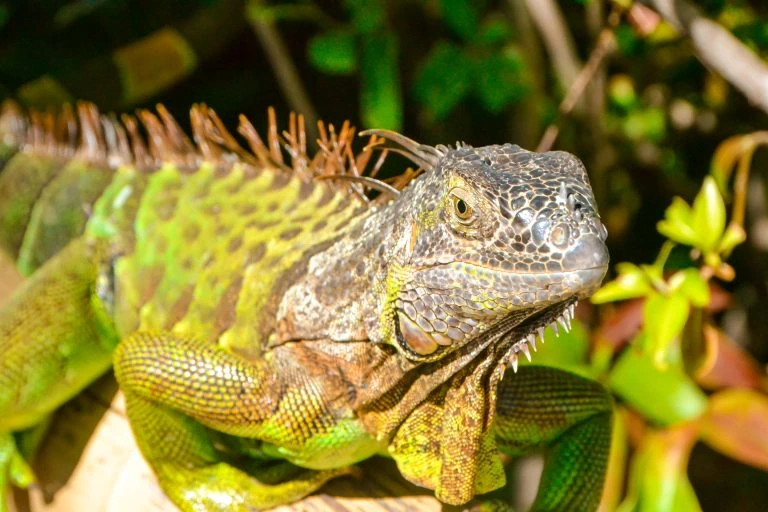
Green iguanas generally have a prominent dewlap, a row of back spines, a long tail and a distinctive large scale below the ear. Adults can be brown, dark or orange rather than bright green. UF/IFAS also documents established spiny-tailed iguanas in South Florida and discusses other large lizards that people misidentify as iguanas.
Do not assume every large lizard belongs to the species with the largest quoted maximum. Compare visible features with authoritative photographs or request qualified identification. A six-foot estimate is not evidence that a spiny-tailed species has reached the green iguana’s size range.
Our article about the biggest iguana on record is related reading, not independent verification of a record animal. Claims about seven-foot sightings or an official record need measurement and source documentation before they can be treated as fact.
Why Property Concerns Are Not a Size Contest
Green iguanas eat vegetation, including ornamental plants, and may leave droppings on decks, docks and pool areas. FWC and UF/IFAS describe burrowing that can erode soil around seawalls, sidewalks and foundations. Those risks deserve attention whether or not an animal reaches a headline length.
Visible holes or cracks do not establish that one large male caused structural damage. Identify recurring activity and have unstable structures assessed by a qualified structural professional. Removing an animal does not repair erosion or certify a foundation. Avoid unsupported rules such as “larger animal equals deeper burrow” or “one six-foot iguana guarantees seawall collapse.”
General traits discussed in our guide to adaptations that allow iguanas to grow so large should not be read as evidence that local animals have unlimited food, no predators or uninterrupted growth.
Keep Distance and Document the Encounter
UF/IFAS describes adult iguanas as powerful animals that can bite, scratch and strike with their tails when caught or cornered. Keep pets from chasing them and give the animal space. Do not approach for a better scale comparison or attempt to lift it out of vegetation.
- Take a photograph only if it is possible without approaching.
- Record the location, date and whether the sighting is recurring.
- Describe visible feeding damage or droppings separately from suspected structural problems.
- Keep people away from unstable seawall edges and contaminated areas.
CDC explains that reptiles can carry Salmonella even when healthy and that contaminated environments can spread germs. Wash hands after accidental contact with affected surfaces. Size does not tell you whether a particular animal carries a pathogen.
Arrange a Site Assessment, Not a DIY Capture
Do not feed iguanas. Discuss protecting valued plants and reducing attractants with a qualified professional. Leave unidentified burrows open for assessment rather than filling them while an animal may be inside. Major vegetation or shoreline changes may also need site-specific advice.
On Demand Pest Control can discuss your observations, property concerns and service availability. A quote should define the proposed scope without promising permanent elimination or a particular outcome based solely on an estimated length.
Under current FWC guidance, green iguanas may be humanely killed on private property with landowner permission, subject to anti-cruelty law. They are prohibited species; live captured possession for eradication and control requires a permit, and captured animals cannot be relocated and released elsewhere in Florida. This is policy context, not handling or killing instructions. A qualified wildlife professional should assess species, lawful handling and access before work proceeds.
Frequently Asked Questions
-
Are six foot iguanas dangerous to pets?
A large iguana can injure a pet if chased, caught or cornered; UF/IFAS describes bites, scratches and tail strikes. Keep pets away and supervised. The risk does not require a verified six-foot measurement.
-
How much does a six foot iguana weigh?
An exact weight cannot be reliably inferred from an estimated six-foot length. FWC reports male green iguanas weighing up to 17 pounds as species context, not as a six-foot conversion.
-
Is it legal to kill a six foot iguana on my property in Florida?
FWC’s current green iguana guidance allows humane killing on private property with landowner permission, subject to anti-cruelty law. Live captured possession for eradication and control requires a permit, and relocation and release elsewhere in Florida are prohibited. This is not a DIY instruction; consult a qualified wildlife professional and current FWC rules.
-
How do I know if the iguana in my yard is actually six feet long?
A distant photograph usually supports an estimate, not an exact measurement. Total length includes the tail; perspective, posture and an obscured or shortened tail can mislead. Do not approach or restrain the animal to measure it. Label any sighting size as estimated.
-
Can a six foot iguana damage my seawall or foundation?
Burrowing by green iguanas can erode soil around seawalls and foundations, according to FWC and UF/IFAS. That does not prove the cause of a particular crack or collapse. Have animal activity assessed separately from structural damage by appropriately qualified professionals.
-
What attracts six foot iguanas to residential properties?
Food plants, basking surfaces and shelter can support recurring activity, and nearby water can provide an escape route. UF/IFAS advises against feeding iguanas. A site-specific assessment is more useful than assuming every large animal is attracted by the same feature.
Sources and Further Reading
FWC green iguana profile provides current Florida distribution, impacts and policy context. UF/IFAS landscape guidance supports behavior and damage descriptions; its older control-policy text is not used instead of current FWC rules. CDC reptile health guidance supports hygiene precautions. Animal Diversity Web’s green iguana account provides head-to-tail size context.
Get help with an iguana concern.
Tell us what you are seeing. Our team can discuss the concern and the next step.
- Share your concern and contact details.
- Our team contacts you to discuss available service.
- Ask for a written scope and quote before work.
Where can we reach you?
Our team will call to confirm the next step.
By submitting, you’re asking On Demand Pest Control to contact you about this request.
↗ Prefer to call? (954) 947-0805