Table of Contents
ToggleKey Takeaways
- TAP pest control insulation is a blown-in cellulose product treated with borate that kills common household pests on contact.
- It provides superior thermal performance compared to standard fiberglass batts while also acting as a continuous pest barrier.
- TAP insulation is EPA-registered, fire-retardant, and safe for families and pets when installed in attic spaces.
- Professional installation over existing insulation is possible, making it a cost-effective upgrade for older homes.
- Pests such as ants, cockroaches, silverfish, and termites are among the many insects controlled by TAP insulation.
TAP pest control insulation offers homeowners something no other attic product can — a single material that stops heat transfer and kills insects at the same time. If you have ever dealt with ants, cockroaches, or silverfish nesting in your attic, you already know that traditional insulation does nothing to discourage them. In fact, fiberglass batts can actually shelter pests by giving them warm, undisturbed hiding spots. TAP (Thermal Acoustical Pest Control) insulation flips that dynamic entirely. It turns your attic into an active defense zone where insects that crawl through it are eliminated before they can establish colonies. In this guide, you will learn exactly how TAP works, which pests it targets, how it compares to standard insulation, and what to expect during installation.
What Is TAP Pest Control Insulation?
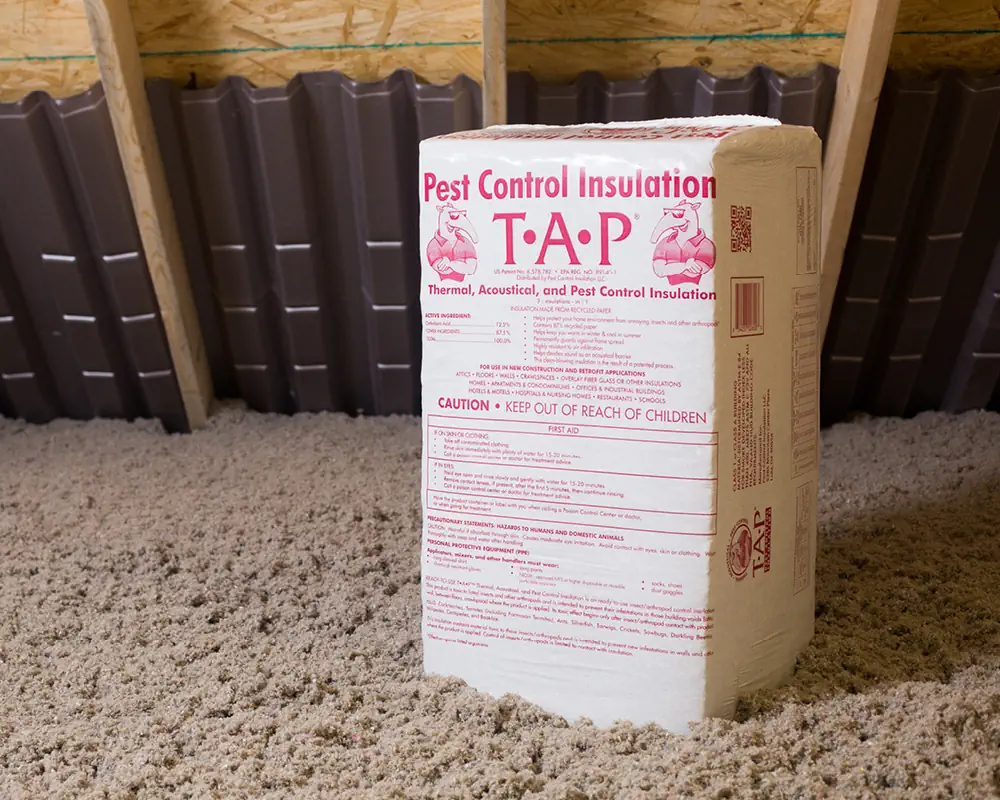
TAP stands for Thermal Acoustical Pest Control. It is a loose-fill cellulose insulation made from recycled newsprint that has been treated with a borate-based pesticide. The material is blown into attic spaces using professional equipment, settling into every gap, crack, and crevice that rolled insulation would miss.
What sets TAP apart from regular cellulose is the active ingredient. Boric acid, a naturally occurring mineral compound, is infused throughout every fiber. When insects crawl through the insulation, microscopic borate particles cling to their bodies. These particles damage the pest’s exoskeleton and disrupt its digestive system after grooming. The result is death within days of contact — no sprays, no traps, and no additional treatments required.
TAP insulation is registered with the U.S. Environmental Protection Agency (EPA) as a pesticide product. Despite that classification, borates pose extremely low toxicity risk to humans and pets. The product has been used in residential settings for over two decades with an excellent safety record.
Key Ingredients and How Borates Kill Pests
Borates work through two mechanisms. First, when an insect walks through treated cellulose, fine particles adhere to its legs, antennae, and body. The insect instinctively grooms itself and ingests the borate. Second, borates interfere with the insect’s ability to extract nutrition from food, essentially starving it at the cellular level.
Because this process is mechanical and metabolic rather than chemical in the traditional sense, insects cannot develop resistance to borates. This makes TAP pest control insulation a long-term solution that does not lose effectiveness over time.
Which Pests Does TAP Insulation Control?
TAP insulation is effective against a broad spectrum of household pests. The EPA label lists over a dozen insect species that borates target. Here are the most common ones homeowners encounter:
- Ants — including fire ants, carpenter ants, and Argentine ants
- Cockroaches — American cockroaches and German cockroaches
- Silverfish — a common attic-dwelling pest that feeds on paper and fabric
- Termites — including subterranean and drywood species
- Crickets — often found in insulation seeking warmth
- Earwigs — attracted to moisture in poorly ventilated attics
- Darkling beetles and booklice
It is important to understand that TAP insulation works against insects that physically pass through it. Flying insects that do not crawl through attic insulation, such as mosquitoes, will not be affected. Similarly, rodents like rats and mice are too large for borate particles to impact their systems meaningfully.
How Does TAP Compare to Standard Insulation?
Homeowners often wonder whether TAP pest control insulation delivers the same thermal performance as conventional products. The answer is that it actually outperforms standard fiberglass batts in several key areas. For a deeper comparison, see our breakdown of TAP versus standard cellulose insulation.
Thermal Performance Comparison
| Feature | TAP Insulation | Fiberglass Batts | Standard Cellulose |
|---|---|---|---|
| R-Value per Inch | 3.6 – 3.8 | 2.9 – 3.8 | 3.2 – 3.8 |
| Pest Control | Yes (EPA-registered) | No | No |
| Fire Resistance | Class 1 rated | Non-combustible | Class 1 rated |
| Gap Coverage | Fills all voids | Leaves gaps at seams | Fills all voids |
| Sound Dampening | Excellent | Good | Excellent |
Because TAP is blown in rather than rolled out, it fills around wiring, pipes, and irregular framing members. This eliminates thermal bridging — the gaps in coverage that fiberglass batts leave behind. Those gaps can account for 20–30 percent of attic heat loss.
Energy Savings Over Time
According to industry data, properly insulated attics can reduce heating and cooling costs by 20 to 40 percent. Since TAP insulation delivers a comparable or better R-value per inch than competing products, homeowners get strong energy returns. The pest control benefit is essentially a bonus that eliminates the need for separate attic pest treatments.
For a more comprehensive look at how different attic products stack up, explore our guide to types of attic insulation and why TAP reigns supreme.
Is TAP Pest Control Insulation Safe for Your Family?
Safety is one of the most common concerns homeowners raise. Understandably, the idea of a pesticide in your attic gives some people pause. However, the safety profile of TAP insulation is well established.
- Borates are low-toxicity. Boric acid is the same compound used in eye wash solutions and laundry boosters. Its toxicity to mammals is lower than table salt when measured by LD50 (the standard dose required to cause harm).
- Installed above the living space. TAP sits on the attic floor, separated from your living areas by drywall ceilings. There is no off-gassing or airborne exposure during normal conditions.
- Fire-retardant. Unlike untreated cellulose, TAP is treated to achieve a Class 1 fire rating. It will not ignite from electrical sparks or overheated recessed lighting fixtures.
- No formaldehyde. Many fiberglass insulation products contain formaldehyde-based binders. TAP insulation does not.
Professional installers wear respiratory protection during application because the blowing process creates airborne dust. Once the material settles, it poses no inhalation risk to the people living below.
How Is TAP Insulation Installed in Your Attic?
TAP pest control insulation must be installed by a licensed pest control professional — not a general contractor or insulation company. This is because the borate treatment classifies it as a registered pesticide product. The installation process is straightforward but requires specialized equipment.
Step-by-Step Installation Process
- Attic inspection: A technician evaluates your current insulation depth, checks for pest activity, identifies moisture issues, and measures ventilation.
- Preparation: If old insulation is contaminated or damaged, it may need removal. In most cases, TAP is blown directly over existing insulation to add depth and pest protection.
- Air sealing: Before blowing, the technician seals gaps around plumbing penetrations, electrical boxes, and HVAC ductwork. This prevents conditioned air from escaping and pests from entering.
- Blowing the insulation: Using a commercial blowing machine, the technician distributes TAP evenly across the attic floor. Depth is measured at multiple points to ensure consistent R-value.
- Final inspection: The technician verifies coverage depth, checks that no vents are blocked, and documents the installation for warranty purposes.
Most attic installations for an average-sized home take between two and four hours. There is minimal disruption to your daily routine, and the attic is ready immediately after installation.
Can You Add TAP Over Existing Insulation?
Yes. One of the biggest advantages of TAP insulation is its ability to layer over fiberglass batts or existing cellulose. This means you do not have to tear out your current insulation to get the pest-control benefit. The new TAP layer adds R-value and creates a pest barrier on top of whatever material is already there.
However, if your existing insulation is heavily soiled by rodent droppings, mold, or water damage, removal is recommended before adding fresh material. A qualified technician can advise you during the initial inspection.
How Long Does TAP Pest Control Insulation Last?
TAP insulation is designed to last the lifetime of your home. Unlike chemical pest treatments that degrade within months, the borate compound in TAP does not evaporate, break down from UV exposure, or lose potency. As long as the insulation remains dry and undisturbed, it continues to provide pest control and thermal performance indefinitely.
There is no need for reapplication or periodic retreatment. Compare that to perimeter sprays or bait stations that need quarterly maintenance, and the long-term value becomes clear. You pay once for installation and receive decades of protection.
The only scenario that would require replacement is significant water intrusion — a roof leak, for example — that saturates the insulation. In that case, the damaged section would be removed and replaced. Routine roof maintenance prevents this from becoming an issue.
What Are the Cost Benefits of TAP Insulation?
Homeowners naturally want to know whether TAP pest control insulation justifies its price. The upfront cost is typically higher than standard blown-in cellulose but comparable to spray foam for the same coverage area. Here is how the economics break down over time:
- Energy savings: A well-insulated attic reduces HVAC runtime, lowering monthly utility bills by an estimated 20–40 percent.
- Eliminated pest treatments: If you currently pay for quarterly or annual attic pest control, that recurring expense disappears.
- Tax credits and utility rebates: Some local utilities and federal programs offer incentives for improving home insulation. TAP qualifies for many of these programs because it meets ENERGY STAR standards.
- Increased home value: Updated insulation is a selling point during home inspections. Buyers appreciate the dual benefit of energy efficiency and built-in pest protection.
When you factor in energy savings, eliminated pest treatment costs, and potential rebates, most homeowners recoup their investment within three to five years.
Why Choose Professional TAP Insulation Installation?
Because TAP is an EPA-registered pesticide, only licensed professionals can install it. This is not a weekend DIY project. Beyond the legal requirement, professional installation ensures proper coverage depth, correct air sealing, and compliance with local building codes.
A trained technician also knows how to evaluate your attic for underlying issues — pest infestations, moisture problems, and ventilation deficiencies — that could undermine the performance of new insulation. Addressing these problems before installation protects your investment and maximizes the lifespan of the product.
If you are ready to upgrade your attic with a material that works harder than traditional insulation, professional TAP installation delivers measurable results from day one. Reach out to a licensed pest control provider who carries the TAP product to get an attic evaluation and a customized quote for your home.
Frequently Asked Questions
-
Does TAP pest control insulation work on rodents like mice and rats?
No. TAP insulation is effective against insects that crawl through it, such as ants, cockroaches, silverfish, and termites. Rodents are too large for the borate particles to affect their systems. Separate rodent exclusion measures are necessary for mice and rats.
-
How much does TAP insulation cost compared to fiberglass?
TAP insulation typically costs more per square foot than fiberglass batts but delivers better gap-free coverage and built-in pest control. When you account for eliminated pest treatment expenses and energy savings, the total cost of ownership is often lower over a five-year period.
-
Can TAP insulation be installed in walls or only in attics?
TAP insulation is primarily designed for attic applications where it is blown over the attic floor. While cellulose can technically be dense-packed into wall cavities, the EPA registration for TAP specifically covers attic use. Consult your installer about wall options.
-
Will TAP insulation lose its pest-killing effectiveness over time?
No. The borate compound in TAP does not evaporate, degrade from sunlight, or lose potency under normal conditions. As long as the insulation stays dry and in place, it continues to control pests indefinitely without reapplication.
-
Is TAP insulation safe if I have pets or young children?
Yes. Boric acid has very low toxicity to mammals and is the same compound found in common household products like eye wash. TAP insulation sits on the attic floor, separated from living spaces by drywall, so there is no exposure risk during daily activities.
-
Do I need to remove my old insulation before installing TAP?
In most cases, no. TAP insulation can be blown directly over existing fiberglass or cellulose to add R-value and pest protection. However, if existing insulation is contaminated by mold, water damage, or heavy rodent activity, removal is recommended first.