
Key Takeaways
- Iguanas in Florida Keys have established large breeding populations that threaten native wildlife, infrastructure, and landscaping across the island chain.
- Green iguanas are the most common species in the Keys, but black spiny-tailed iguanas also appear in certain areas.
- The tropical climate of the Keys provides year-round warmth that allows iguanas to breed continuously without the cold snap die-offs seen in mainland Florida.
- Property damage from iguana burrows can undermine seawalls, foundations, and canal banks throughout Key West and surrounding islands.
- Professional iguana removal is the most effective solution for Keys residents dealing with persistent iguana populations on their property.
Iguanas in Florida Keys have become one of the most visible and disruptive invasive species challenges in the entire state. If you live anywhere from Key Largo to Key West, you already know the sight of large green lizards sunning on sidewalks, raiding gardens, and digging burrows along seawalls. These reptiles aren't just a nuisance — they cause real damage to native ecosystems, residential properties, and public infrastructure. The island geography of the Keys makes the problem uniquely difficult to manage because iguanas swim between islands, spread rapidly, and face almost no natural predators. This guide covers everything Keys residents need to know about the iguana population, the damage these animals cause, and the most effective strategies for managing them on your property.
Why Are Iguanas in the Keys Such a Major Problem?
The Florida Keys provide near-perfect conditions for invasive iguanas to thrive. Temperatures rarely drop below 60°F, even during the coldest winter nights. On mainland Florida, periodic cold snaps can knock iguana populations back temporarily when the cold-blooded reptiles become immobilized and fall from trees. In the Keys, that natural population check barely exists.
The surrounding ocean moderates temperatures year-round. This means iguanas in the Keys breed continuously across multiple seasons, producing clutches of 20 to 70 eggs several times per year. Without freezing events to thin the population, numbers climb rapidly. Understanding the full scope of the statewide iguana problem in Florida helps put the Keys situation into broader context.
Limited Land Area Concentrates the Population
The Keys are a narrow chain of islands with limited green space. Unlike sprawling suburban developments on the mainland, the Keys pack homes, businesses, and vegetation into tight corridors. Iguanas concentrate in these areas because food sources — ornamental plants, fruit trees, and vegetable gardens — sit close together. A single property might host dozens of iguanas because every neighbor's yard offers additional food and shelter.
Swimming Spreads the Problem Between Islands
Many people don't realize that iguanas are strong swimmers. They use their powerful tails to propel themselves through saltwater channels between islands. This ability means that even if one island manages to reduce its iguana population, recolonization from neighboring keys happens quickly. The interconnected waterways that define the Keys geography actually help iguanas spread rather than contain them.
Which Iguana Species Live in the Florida Keys?
The most common species you'll encounter is the green iguana (Iguana iguana). These are the large, bright green to grayish-green lizards that can grow over five feet long and weigh more than 15 pounds. Adult males often develop orange coloring during breeding season, which sometimes confuses residents who think they're seeing a different species entirely. To learn more about the iguana species found in the Florida Keys and beyond, it helps to understand how each species behaves and spreads.
Green Iguanas Dominate the Keys
Green iguanas arrived in South Florida through the exotic pet trade decades ago. Released or escaped pets established breeding populations that gradually expanded southward into the Keys. Today, they're the dominant invasive lizard species across the entire island chain. You'll find them in residential yards, commercial properties, marinas, parks, and along every canal bank.
Their diet is primarily herbivorous. They consume flowers, leaves, fruits, and vegetables. In the Keys, they target hibiscus, bougainvillea, orchids, mangoes, and nearly every ornamental plant that homeowners value. They also eat native vegetation that supports local wildlife, creating a ripple effect through the ecosystem.
Black Spiny-Tailed Iguanas in Key West
Key West iguanas include a secondary species that some residents encounter: the black spiny-tailed iguana (Ctenosaura similis). These are smaller and faster than green iguanas, with darker coloring and distinctive spiny ridges along their tails. Black spiny-tailed iguanas are more omnivorous than their green cousins, meaning they eat insects, smaller lizards, bird eggs, and even small vertebrates in addition to plant material.
This dietary flexibility makes them an even greater threat to native wildlife. They've been documented raiding the nests of ground-nesting birds and consuming the eggs of endangered species like the Miami blue butterfly's host plants.
What Damage Do Iguanas Cause to Keys Properties?
Property damage from iguanas in the Florida Keys goes well beyond chewed-up gardens. The structural and financial impact surprises many homeowners who initially view these reptiles as harmless wildlife.
Burrowing Undermines Critical Infrastructure
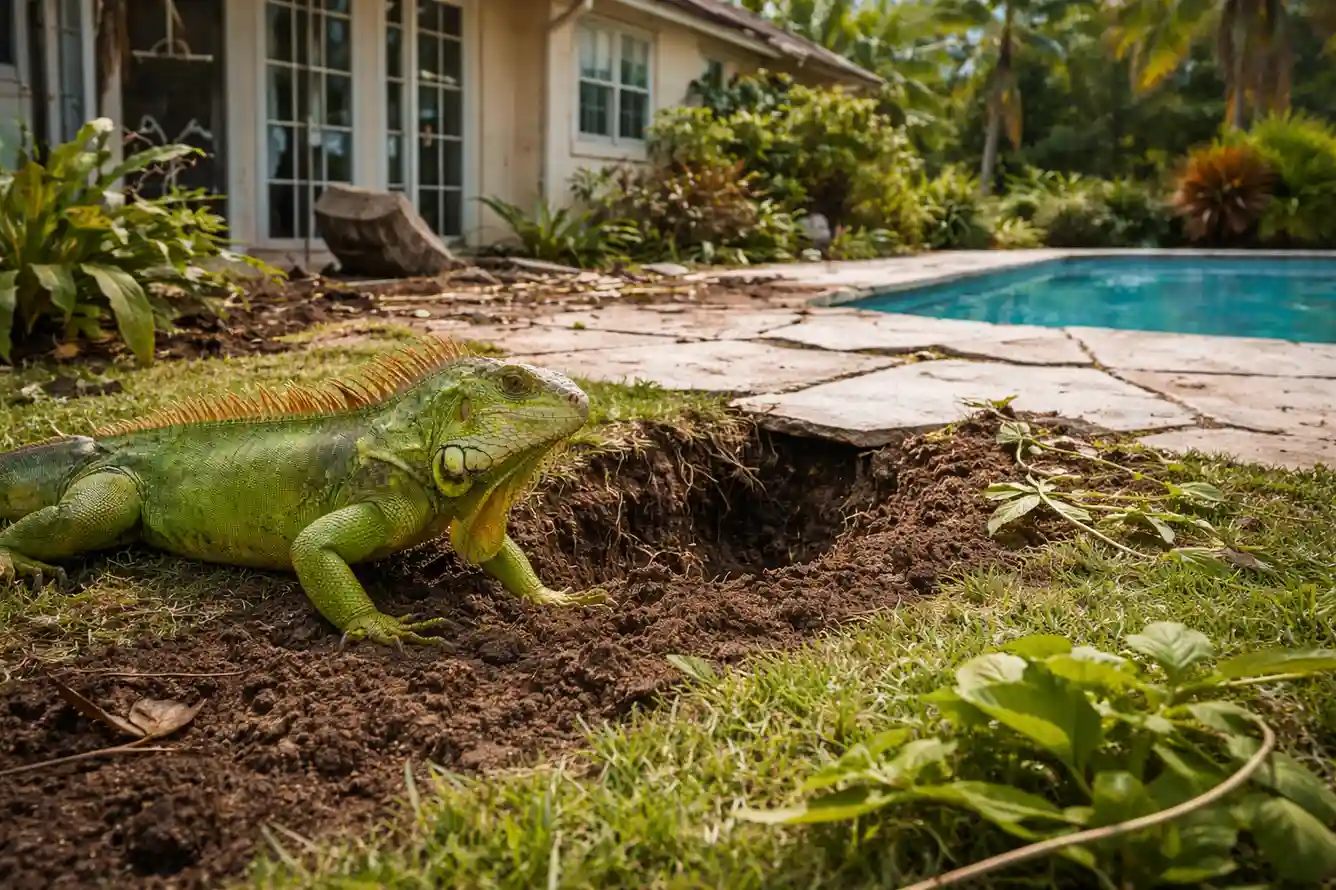
Iguanas dig extensive burrow networks for nesting and shelter. In the Keys, where seawalls and canal banks protect properties from tidal flooding, these burrows create serious structural vulnerabilities. A single female iguana can excavate a burrow system several feet deep and many feet long. When multiple iguanas burrow into the same seawall, the cumulative erosion weakens the structure from within.
Seawall repairs in the Keys can cost thousands of dollars. Foundation damage from burrowing near homes or commercial buildings adds even more expense. Some properties along canals in Key West and Marathon have experienced partial seawall collapses directly attributable to iguana burrowing activity.
Landscape and Garden Destruction
Iguanas strip vegetation quickly and thoroughly. A group of five or six adult iguanas can defoliate a mature hibiscus hedge overnight. In the Keys, where lush tropical landscaping is part of property values and community character, this destruction hits homeowners hard. Replacing mature plants repeatedly becomes expensive and frustrating.
Common targets include:
- Hibiscus flowers and buds
- Bougainvillea
- Orchids and bromeliads
- Mango and papaya fruit
- Vegetable gardens — especially leafy greens
- Roses and other ornamental flowering plants
Iguana Droppings Create Health Concerns
Iguana feces carry Salmonella bacteria. When iguanas defecate on pool decks, patios, docks, and outdoor dining areas — all common in the Keys lifestyle — they create potential health hazards. Residents with young children or compromised immune systems face heightened risk. Swimming pools contaminated by iguana droppings require thorough cleaning and chemical treatment before safe use.
The droppings also stain concrete, wood decking, and boat surfaces. For Keys residents who spend significant time outdoors, cleaning up after iguanas becomes a daily chore.
How Do Iguanas in Key West FL Affect Native Wildlife?
The ecological impact of iguanas in Key West FL and throughout the Keys extends far beyond property damage. These invasive reptiles directly compete with and prey upon native species that evolved without large herbivorous lizards in their environment.
Competition With Native Species
The Keys support several threatened and endangered species that share habitat with invasive iguanas. Native tree snails, butterflies, and ground-nesting birds all face increased pressure from iguana populations. When iguanas consume native vegetation, they remove food sources and shelter that native wildlife depends on.
The endangered Key West quail dove, various native butterflies, and the Lower Keys marsh rabbit all inhabit areas where iguanas have established dense populations. While iguanas don't directly prey on most of these species, habitat destruction through overgrazing creates indirect harm.
Disruption of Native Plant Communities
Many native Keys plants evolved in an environment without large herbivorous reptiles. They lack the chemical defenses or growth strategies to recover from sustained iguana feeding. As iguanas consume native vegetation faster than it regenerates, plant communities shift toward species that iguanas avoid — many of which are themselves invasive exotics.
This creates a cascading ecological problem. Native plants disappear, native insects and birds that depend on those plants decline, and the entire food web shifts in ways that favor invasive species over native ones.
What Laws Govern Iguana Management in the Keys?
Florida law classifies green iguanas as invasive species. The Florida Fish and Wildlife Conservation Commission (FWC) encourages property owners to remove iguanas from their land. However, specific regulations govern how removal must happen.
Legal Removal on Your Own Property
You can legally remove iguanas from your own property in the Keys without a special permit. However, all removal methods must be conducted humanely. Florida law requires that any iguana killed must be dispatched quickly and without unnecessary suffering. Drowning, freezing alive, and other inhumane methods are explicitly prohibited.
Rules for Public Land and Neighboring Properties
You cannot remove iguanas from someone else's property without permission. On public lands, regulations vary by managing agency. In Key West, the city has implemented various iguana management programs over the years with mixed results. Monroe County also addresses iguana issues on county-managed properties.
Ethical and Humane Considerations
Even though iguanas are invasive and destructive, responsible management requires humane methods. Trapping and professional removal services use methods approved by FWC guidelines. If you choose to handle removal yourself, research approved methods thoroughly before taking action.
What Are the Best Ways to Manage Key West Iguanas?
Managing key west iguanas effectively requires a combination of deterrence, exclusion, and direct removal. No single approach works perfectly, but combining methods produces the best results.
Habitat Modification
Reducing what attracts iguanas to your property is the first step. Remove fallen fruit promptly. Trim trees and hedges away from rooflines and fences — iguanas use overhanging branches as highways between properties. Fill existing burrow entrances with rock or concrete to discourage re-use.
Consider replacing the most iguana-attractive plants with species they avoid. Iguanas generally dislike:
- Citrus trees (leaves are unpalatable)
- Oleander
- Milkweed
- Crotons (certain varieties)
- Pigeon plum
However, in the Keys' dense residential environment, your neighbor's garden may still attract iguanas that wander onto your property regardless of your landscaping choices.
Physical Barriers and Exclusion
Protecting specific plants or garden beds with wire mesh caging can prevent iguana feeding damage. Sheet metal wraps around tree trunks stop iguanas from climbing to reach fruit or nesting sites in canopies. Seawall caps and mesh barriers over burrow-prone areas can reduce structural damage.
These physical barriers work well for targeted protection but become impractical when trying to exclude iguanas from an entire property. The animals are agile climbers and determined diggers that eventually find ways around most barriers.
Professional Trapping and Removal
For most Keys residents dealing with significant iguana populations, professional removal services deliver the most effective results. Licensed trappers understand iguana behavior, know the most productive trapping locations, and can humanely remove large numbers of animals efficiently.
Professional services typically use cage traps, snares, and in some cases, capture poles. Regular service visits work better than one-time removals because neighboring iguanas quickly recolonize cleared areas. Many Keys properties require ongoing management rather than a single intervention.
How Does the Keys Climate Make the Iguana Problem Unique?
The subtropical climate of the Florida Keys creates conditions that differ meaningfully from mainland South Florida, and those differences matter for iguana management.
Ocean-Moderated Temperatures Eliminate Cold Events
While Fort Lauderdale or West Palm Beach might experience overnight lows in the 30s or 40s during strong cold fronts, the Keys rarely see temperatures below the mid-50s. Surrounding ocean water acts as a thermal buffer, keeping island temperatures warmer than inland areas at the same latitude.
For iguanas, this means the periodic die-offs that temporarily reduce populations on the mainland simply don't happen in the Keys. Cold-stunned iguanas falling from trees — a regular January spectacle in parts of mainland South Florida — is an extremely rare event on the islands.
Year-Round Breeding Pressure
Without cold-induced dormancy periods, iguanas in the Keys maintain active metabolism and breeding behavior across more months of the year. Females can produce multiple clutches annually. Combined with high egg survival rates in the warm, humid Keys environment, population growth rates exceed those seen in cooler parts of the iguana's Florida range.
A single female green iguana can lay 20 to 70 eggs per clutch. Even with predation on eggs by raccoons and other animals, enough hatchlings survive to sustain rapid population growth. Within a few years, a small founding group can balloon into a large colony.
Salt Tolerance Enables Island Hopping
The marine environment of the Keys would seem like a natural barrier to iguana spread. In reality, green iguanas tolerate saltwater well. They've been documented swimming between islands separated by open water. This salt tolerance, combined with their strong swimming ability, means that eradication efforts on individual islands face constant reintroduction pressure from neighboring populations.
What Should You Do If Iguanas Are on Your Keys Property?
If you're a Keys homeowner or property manager dealing with iguanas, taking a systematic approach produces better long-term results than reactive, one-off efforts.
Assess the Scope of the Problem
Before taking action, understand what you're dealing with. Count how many iguanas you regularly see on your property. Note where they feed, bask, and burrow. Check seawalls and foundations for burrow holes. Document plant damage. This assessment helps determine whether DIY methods might work or whether professional intervention is needed.
Start With Prevention and Deterrence
Remove food attractants first. Pick up fallen fruit daily. Protect vegetable gardens with physical caging. Trim vegetation that provides climbing access to roofs and walls. Fill small burrow openings before they become major tunnel systems.
Call a Professional When Numbers Are High
If you're seeing more than a handful of iguanas regularly, or if burrow damage threatens seawalls or foundations, contact a professional iguana removal service. The cost of professional trapping is typically far less than the cost of repairing structural damage from unchecked burrowing.
Keys-based and South Florida removal companies understand the unique challenges of island-based iguana management. They can set up recurring service plans that keep populations manageable rather than waiting for the problem to spiral.
How Does Iguana Management Differ Across the Keys?
Iguanas in the Keys aren't distributed evenly. Population density and management challenges vary by location within the island chain. Consulting a regional map of iguana populations in Florida can help illustrate how density shifts from the Upper Keys down to Key West.
Upper Keys: Key Largo to Islamorada
The Upper Keys have closer connections to mainland populations. Iguanas can potentially travel from the mainland through the upper island chain. Population densities here are significant, though slightly less concentrated than in Key West because properties tend to have more space between them.
Middle Keys: Marathon and Surrounding Islands
Marathon has seen substantial iguana population growth in recent years. The mix of residential properties, commercial areas, and natural habitat creates ideal conditions. Canals and seawalls throughout Marathon provide prime burrowing sites.
Lower Keys and Key West
Key West has the densest iguana populations in the entire Keys chain. The compact urban environment, abundant ornamental landscaping, heavy tourist activity (which sometimes leads to feeding), and warm microclimate all support large numbers. Key West's historic district, with its lush gardens and old stone walls, provides exceptional iguana habitat.
Some Key West residents have lived alongside iguanas for so long that they view them as part of the island's character. Others are frustrated by escalating property damage. This split in attitudes sometimes complicates community-level management efforts.
Frequently Asked Questions
-
How did iguanas first arrive in the Florida Keys?
Iguanas arrived in the Keys through a combination of the exotic pet trade and natural dispersal from mainland South Florida populations. Released or escaped pet iguanas established breeding colonies that expanded over decades. Some iguanas likely swam or rafted to the Keys from established populations in Miami-Dade and Broward counties.
-
Are iguanas in the Keys dangerous to people or pets?
Iguanas generally avoid direct confrontation with people, but they can bite or tail-whip if cornered or handled. Large males can deliver painful bites that may require medical attention. Their droppings carry Salmonella, which poses a health risk, especially for children and immunocompromised individuals. Small pets should be supervised around large iguanas.
-
Can the iguana population in the Keys ever be fully eradicated?
Complete eradication is extremely unlikely given the current population size, the iguanas' ability to swim between islands, and their high reproductive rate. However, consistent management through trapping, habitat modification, and community-wide efforts can keep populations at manageable levels and reduce property damage significantly.
-
How much does professional iguana removal cost in the Keys?
Costs vary depending on the severity of the infestation and the property's size. Most professional services in the Keys charge between $150 and $500 per visit, with recurring service plans offering lower per-visit rates. Severe infestations on large properties with extensive seawall damage may require higher investment for initial population reduction.
-
Do iguanas in the Keys carry diseases?
The primary disease concern is Salmonella, which iguanas carry in their intestinal tracts and shed through their feces. Direct contact with iguana droppings or surfaces contaminated by droppings can transmit the bacteria. Always wash hands thoroughly after any contact with iguanas or areas where they've been active.
-
What time of year are iguanas most active in the Keys?
Because the Keys maintain warm temperatures year-round, iguanas remain active across all seasons. However, breeding season — typically late fall through spring — sees increased territorial behavior, more visible displays from males, and heightened egg-laying activity from females. You may notice more iguanas basking in open areas and more aggressive interactions between males during this period.