
Identify common spider types, reduce insect prey and hiding places, repair suitable entry gaps and know when a spider or suspected bite needs expert attention.
A circular web over a hedge and a fast-moving spider in the garage are different situations. Most spiders are predators of insects, and a sighting does not prove a dangerous infestation. For a Coral Springs home, start with the spider type, its location and the conditions supporting it.
Compare orb weavers, banana spiders, widows and huntsman spiders
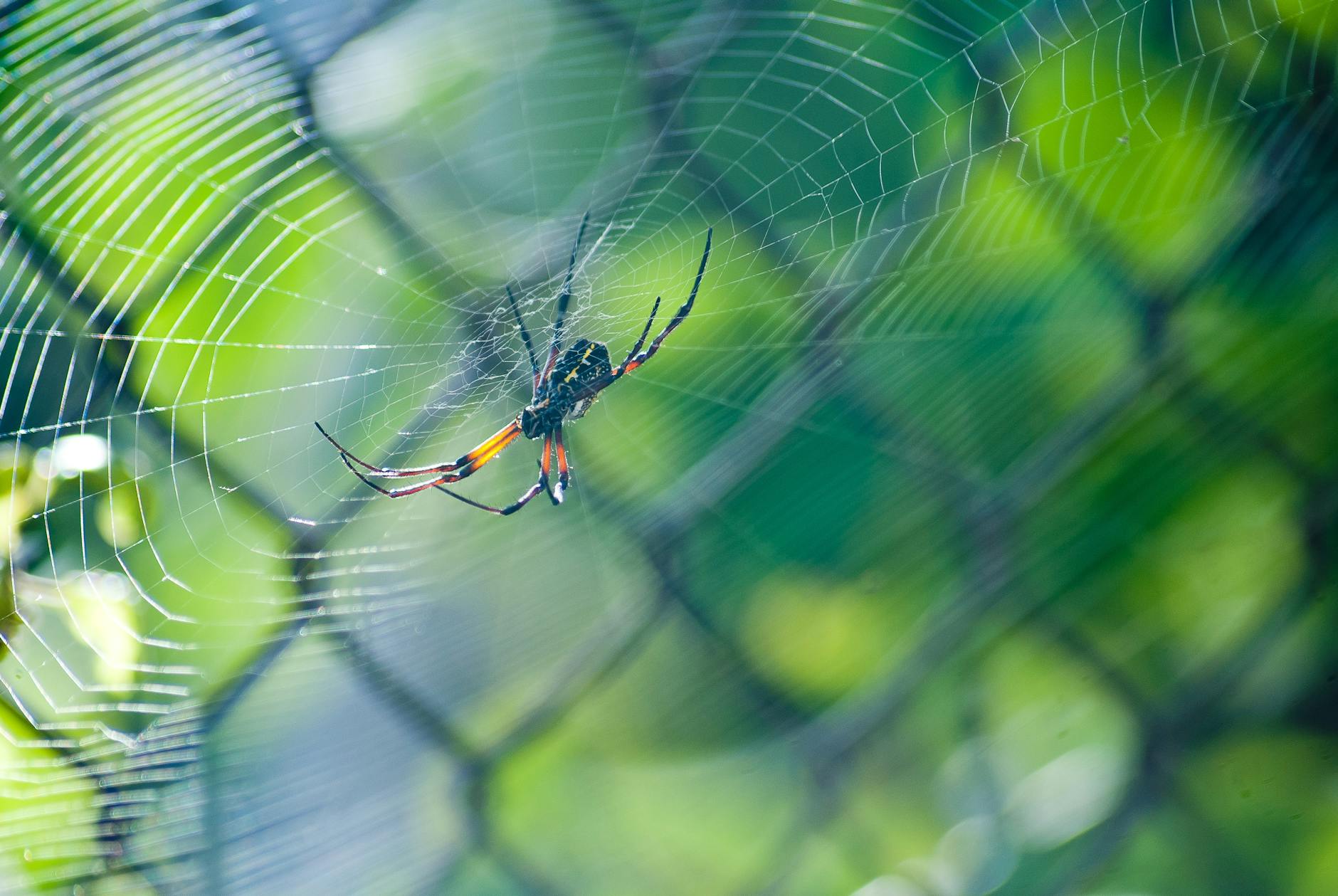
Orb weavers build circular capture webs in vegetation or around structures. The golden silk orb weaver is one spider called a “banana spider,” but common names can be ambiguous. These conspicuous webs are different from the irregular, sheltered webs associated with widows.
Widow spiders need more caution because their venom can be medically significant. Do not reach into a dark storage space or turn a spider over to inspect its underside. A distant photograph can help an expert; an hourglass-like impression in a blurry photo does not establish a species.
Huntsman spiders are hunting spiders rather than circular-web builders. Their size and speed can be alarming, but size alone is not a measure of medical risk. Compare orb weavers, banana spider concerns, widow precautions and huntsman identification by actual characteristics, not by a promise that every member of a group is harmless.
Spider biology, prey and household activity
Spiders have eight legs, two main body regions, and no wings or antennae. Many build webs to catch insects; others hunt without a capture web. They produce eggs in silk sacs, so a web and an egg sac have different meanings during an inspection.
The number of spiders indoors can reflect insect prey, entry openings, stored items or suitable hiding places. A web rebuilt after cleaning may represent one active spider rather than a large hidden population. Record where you see live spiders and fresh webs instead of inferring population size from old dusty silk.
Warm weather may permit activity, but spider activity in Coral Springs differs by species and site conditions. Canals, parks and particular neighborhoods are not a basis for ranking individual homes. The Florida spider guide offers background; the property’s observations should guide management.
Inspect entry points without compromising the building
Check screen tears, gaps around doors and windows, and accessible utility penetrations. Repair suitable openings with appropriate materials. Keep necessary dryer exhausts, ventilation, drainage and equipment clearances functioning; do not simply seal every visible hole.
Inspect plants, boxes and outdoor items before bringing them inside. A spider can arrive on an object even when the house has sound screens. Keep exterior doors and garage doors closed when practical, and inspect the door between an attached garage and living space.
After storm damage, review torn screens and displaced materials safely from accessible areas. Roof, electrical or structural repairs belong with qualified professionals. Exclusion reduces opportunities for entry and prey, but it cannot certify a house permanently free of spiders.
Reduce clutter, webs and contact risk
Keep storage organized and off the floor where practical, with sound closed containers and visible edges for inspection. Limit debris and dense plant contact at the foundation. The purpose is access and reduced hiding places, not a fixed twelve-inch vegetation rule for every plant.
Use regular cleaning for accessible empty webs. If a live spider, egg sac or an uncertain species is present, avoid barehanded handling and obtain identification or professional help when needed. Do not reach into pool equipment, meter boxes or electrical housings to remove a suspected widow.
Inspect shoes, gloves and stored items before use when they have been left undisturbed. Wear appropriate protection for ordinary cleanup, and keep children and pets away from a suspicious spider’s location. Cleaning can reduce harborage while leaving outdoor spiders away from occupied areas to perform their predator role.
Lighting and moisture: manage the conditions you find
Outdoor lighting can attract insects and, in turn, spiders. Where practical, keep unnecessary lights off and place fixtures away from doorways. Choose lighting that meets security needs; no bulb color guarantees a dramatic reduction at every home.
Repair leaks and manage standing water that supports insect problems. Moisture work should address the actual plumbing or drainage cause. It is not proof that spiders require a fixed high humidity level, and a dehumidifier alone will not close an entry gap.
Compare activity before and after each change. For example, record fresh webs at one doorway after altering the light and removing nearby clutter. If hunting spiders continue elsewhere, inspect that route instead of repeating a treatment intended for web builders.
Peppermint, vinegar, DE and cedar mulch have limits
Do not rely on a homemade peppermint or vinegar spray to prevent spider entry. Use exclusion, housekeeping and reduced hiding places as the practical foundation of prevention; scented mixtures do not replace those steps.
Cedar mulch is not a certified spider barrier, and loose food-grade diatomaceous earth is not automatically safe or effective for the proposed living-space application. Pesticide status and permitted sites come from the actual product label, not the word “natural.” Keep powders and sprays away from exposed food and places accessible to children and pets.
UC IPM explains that insecticides generally do not provide lasting outdoor spider control. Any treatment needs to complement housekeeping and inspection. Ask a provider how the treatment will address the identified species and what follow-up observations will show whether it helped.
When to seek pest-control or medical help
Request identification or professional inspection for suspected widows, repeated indoor activity, inaccessible locations or spiders near spaces used by children. Ask On Demand Pest Control in Coral Springs what was identified, whether prey or entry routes need correction, and what the proposed treatment can realistically accomplish.
A skin lesion alone is not a spider identification. If a suspected bite causes severe or unusual symptoms, increasing pain or marked swelling, contact a healthcare provider promptly. Do not delay medical assessment while trying to capture the spider or obtaining a pest treatment.
Keep pest observations separate from a clinical diagnosis. Record the location and timing and provide an existing photo if available. A provider can address household activity; medical care determines what caused a wound and what treatment is appropriate.
Frequently Asked Questions
-
What attracts spiders to homes in Coral Springs?
Insect prey, sheltered storage, nearby vegetation and entry openings can support spider activity. Inspect those conditions at the home instead of assuming a particular neighborhood has more spiders.
-
Are there venomous spiders in Coral Springs, Florida?
Yes. Spiders generally use venom to subdue prey, and widow spiders can be medically significant. Avoid handling an unidentified spider and seek expert identification for suspected widows.
-
How often should I spray for spiders in Coral Springs?
There is no universal spray interval. Exclusion, housekeeping and inspection often matter more than outdoor sprays. A provider should base any treatment and follow-up on the species, location and actual product label.
-
Does keeping lights off really reduce spiders around my house?
Outdoor lighting can attract insects and the spiders that feed on them. Reducing unnecessary lighting or moving it away from entrances may help, while preserving needed security lighting. It does not guarantee elimination.
-
Can landscaping changes help keep spiders away in Coral Springs?
Yes. Reduce clutter and dense vegetation touching the building, keep inspection access and check water-holding containers that support insect prey. Use plant-appropriate maintenance rather than a fixed distance or cedar-mulch guarantee.
Sources and further guidance
- Spiders / Home and Landscape / UC Statewide IPM Program (UC IPM)
- ENY2080/IN1366: An Introduction to Some Common and Charismatic Florida Spiders
- EENY-160/IN317: Pantropical Huntsman Spider, Heteropoda venatoria (Linnaeus) (Arachnida: Araneae: Sparassidae)
- Do’s and Don’ts of Pest Control | US EPA
- Venomous Spiders at Work | Outdoor | CDC
Get help with your pest concern.
Tell us what you are seeing. Our team can discuss the concern and the next step.
- Share your concern and contact details.
- Our team contacts you to discuss available service.
- Ask for a written scope and quote before work.
Where can we reach you?
Our team will call to confirm the next step.
By submitting, you’re asking On Demand Pest Control to contact you about this request.
↗ Prefer to call? (954) 947-0805