
Key Takeaways
- Iguana skin is covered in tough, keratinous scales that protect against predators, UV radiation, and water loss in Florida's subtropical climate.
- Shedding (ecdysis) happens regularly throughout an iguana's life and leaves behind dry, papery skin fragments across yards, pools, and patios.
- The texture, color, and condition of iguana skin vary by species, age, health, and environmental factors like temperature and humidity.
- Understanding iguana skin characteristics helps Florida homeowners identify species, gauge maturity, and recognize signs of an active iguana population on their property.
- Iguana scales serve multiple biological functions — from thermoregulation to territorial signaling — that help explain why these reptiles thrive so successfully in South Florida.
Iguana skin is one of the most distinctive and misunderstood features of these invasive reptiles now found across South Florida. Whether you've spotted a shed skin draped over your fence or noticed the rough, armored texture of a basking iguana up close, understanding their skin tells you a lot about the animal — its species, its health, and how well-adapted it is to your neighborhood. This guide covers everything Florida homeowners need to know about iguana skin texture, the shedding process, scale structure, color variations, and what discarded skin on your property actually means. By the end, you'll know how to identify what you're seeing and when it signals a bigger iguana problem.
What Makes Iguana Skin Unique Among Reptiles?
Iguana skin stands apart from the skin of many other reptiles because of its complex, layered scale structure and the variety of textures found across a single animal's body. Unlike snakes, which have smooth belly scales and overlapping dorsal scales, iguanas display a mosaic of scale types that serve different purposes depending on their location.
The skin itself is composed of two primary layers: the epidermis (outer layer) and the dermis (inner layer). The epidermis produces keratin — the same protein found in human fingernails — which hardens into the scales that give iguanas their armored appearance. Beneath the epidermis, the dermis contains blood vessels, nerves, and chromatophores (pigment-containing cells) responsible for iguana coloration.
Scale Types Found on Iguanas
Not all iguana scales are the same. Different body regions feature distinctly different scale types:
- Dorsal crest scales: The raised, spiny scales running along the iguana's back and tail are elongated and pointed. These serve as both defense mechanisms and display features during territorial encounters.
- Lateral body scales: The sides of the body are covered in smaller, granular scales that overlap slightly, creating a flexible but protective surface.
- Ventral scales: The belly features smoother, flatter scales that reduce friction when the iguana moves across surfaces like tree bark, concrete, or stucco walls.
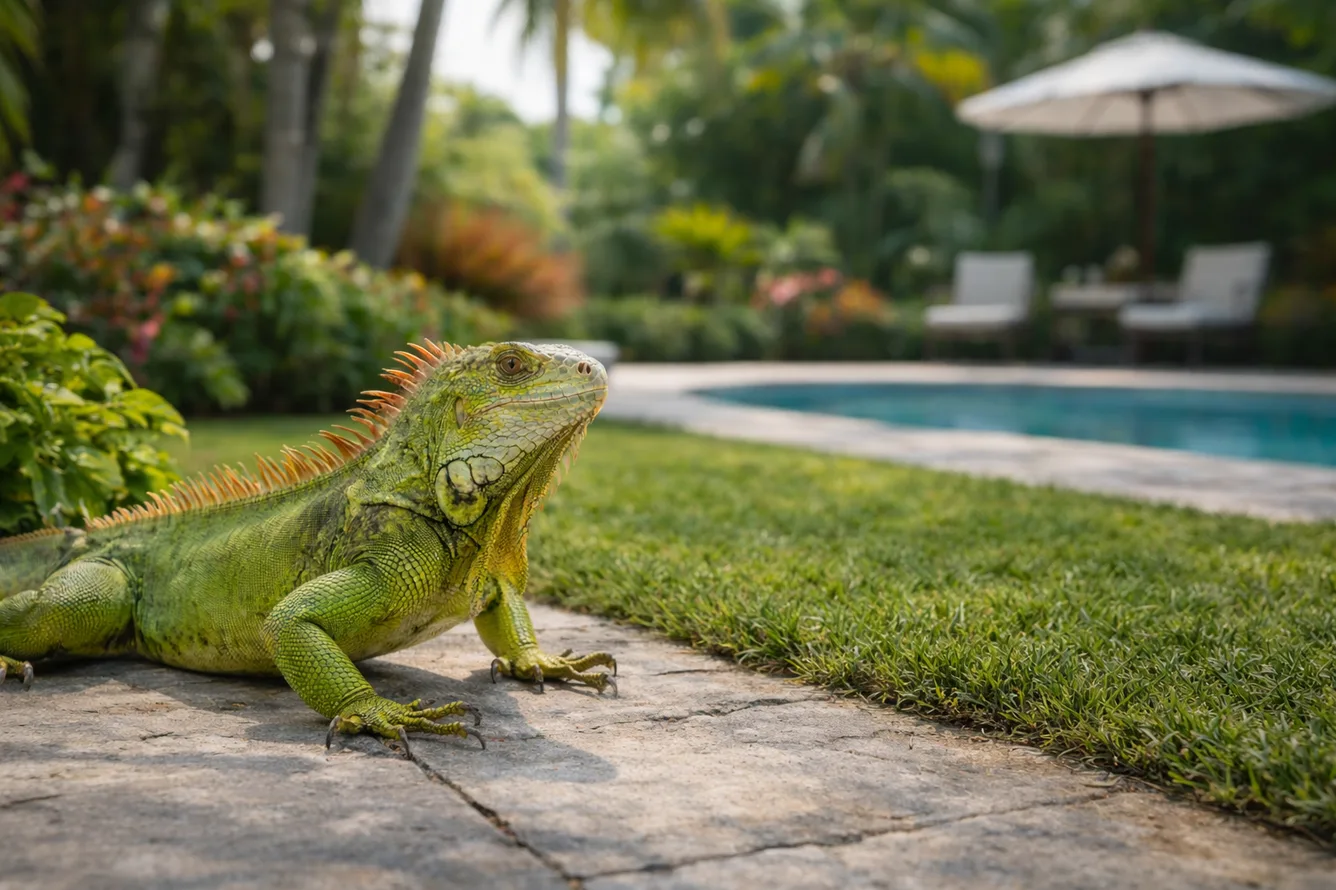
- Subtympanic shield: Green iguanas have a large, round scale beneath the ear called the subtympanic shield. This feature is a key identifier for the species and can grow impressively large on mature males.
- Head scales: The head is covered in irregular, plate-like scales that are thicker and more rigid than body scales, offering extra protection for the skull.
Each scale type reflects an evolutionary adaptation. The combination of flexible lateral scales and rigid head plates allows iguanas to squeeze through tight spaces — like gaps in seawalls and attic vents — while still maintaining structural protection.
How Iguana Scales Function as Armor and Survival Tools
Iguana scales do far more than just cover the body. They function as a multi-purpose survival system that helps explain why these reptiles have colonized South Florida so effectively. Knowing how large iguanas get in size puts their scale structure and physical capabilities into clearer perspective — a six-foot adult green iguana relies on very different armor demands than a juvenile.
Protection Against Predators
The tough, keratinous surface of iguana skin acts as a physical barrier against bites, scratches, and impacts. When threatened, an iguana may flatten its body laterally to appear larger, making the raised dorsal crest spines more prominent. These spines can deter birds, raccoons, and other predators common in Florida.
The tail, which is covered in ringed, overlapping scales, doubles as a defensive weapon. An iguana tail whip can break skin and leave welts — and those hard scales amplify the impact significantly.
Thermoregulation and UV Absorption
Because iguanas are ectothermic (cold-blooded), their skin plays a critical role in temperature management. Darker iguana skin absorbs more solar radiation, helping the animal warm up faster during cool Florida mornings. Lighter skin reflects more heat, which can prevent overheating during peak afternoon temperatures.
The skin also absorbs UVB radiation, which iguanas need to synthesize vitamin D3 for calcium metabolism. This is one reason you'll find iguanas basking on rooftops, seawalls, sidewalks, and pool decks — they're using their skin as a biological solar panel.
Water Retention
Iguana scales interlock tightly enough to minimize transepidermal water loss. This adaptation is critical for a species originally from arid and semi-arid environments in Central and South America. In Florida's humid climate, water retention is less of a survival challenge, but the adaptation still contributes to their hardiness during dry spells and cooler months.
Communication and Display
Iguana skin color and texture change during social interactions. Males often darken or brighten their coloration during breeding season to signal dominance. The dewlap — the flap of skin beneath the chin — extends outward during territorial displays, and its color and size communicate information about the iguana's sex, maturity, and reproductive readiness. Iguanas also use their unique third eye — a light-sensitive organ on top of the head — to detect overhead movement, which complements the information their skin signals provide during these social encounters.
Iguana Skin Shedding: How and Why It Happens
All reptiles shed their skin, and iguanas are no exception. The shedding process — scientifically called ecdysis — is a normal, recurring event that allows the iguana to grow and replace worn or damaged skin tissue.
The Shedding Cycle Explained
Unlike snakes, which shed their skin in one continuous piece, iguanas shed in patches. The process follows a predictable pattern:
- Pre-shed phase: The iguana's skin becomes dull and slightly grayish as a fluid layer develops between the old outer epidermis and the new skin forming beneath it.
- Separation phase: The old skin begins to crack and lift, particularly along the limbs, tail, and head. You may notice dry, flaky patches appearing on the iguana's body.
- Active shedding: Pieces of skin peel away in irregular sections. Iguanas often rub against rough surfaces — tree bark, concrete walls, rocks, and stucco — to help loosen stubborn patches.
- Completion: The new skin underneath is vibrant, smooth, and more intensely colored than the old layer.
How Often Do Iguanas Shed?
Shedding frequency depends on age, growth rate, health, and environmental conditions:
- Juvenile iguanas shed most frequently — sometimes every 4 to 6 weeks — because they're growing rapidly during their first two years of life.
- Sub-adult iguanas shed every 6 to 8 weeks as growth slows.
- Adult iguanas shed less often, typically every 4 to 8 weeks depending on diet, temperature, and overall health.
In South Florida's warm, humid climate, shedding tends to occur more regularly than in cooler environments because iguanas remain active year-round. There is no true dormancy period to slow the process, except during brief cold snaps when metabolic activity drops.
What Shed Iguana Skin Looks Like
Shed iguana skin is thin, dry, and translucent. It often appears as papery, whitish-gray fragments scattered in areas where iguanas frequent. You might find these pieces:
- On pool decks and patios
- Along fence tops and seawalls
- Draped across landscaping plants and tree branches
- Inside attic spaces, garages, and sheds
- Near burrow entrances in lawns and garden beds
Finding shed skin on your property is a strong indicator of resident iguanas. If you're finding large pieces regularly, it likely means multiple animals are living and shedding in the same area — a sign of an established population rather than a single passing visitor.
Iguana Skin Color Variations and What They Mean
The color of iguana skin is not purely cosmetic. It communicates important biological information about species, age, mood, health, and environmental response.
Species-Specific Coloration
Different iguana species found in Florida display different baseline skin colors:
- Green iguanas (Iguana iguana) range from bright emerald green as juveniles to darker olive, gray, or brownish-green as adults. Males often develop orange or rust-colored skin during breeding season.
- Black spiny-tailed iguanas (Ctenosaura similis) are darker overall, with gray-to-black body scales and banded tails. Their skin texture is notably rougher than that of green iguanas.
- Mexican spiny-tailed iguanas display similar dark coloration with lighter crossbands on the tail and a stockier body profile.
Age-Related Color Changes
Juvenile iguanas of most species are more brightly colored than adults. A baby green iguana, for instance, is often an intense, vivid green that fades to muted olive or gray-brown over 3 to 5 years. This color shift serves a purpose: bright green camouflages young iguanas in leafy canopy environments, while darker adult coloration helps with thermoregulation and blends into bark and soil tones.
Stress and Health Indicators
Iguana skin color can shift in response to stress, illness, and environmental conditions:
- Darkening skin often indicates stress, cold temperatures, or illness. An iguana that appears unusually dark may be hypothermic, dehydrated, or suffering from a bacterial or fungal skin infection.
- Yellowing or orange shifts in green iguanas are often linked to breeding hormones in males. However, persistent discoloration outside of breeding season can indicate nutritional deficiencies or liver problems.
- Pale or washed-out skin sometimes signals pending ecdysis (the pre-shed dull phase) but can also indicate parasitic infections or poor circulation.
For homeowners, recognizing these color changes isn't about diagnosing iguana health — it's about understanding what you're seeing in your yard and whether it represents a normal, healthy animal or one that may behave unpredictably due to stress.
How Iguana Skin Helps Them Thrive in Florida
The structural and functional properties of iguana skin are a major reason these reptiles have become such successful invaders in Florida's subtropical environment. The adaptations iguanas rely on to thrive extend well beyond their skin, but several key skin-specific traits align perfectly with the conditions found in South Florida.
Humidity Tolerance
Florida's high humidity levels keep iguana skin supple between sheds, reducing the risk of dysecdysis (incomplete or problematic shedding). In drier climates, captive iguanas often struggle with retained shed skin that can restrict blood flow to extremities. Wild Florida iguanas rarely face this problem because ambient humidity supports the shedding process naturally.
Heat Absorption on Urban Surfaces
The dark pigmentation of mature iguana skin allows efficient heat absorption from concrete, asphalt, stucco, and roofing materials. Florida's built environment provides an abundance of heat-retaining surfaces that iguanas exploit for basking. Their skin's ability to rapidly absorb warmth from these surfaces gives them a thermoregulatory advantage over species that rely solely on direct sunlight.
Saltwater and Chlorine Resistance
Iguanas frequently swim through canals, brackish waterways, and — much to homeowners' frustration — swimming pools. Their keratinous scales are remarkably resistant to salt, chlorine, and other dissolved chemicals. The tight interlocking structure of the scales prevents these substances from penetrating to the sensitive dermis beneath, allowing iguanas to move freely between freshwater, saltwater, and chemically treated water without skin damage.
Wound Healing and Regeneration
Iguana skin heals relatively quickly after minor injuries. Scratches, scrapes, and superficial bites from territorial encounters typically seal within days, and new scale tissue begins forming within weeks. This resilience means that physical deterrents like rough-textured fencing or prickly landscaping are only marginally effective — the skin adapts and heals fast enough that minor abrasions don't discourage repeated trespass.
Iguana Skin and Property Concerns for Homeowners
For Florida homeowners, iguana skin matters beyond biology. Shed skin, scale residue, and the physical impact of rough-scaled iguanas on property surfaces create real maintenance concerns.
Shed Skin as a Nuisance
Regular shedding means regular cleanup. If iguanas are living on your property, you'll find skin fragments in your pool skimmer, stuck to outdoor furniture, scattered across driveways, and wedged into landscaping. While shed skin is not inherently hazardous, it can carry bacteria — including Salmonella — on its surface, just as iguana feces do.
Surface Damage From Scales and Claws
Iguanas climbing stucco walls, screen enclosures, wooden fences, and roof tiles leave scratch marks. Their rough ventral scales, combined with sharp claws, can damage:
- Window screens and pool enclosures
- Painted surfaces on exterior walls
- Wooden deck railings and pergolas
- Roof tiles and flashing
Over time, repeated climbing across the same surfaces causes cumulative wear that's costly to repair.
Identifying Iguana Presence Through Skin Evidence
Shed skin is one of the clearest signs that iguanas are actively using your property. If you find shed skin in combination with droppings, burrow holes, or chewed plants, you're looking at an established iguana population — not an occasional passerby. At that point, assessing your removal options becomes a practical next step for protecting your landscape and structures.
How to Identify Iguana Species by Their Skin
If you find an iguana on your property — or just its shed skin — the texture and scale pattern can help you determine which species you're dealing with.
Green Iguana Skin Characteristics
Green iguanas have relatively smooth, fine-grained scales on the body with a prominent dorsal crest of elongated spines. The subtympanic shield is a distinguishing feature — a large, circular scale on each side of the jaw. Skin color ranges from bright green (juveniles) to olive, gray-green, or brownish-green (adults), with darker banding on the tail.
Black Spiny-Tailed Iguana Skin Characteristics
Black spiny-tailed iguanas have rougher, more heavily keeled scales — meaning each scale has a raised ridge running down its center. The tail scales form prominent whorls of spiny projections. Body color is generally dark gray to black, with lighter crossbands that fade with age. These iguanas lack the large subtympanic shield seen on green iguanas.
Comparing Shed Skin Between Species
Green iguana shed skin tends to be finer-textured and more translucent. Black spiny-tailed iguana shed skin is thicker and shows more prominent scale impressions. If you're finding coarse, dark-toned shed skin with visible spine patterns, you're likely dealing with a spiny-tailed species — which can be more aggressive and harder to deter than green iguanas.
Frequently Asked Questions
-
Is iguana skin dangerous to touch?
Iguana skin itself is not toxic or venomous. However, the surface of both live iguana skin and shed skin can harbor Salmonella bacteria. If you handle an iguana or pick up shed skin, wash your hands thoroughly with soap and water afterward. Avoid touching your face, food, or kitchen surfaces before washing.
-
Why is there shed iguana skin in my pool?
Iguanas frequently bask on pool decks and screen enclosure frames, and they sometimes swim through pools. When they shed, pieces of skin fall into the water. If you're regularly finding shed skin in your pool, it means iguanas are spending significant time near or in your pool area, and the population may be larger than you realize.
-
Can you tell how big an iguana is from its shed skin?
You can estimate size based on shed skin fragments. Larger, thicker pieces with wider scale impressions come from mature adults, while smaller, thinner, more translucent fragments are from juveniles. However, because iguanas shed in patches rather than one complete piece, it's difficult to determine exact body length from shed skin alone.
-
Do iguanas shed more during certain seasons in Florida?
Iguanas in Florida shed year-round because the warm climate keeps their metabolism active. However, shedding may increase slightly during the warmer months (April through October) when growth rates accelerate and food is most abundant. Juvenile iguanas shed more frequently than adults regardless of season.
-
Does iguana skin carry diseases that affect pets?
Shed iguana skin can carry Salmonella on its surface, which poses a risk to dogs and cats that chew on or ingest the material. If your pets have access to areas where iguanas shed, remove skin fragments promptly and discourage your pets from investigating iguana activity zones. Contact your veterinarian if your pet shows signs of gastrointestinal distress after potential exposure.
-
Why do some iguanas have orange or reddish skin?
Male green iguanas often develop orange, rust, or reddish-orange skin coloration during breeding season, which typically runs from October through February in South Florida. This shift is driven by hormonal changes and signals reproductive readiness to females. The coloration is most intense on the head, dewlap, limbs, and dorsal crest, and it fades after the breeding season ends.