
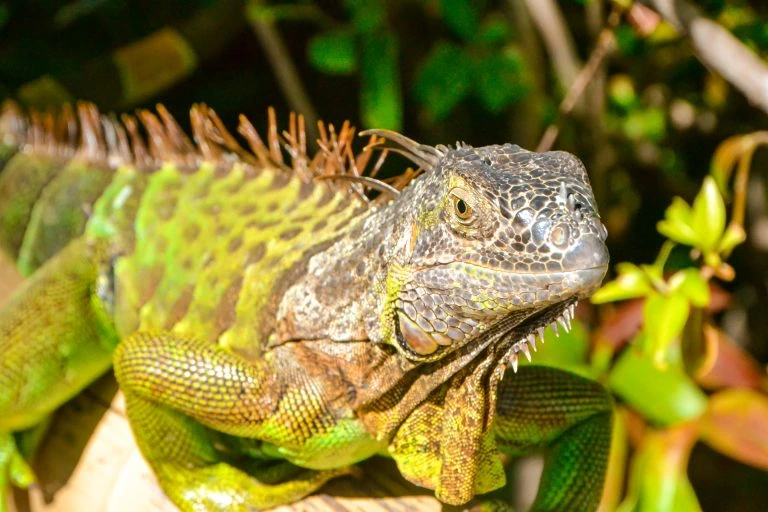
Key Takeaways
- Iguana anatomy includes specialized body parts like powerful limbs, serrated teeth, a whip-like tail, and a unique parietal (third) eye that help them thrive as invasive reptiles in Florida.
- Their skeletal structure supports climbing, swimming, and burrowing — three behaviors that cause significant property damage across South Florida.
- The iguana dewlap, tongue, and eyes each serve critical survival functions that make these lizards nearly impossible to eliminate once established.
- Understanding iguana feet, claws, and tail mechanics explains why they scale walls, dig under foundations, and defend themselves so effectively.
- Each anatomical adaptation contributes directly to their explosive population growth and resilience in subtropical environments.
Iguana anatomy is far more than a biology lesson — it explains exactly why these large lizards dominate South Florida landscapes and resist nearly every control method homeowners try. Every body part, from their razor-edged teeth to their paddle-like tails, serves a survival purpose that has allowed green iguanas and their relatives to colonize neighborhoods, canals, and commercial properties across the state. These aren't random features. They're the result of millions of years of evolution in tropical environments, and they translate perfectly to Florida's warm, humid climate. This guide breaks down every major anatomical system and shows you how each one fuels their invasive success. By the end, you'll understand not just what an iguana looks like on the outside but why its body is built for takeover.
How the Iguana Skeleton Supports Invasive Behavior
The iguana skeleton is a lightweight yet remarkably strong framework that enables these reptiles to climb, swim, dig, and survive falls that would injure most animals. Like all lizards, iguanas have a skeleton of bone rather than cartilage, and their skeletal structure follows the basic reptilian body plan — skull, spinal column, ribcage, and four limbs. To appreciate why this framework causes so much trouble, it helps to first understand how big iguanas actually get before considering the power behind each body part.
Skull and Jaw Structure
An iguana's skull is broad and flat, with powerful jaw muscles anchored to bony ridges along the temporal region. This gives them tremendous bite force relative to their size. The lower jaw (mandible) connects to the skull through a flexible joint that allows both vertical and slight lateral movement. That flexibility helps them shear through tough plant stems, flowers, and even the occasional invertebrate.
The skeleton of iguana species found in Florida — primarily the green iguana (Iguana iguana) — also features a prominent nasal salt gland. This gland sits near the nostrils and allows iguanas to expel excess salt. It's one reason they tolerate brackish water and coastal environments so well.
Spinal Column and Tail Vertebrae
The spinal column runs from the base of the skull through a long, muscular tail that can account for more than half the animal's total length. The tail contains dozens of vertebrae surrounded by dense muscle. This structure makes the tail both a swimming rudder and a powerful defensive weapon.
However, the tail vertebrae also feature specialized fracture planes — weak points that allow the tail to break off when grabbed by a predator. The iguana escapes, and the tail eventually regenerates. This ability to autotomize (drop the tail) is a critical survival adaptation that makes trapping and manual capture more difficult.
Ribcage and Body Compression
The ribcage is relatively flexible compared to mammals. Iguanas can flatten their bodies laterally to squeeze into tight crevices, attic spaces, and gaps in seawalls. This body compression ability is one reason they so easily infiltrate man-made structures. A gap that looks too narrow often isn't.
Iguana Teeth: Serrated Blades for Feeding and Defense
Iguanas possess pleurodont dentition, meaning their teeth are fused to the inner edge of the jawbone rather than seated in sockets. They have small, leaf-shaped teeth with serrated edges that look like tiny saw blades under magnification. Adult green iguanas can have 80 to 120 teeth at any given time.
Why Their Teeth Matter for Invasiveness
Those serrated teeth let iguanas shear through a wide variety of vegetation with incredible efficiency. Hibiscus flowers, bougainvillea blooms, fruit, young shoots, and garden vegetables are all clipped cleanly from the plant. A single adult iguana can strip an ornamental garden in days.
Their teeth also regenerate throughout their lifetime. When a tooth wears down or breaks, a replacement pushes up from below. This polyphyodont system means an iguana never loses its ability to feed — unlike mammals that lose adult teeth permanently.
From a defensive standpoint, iguana bites can break skin and cause lacerations. The serrated edges create ragged wounds that are prone to infection because iguana mouths harbor bacteria, including Salmonella.
Iguana Eyes: Superior Vision for Survival
Iguana eyes are positioned on the sides of the head, giving them a wide field of vision that spans nearly 350 degrees. This panoramic sight makes it extremely difficult to approach an iguana undetected — a fact that frustrates homeowners and trappers alike.
Color Vision and UV Detection
Iguanas have excellent color vision. Their retinas contain multiple types of cone cells, allowing them to perceive a broad spectrum of colors including ultraviolet (UV) light. UV detection helps them identify ripe fruit, assess the health of potential mates, and navigate their environment using light cues invisible to humans.
The Parietal Eye (Third Eye)
On the top of an iguana's head sits a small, scale-covered photosensory organ called the parietal eye. While it cannot form images, this "third eye" detects changes in light and shadow overhead. It functions as an early warning system against aerial predators like hawks and eagles.
For invasive iguanas in Florida, the parietal eye also helps regulate circadian rhythms and thermoregulation behavior. It tells the iguana when to bask, when to seek shade, and when seasonal daylight patterns shift — all critical for surviving and reproducing in a subtropical climate.
The Iguana Dewlap: Communication and Territorial Dominance
The iguana dewlap is the large, fan-shaped flap of skin hanging beneath the throat. It's supported by a flexible hyoid bone and can be extended or retracted at will. Males typically have larger dewlaps than females, and they deploy them frequently during territorial displays and mating rituals.
How the Dewlap Fuels Population Growth
During breeding season, dominant males extend their dewlap, bob their heads, and perform push-up displays to attract females and intimidate rival males. A larger, more colorful dewlap signals health and genetic fitness.
This communication system allows iguanas to establish breeding hierarchies quickly in new environments. In South Florida, where resources are abundant and predators are few, dominant males can mate with multiple females in a single season. The result is rapid population expansion — a hallmark of invasive success.
The dewlap also plays a role in thermoregulation. By extending this thin, vascularized skin flap, iguanas increase their surface area and dissipate heat more efficiently. In Florida's intense summer temperatures, this ability to cool down without retreating to shade keeps iguanas active and feeding for longer periods each day.
Iguana Tongue: Tasting the Environment
The iguana tongue is broad, fleshy, and slightly forked at the tip. Unlike snakes, which constantly flick their tongues to collect chemical particles, iguanas use their tongues primarily during feeding. However, they do engage in occasional tongue-flicking to sample their surroundings.
Vomeronasal Organ Connection
When an iguana flicks its tongue, it collects airborne particles and presses them against the vomeronasal organ (Jacobson's organ) located in the roof of the mouth. This gives the iguana chemical information about nearby food sources, potential mates, and predators.
In practice, this means iguanas can locate your garden from a distance. They detect the chemical signatures of ripening fruit, blooming flowers, and tender leaves carried on the breeze. Once they've identified a reliable food source, they return to it repeatedly — which is why iguana damage to landscaping tends to escalate rather than remain isolated.
The tongue also assists in manipulating food within the mouth. Iguanas don't chew their food thoroughly. Instead, they use the tongue to position plant material between their serrated teeth, shear off manageable pieces, and swallow them with minimal processing.
Iguana Feet and Claws: Built for Climbing and Digging
Iguana feet are one of their most impressive anatomical tools. Each foot has five toes tipped with sharp, curved claws. The front feet are slightly smaller and more dexterous, while the hind feet are larger and more powerful.
Climbing Ability
An iguana foot grips surfaces with remarkable tenacity. The sharp claws dig into tree bark, stucco walls, screen enclosures, concrete block, and wooden fencing. Iguanas routinely scale vertical surfaces that seem impossible for an animal their size.
This climbing ability is central to their invasiveness. They access rooftops, attic soffits, elevated garden beds, and fruit trees with ease. Once on a roof, they may enter attic spaces through damaged soffits or vents, creating nesting sites that are difficult to access and remove.
Digging Power
The clawed iguana feet also make them formidable diggers. Female iguanas excavate nesting burrows that can extend three to six feet underground and span several feet in width. These burrows undermine sidewalks, seawalls, foundations, canal banks, and retaining walls.
The hind limbs are muscularly powerful, and the claws act like miniature shovels. A single nesting female can displace hundreds of pounds of soil in a matter of days. In areas with dense iguana populations, the cumulative burrowing damage to infrastructure runs into millions of dollars annually.
Swimming Locomotion
Iguana feet contribute to swimming ability as well. While their toes aren't webbed, the broad surface area of the splayed foot acts as a paddle. Combined with the laterally compressed tail, iguanas are strong swimmers capable of crossing canals, ponds, and even stretches of open ocean between islands.
This swimming ability allows iguanas to spread across waterways that would otherwise serve as natural barriers. It's a major factor in their rapid geographic expansion throughout South Florida's interconnected canal systems.
The Iguana Tail: Weapon, Rudder, and Escape Tool
The tail deserves its own detailed section because it's arguably the most versatile body part in the anatomy of iguana species. Accounting for up to two-thirds of the animal's total length, the tail serves three distinct survival functions.
Defensive Weapon
An iguana tail whip can deliver a painful and damaging strike. The tail muscles generate enough force to leave welts, bruises, and even lacerations on human skin. Large males with tails exceeding three feet can strike with surprising speed and accuracy.
This defense mechanism makes iguanas dangerous to handle without proper equipment and training. Homeowners who attempt DIY removal often discover this the hard way.
Swimming Rudder
In water, the laterally compressed tail undulates side to side, propelling the iguana forward with powerful strokes. Iguanas can remain submerged for extended periods — some observations suggest they can hold their breath for up to 30 minutes. The tail's hydrodynamic shape makes them efficient swimmers that cross waterways quickly.
Autotomy (Tail Drop)
As mentioned in the skeletal section, iguanas can voluntarily shed their tails at fracture planes between vertebrae. The detached tail thrashes on the ground, distracting the predator while the iguana escapes. The tail regrows over several months, though the regenerated version is typically shorter, darker, and lacks the bony vertebrae of the original.
Iguana Skin and Scales: Armor and Camouflage
Iguana skin consists of overlapping keratinous scales that provide physical protection against abrasion, minor predator attacks, and UV radiation. The scales vary in size across the body — large, plate-like scales on the head and back, and smaller, granular scales on the limbs and belly. Learning about their unique skin and shedding process reveals just how well-equipped these reptiles are to survive repeated encounters with predators and environmental hazards.
Color-Based Camouflage
The green coloration of Iguana iguana provides effective camouflage in tropical and subtropical vegetation. Juveniles are especially vibrant green, blending almost perfectly into leaf canopies. As iguanas mature, their coloration may shift toward gray, brown, or orange depending on age, sex, health, and season.
This natural camouflage makes detection difficult. Iguanas sitting motionless in trees or hedges are nearly invisible until they move. Homeowners often don't realize they have an iguana problem until the population is already well established.
Shedding and Growth
Iguanas shed their skin periodically as they grow. Unlike snakes that shed in one piece, iguanas shed in patches. The shedding process allows continuous growth and replaces damaged scales. This regenerative capacity means that minor injuries from encounters with predators, fences, or traps heal relatively quickly without long-term impairment.
The Dorsal Crest and Spines: More Than Decoration
Running along the iguana's back from the nape of the neck to the base of the tail is a row of elongated, pointed scales called the dorsal crest. These spines are largest on adult males and serve multiple functions.
Intimidation Display
When threatened, an iguana arches its back and raises the dorsal spines to appear larger and more formidable. Combined with the extended dewlap and lateral body compression, this display often deters smaller predators.
Thermoregulation
The dorsal crest increases surface area along the spine, which aids in absorbing solar radiation during basking. Iguanas are ectothermic — they rely entirely on external heat sources to regulate body temperature. The spines help them warm up faster in the morning, allowing earlier activity and more time for feeding and territorial patrols.
Species Identification
The size, shape, and distribution of dorsal spines also help distinguish between iguana species. Green iguanas have relatively uniform, conical spines, while black spiny-tailed iguanas have shorter, blunter spines concentrated near the tail. This distinction matters for identification and management because different species have different behavior patterns and habitat preferences.
How Iguana Anatomy Creates Property Damage
Every anatomical feature discussed above translates into a specific type of property damage or control challenge for Florida homeowners.
- Teeth strip ornamental plants, vegetable gardens, and fruit trees
- Claws and feet damage screen enclosures, stucco facades, and roof soffits
- Burrowing limbs undermine foundations, seawalls, sidewalks, and canal levees
- Tails make handling dangerous and complicate trapping efforts
- Eyes and parietal eye make iguanas nearly impossible to approach undetected
- Swimming ability spreads populations across canal-connected neighborhoods
- Reproductive anatomy (paired hemipenes in males, high egg output in females) drives population explosions
Understanding the anatomy of iguana species isn't just academic. It's the foundation of effective iguana management, and recognizing the key adaptations that make iguanas invasive is essential for choosing the right prevention and control strategies. Knowing why they can climb your wall, dig under your patio, or escape your trap helps you make better decisions. If iguana damage is escalating on your property, professional assessment is the most reliable path to a lasting solution.
Frequently Asked Questions
-
How many teeth does an iguana have?
Adult green iguanas typically have between 80 and 120 small, serrated teeth at any time. Their teeth are pleurodont, meaning they're fused to the jawbone. Iguanas replace worn or broken teeth continuously throughout their lives, so they never lose their ability to feed or bite.
-
What is the iguana dewlap used for?
The iguana dewlap is a throat fan used primarily for communication. Males extend it during territorial displays and mating rituals to signal dominance and attract females. It also aids thermoregulation by increasing surface area for heat dissipation during hot weather.
-
Can iguanas see in color?
Yes, iguanas have excellent color vision that includes the ability to detect ultraviolet light. Their eyes contain multiple cone cell types, allowing them to perceive a wide color spectrum. This helps them find food, evaluate mates, and navigate their environment effectively.
-
Why are iguana feet so effective at climbing?
Each iguana foot has five toes with sharp, curved claws that grip bark, concrete, stucco, and wood. The combination of claw sharpness and powerful leg muscles allows iguanas to scale vertical surfaces quickly. This climbing ability lets them access rooftops, trees, and elevated structures with ease.
-
What does the parietal eye on top of an iguana's head do?
The parietal eye is a photosensory organ that detects light and shadow changes but cannot form images. It warns iguanas of aerial predators approaching from above. It also helps regulate their body clock, telling them when to bask, when to sleep, and when seasonal light patterns are shifting.
-
How does iguana anatomy make them hard to remove?
Their wide-angle vision detects approaching threats from nearly every direction. Tail autotomy lets them escape when grabbed. Strong claws allow rapid retreat up trees or walls. Powerful swimming ability lets them flee across water. Together, these features make iguanas extremely difficult to capture without professional techniques and equipment.