
Table of Contents
ToggleKey Takeaways
- Mice can easily climb stairs, walls, pipes, and wiring to reach every floor of your home.
- Textured surfaces like brick, stucco, wood siding, and drywall give mice the grip they need to scale vertical surfaces.
- Upper floors and attics are common nesting spots because they offer warmth, quiet, and proximity to insulation materials.
- Scratching sounds in ceilings or walls at night are a strong indicator that mice have already reached your upper levels.
- Sealing entry points, removing food sources, and setting traps on every floor are the most effective ways to stop mice from spreading upstairs.
Can mice climb stairs and walls to invade upper floors of your home? The short answer is yes — and they do it far more often than most homeowners realize. Mice are remarkably agile creatures that can scale vertical surfaces, squeeze through gaps the size of a dime, and navigate multi-story homes with ease. If you’ve heard scratching in your ceiling or spotted droppings in an upstairs bedroom, you’re not imagining things. These small rodents treat your home like a vertical highway, using walls, pipes, and wiring as pathways to every level. In this guide, you’ll learn exactly how mice reach upper floors, why they’re drawn there, the warning signs to watch for, and what you can do to stop them from spreading throughout your home.
Can Mice Really Climb Stairs?
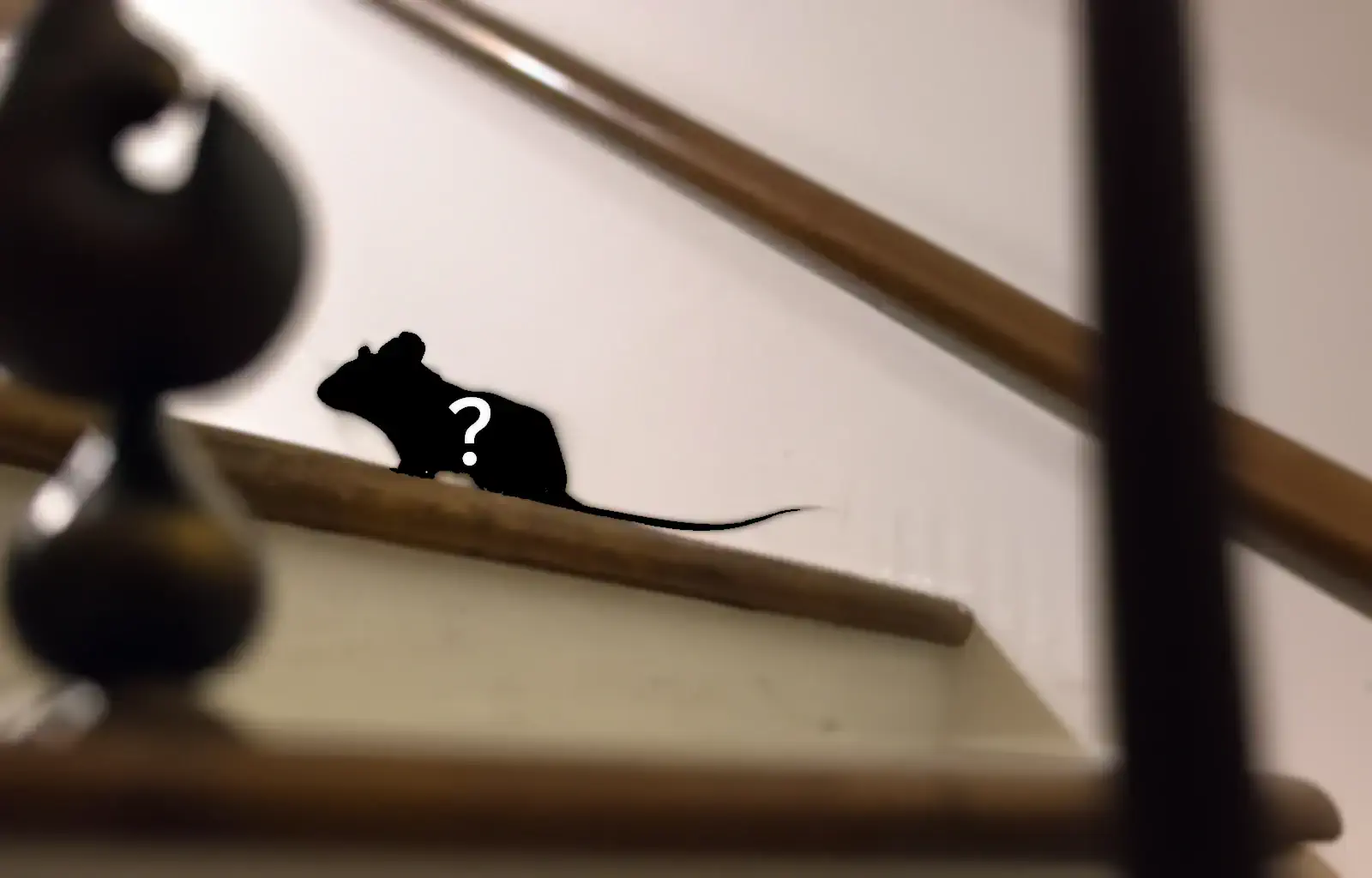
Stairs are no challenge whatsoever for mice. Despite their small size, mice have powerful hind legs relative to their body weight. A standard staircase with carpet, wood, or tile treads provides more than enough traction for a mouse to scamper up quickly and quietly.
In fact, mice can ascend a full flight of stairs in seconds. They typically do this at night when the house is quiet, which is why many homeowners never actually see them traveling between floors. Mice prefer to stick close to walls as they move, using the edge of each step as a guide. This behavior is called “thigmotaxis” — a natural tendency to keep their bodies in contact with surfaces for safety.
Even smooth, polished hardwood stairs rarely stop a determined mouse. Their tiny claws find micro-imperfections in almost any surface. The only material that genuinely gives mice trouble is perfectly smooth glass or polished metal — and those aren’t common staircase materials.
How Do Mice Climb Walls and Vertical Surfaces?
Mice don’t just use your staircase. They regularly climb walls to reach upper floors, attics, and ceilings. Their small, sharp claws act like tiny grappling hooks, latching onto any surface with even the slightest texture.
Claws, Paw Pads, and Jumping Ability
Each of a mouse’s front paws has four toes and each back paw five, all tipped with curved, hook-like claws that dig into surface irregularities invisible to the naked eye. The paw pads add grip the way a rubber sole does — claws and pads together let mice ascend materials that look impossible to climb. Climbs rarely have to start at floor level, either: mice can jump up to 12 inches vertically and about 2 feet horizontally, so a mouse can leap onto a ledge, countertop, or pipe and begin climbing from an elevated starting point. And if a mouse senses food, warmth, or shelter above it, it will attempt the same climb repeatedly until it succeeds.
Surfaces Mice Can Easily Climb
Mice are successful climbers on a wide variety of common building materials. Here’s a breakdown of what they can and cannot scale:
| Surface Type | Can Mice Climb It? | Why |
|---|---|---|
| Brick | Yes — easily | Rough, porous texture provides excellent grip |
| Stucco | Yes — easily | Textured finish offers many footholds |
| Wood siding | Yes — easily | Grain and seams give claws traction |
| Drywall (interior) | Yes — with effort | Slightly textured paint is often enough |
| Vinyl siding | Sometimes | Overlapping seams help, smooth panels are harder |
| Sheet metal | No | Too smooth for claws to grip |
| Glass | No | Zero traction available |
Most homes in South Florida feature stucco or textured exterior walls, making them especially vulnerable. Mice can climb the exterior of your home and enter through gaps near the roofline, soffit vents, or utility penetrations on upper floors.
Inside the Walls: A Hidden Highway
Mice don’t always climb the visible face of a wall. More often, they travel inside the wall cavity. Pipes, electrical wiring, and wooden studs provide perfect vertical pathways. A mouse can climb from your ground floor to your attic entirely within your walls without ever being seen. This is why many homeowners hear noises in their ceiling or walls but never spot the culprit.
Why Do Mice Go Upstairs and Into Attics?
Mice don’t climb to upper floors randomly. They’re driven by survival instincts — specifically the need for shelter, warmth, safety, and proximity to food. Upper levels of your home often satisfy these needs better than ground floors.
- Warmth: Heat rises, making attics and upper stories warmer during cooler months. Mice seek warm nesting spots, and attic insulation provides perfect thermal protection.
- Safety from predators: Upper floors see less foot traffic from people and pets, giving mice undisturbed nesting areas.
- Nesting materials: Attics are filled with insulation, stored cardboard boxes, old clothing, and paper — all ideal materials for building mouse nests.
- Food access: Bedrooms and upstairs pantries may contain snacks, pet food, or crumbs that attract mice.
Understanding what attracts mice to your attic is the first step in preventing them from settling in. Once a mouse establishes a nest on an upper floor, it will travel between levels nightly to forage for food.
Do Mice Have Bones? How Their Bodies Help Them Climb
One of the most common misconceptions about mice is that they’re boneless. Mice absolutely have a full skeletal system, but their bones are remarkably flexible. A mouse’s skull is the widest rigid part of its body, and if its head can fit through a gap, the rest of the body can follow.
This flexibility is what allows mice to squeeze through openings as small as a quarter-inch — roughly the diameter of a pencil. It also helps them navigate tight vertical spaces inside walls. Combined with their light body weight (typically 12 to 30 grams), this flexibility makes them exceptionally efficient climbers. They can grip surfaces, contort their bodies around obstacles, and maintain balance on narrow ledges like wires and pipes.
Their tails also play a role. A mouse’s tail acts as a counterbalance during climbing, helping them stay stable on vertical and angled surfaces. This combination of flexibility, light weight, sharp claws, and a balancing tail makes mice one of the most capable climbers among common household pests.
Signs That Mice Have Reached Your Upper Floors
Mice are nocturnal and secretive, so you may not see them upstairs even if they’re active there every night. Instead, look for these telltale signs of a mouse infestation on your upper levels:
- Droppings: Small, dark, pellet-shaped droppings along walls, in closets, or inside dresser drawers. Mouse droppings are one of the most reliable indicators.
- Scratching or scurrying sounds: Noises in the ceiling or walls, especially between midnight and dawn. If you hear scratching in your walls, mice are likely traveling between floors.
- Gnaw marks: Chewed edges on baseboards, door frames, or stored boxes in closets and attics.
- Urine stains or odor: A distinct, musky ammonia smell in enclosed spaces. Mouse urine stains may also appear as small, dark streaks under UV light.
- Nesting material: Shredded paper, fabric, or insulation gathered in hidden corners of attic spaces or closets.
- Grease marks: Dark rub marks along walls and baseboards where mice repeatedly travel the same route.
If you notice even one of these signs upstairs, take action immediately. Spotting one mouse usually means there are more nearby.
How Do Mice Get Into Upper Floors in the First Place?
Understanding how mice get into your house helps you figure out how they reach upper stories. Mice typically enter at ground level or even below — through foundation cracks, garage doors, utility lines, or gaps around pipes. From there, they move upward using several routes:
- Interior wall cavities: The most common path. Mice climb studs, pipes, and wiring inside walls.
- Stairways: Open staircases are easy to ascend, especially at night when the home is dark and quiet.
- Exterior walls: Mice climb textured exterior surfaces and enter through roofline gaps, soffit vents, or damaged fascia boards.
- Plumbing stacks: Vertical plumbing runs provide direct access from the crawlspace or basement to the attic.
- Tree branches: Overhanging branches touching the roof give mice a bridge directly to upper-level entry points.
For this reason, finding and sealing rodent entry points on every level of your home is critical — not just at the ground floor.
Can Mice Climb Stairs to Reach Bedrooms?
Yes, and this is one of the most unsettling realities of a mouse infestation. Mice can and do enter bedrooms on upper floors. They’re drawn to bedrooms for several reasons: food crumbs from late-night snacking, warmth from bedding, and the quiet darkness that a bedroom provides during the day when occupants are elsewhere.
If you’ve found evidence of mice in your bedroom, you’re understandably concerned. Many people wonder whether mice will bite you while you sleep. While bites are rare, they can happen if a mouse detects food residue on skin. A mouse in the bedroom is a problem that should be addressed quickly — both for your health and your peace of mind.
To reduce the likelihood of mice visiting bedrooms:
- Never eat in bed or leave food in the bedroom.
- Keep closet doors closed and seal gaps under bedroom doors.
- Store clothing in sealed containers rather than open boxes.
- Place snap traps along walls near suspected entry points.
How to Stop Mice From Climbing to Upper Floors
Preventing mice from reaching upper stories requires a multi-pronged approach. You need to block their pathways, remove what attracts them, and actively reduce the population.
Seal Entry Points on Every Level
Start by inspecting your entire home — inside and out — for gaps, cracks, and holes. Pay special attention to:
- Gaps around plumbing and electrical penetrations on every floor
- Soffit vents, ridge vents, and roof-to-wall junctions
- Gaps beneath doors, including interior doors between floors
- Cracks where utility lines enter the home
Use steel wool, copper mesh, or metal flashing to seal openings. Mice can chew through caulk, foam, and wood, but they cannot gnaw through metal. For comprehensive guidance, review these tips for rodent-proofing your home.
Remove Food Sources Throughout the Home
Mice travel to wherever food is available. Eliminating food sources that attract rodents on every floor discourages them from venturing upstairs. Store all food in airtight containers. Clean up crumbs immediately. Don’t leave pet food bowls out overnight. Even a few forgotten crumbs under a bed or couch are enough to draw mice to an upper level.
Set Traps on Multiple Floors
Many homeowners make the mistake of placing traps only where they first saw evidence — usually the kitchen. However, if mice are upstairs, you need traps upstairs too. Place snap traps or rodent bait stations along walls and in corners of every floor where you’ve found droppings or heard activity. Use effective mouse trap bait like peanut butter or chocolate for the best results.
Address the Attic Specifically
Attics deserve special attention because they’re the most common upper-level nesting site. Inspect your attic insulation for tunneling, droppings, or urine stains. If insulation is heavily contaminated, you may need to replace it with pest control attic insulation designed to deter rodents. Trim tree branches at least six feet from the roofline to eliminate aerial access points.
Block Exterior Climbing Routes
Mice often begin their climb outside the house, so exterior defenses matter as much as indoor traps. Cut back shrubs, vines, and ivy growing against exterior walls — vegetation acts as a ladder that lets mice bypass ground-level defenses entirely. Around pipes and utility lines, install sheet metal collars or smooth metal flashing; mice cannot grip polished metal, which is why it is the standard material in professional rodent exclusion work. Cover soffit openings and vents with rodent-proof mesh screens. Finally, reduce what draws mice upward in the first place: keep outdoor garbage cans tightly sealed, move bird feeders away from the house, and never leave pet food outside overnight.
When to Call a Professional for Mice on Upper Floors
DIY methods work for isolated mouse sightings, but a persistent or widespread infestation — especially one that has spread to multiple floors — typically requires professional help. Mice reproduce rapidly. A single pair can produce dozens of offspring in just a few months, so understanding how fast mice grow underscores the urgency of acting quickly.
Professional exterminators know how to eliminate mice in walls and crawlspaces — the hidden areas that homeowners can’t easily access. They use a combination of trapping, exclusion, and monitoring to ensure the entire population is addressed.
If you’re dealing with mice upstairs and want a lasting solution, consult a professional who can provide a full-home inspection. For a complete overview of strategies, read our guide on how to completely get rid of mice in your home. And if rats are part of the problem, our resource on how to get rid of rats covers everything you need to know about these larger rodent invaders as well.
Frequently Asked Questions
-
Can mice climb smooth walls?
Mice struggle with truly smooth surfaces like glass, polished metal, or glossy tile. However, most interior walls have some texture from paint or drywall finish, which can provide enough grip. Textured surfaces like brick, stucco, and wood are easily climbed by mice.
-
How high can a mouse climb?
There is no practical height limit for mice on textured surfaces. They can climb multiple stories on the exterior of a building and travel from the foundation to the attic inside wall cavities. As long as the surface provides traction, mice will continue climbing.
-
Do mice prefer to stay on one floor of a house?
No. Mice regularly travel between floors to access food, water, and nesting areas. They may nest in an attic but forage in the kitchen each night. This is why trapping and sealing efforts should cover every level of the home.
-
Why do I hear mice in my ceiling but not downstairs?
Mice are quieter on carpeted or furnished floors. In ceilings and wall cavities, their movement echoes against drywall and joists, making it more audible. They may also nest primarily in the attic or upper wall spaces while foraging quietly on lower floors.
-
Can mice jump as well as climb?
Yes. Mice can jump up to 12 inches vertically from a standing position and even farther with a running start. Combined with their climbing skills, this allows them to reach countertops, shelves, and elevated surfaces that homeowners assume are safe.
-
Should I put mouse traps upstairs even if I only see mice downstairs?
Absolutely. If mice are in your home, they likely explore multiple floors — even if you haven't seen evidence yet. Place traps along walls, near doors, and in closets on every level. Early trapping upstairs prevents mice from establishing nests in harder-to-reach areas like attics and wall voids.
-
Can baby mice climb walls the same way adult mice do?
Young mice develop climbing abilities quickly, but very young pups (under two weeks old) cannot climb vertical surfaces. By about three weeks of age, juvenile mice are agile enough to climb most textured walls. Their smaller size also allows them to squeeze through even tinier gaps than adults.
-
What wall material is most mouse-proof?
Smooth, polished metal and glass are the only surfaces mice truly cannot climb. For practical home applications, sheet metal barriers installed around pipes and at the base of walls are the most effective way to block climbing. Smooth metal flashing is commonly used in professional rodent exclusion work.