
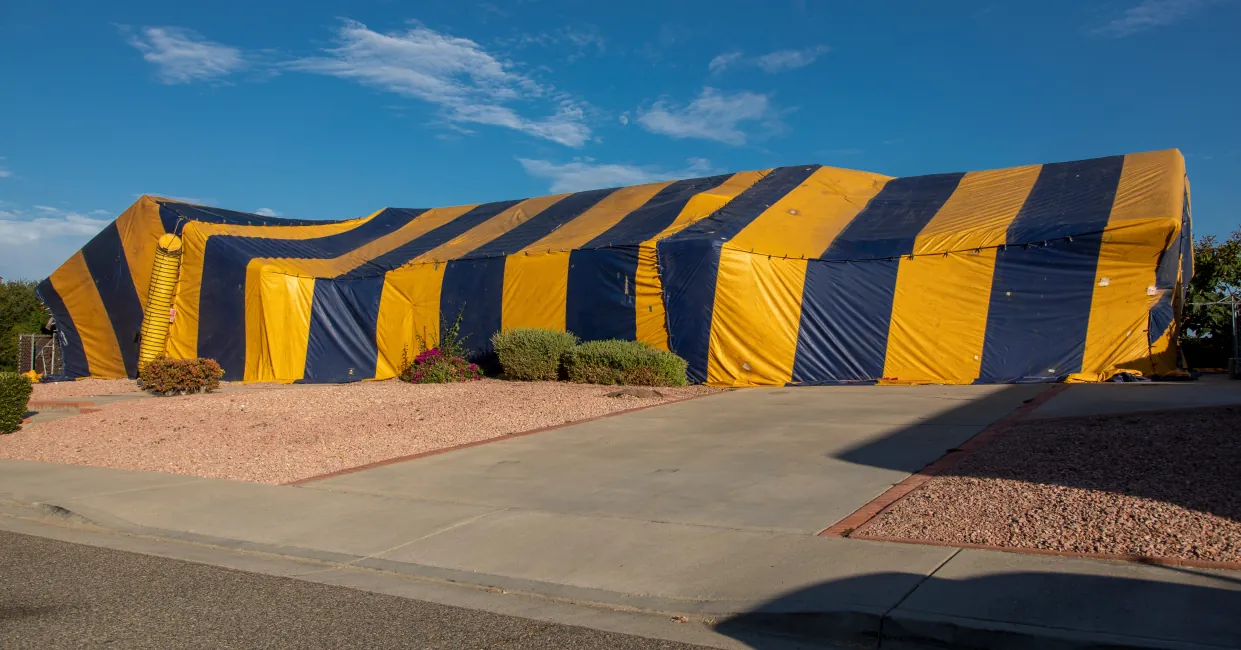
Match termite treatments to the organism and the accessible infestation. Compare soil liquids, maintained baits, fumigation, monitored heat and localized wood treatment without assuming identical coverage or guarantees.
Start with identification and treatment scope
Termite treatment is a species-and-building decision. Soil treatment, baiting, fumigation, heat and localized wood treatment address different problems. A low quote for the wrong organism will not protect the structure. Ask for identification, evidence locations, access limitations and a written explanation of what the proposed treatment covers.
Florida has several structural pest species. Drywood colonies can live entirely within wood. Native subterranean termites and invasive Formosan and Asian subterranean termites have different distributions and biology. Formosan is part of the subterranean group. The Florida termite guide and early warning-sign guide help describe evidence, but a color or a swarming date alone is insufficient for species identification. The treatment assessment also cannot certify structural soundness; repairs may require a separate building professional.
Liquid soil treatments
Liquid termiticides protect a structure by treating soil at appropriate access points used by subterranean termites. Application may involve trenches, rodding or drilling selected slabs, according to the product label and construction. Ask how attached slabs, wells, drains, inaccessible sections and utilities affect the plan. These are professional application decisions, not a homeowner drilling recipe.
Products commonly described as repellent or non-repellent differ in how termites encounter treated zones. Transfer between individuals does not establish that every soil application eliminates the entire colony. UF/IFAS explains that soil treatments generally provide structural protection rather than reliable whole-colony elimination. Coverage gaps or later soil disturbance can compromise protection.
Do not substitute a universal five-to-eight-year lifetime for the actual label, site conditions and service agreement. Ask what inspection and maintenance are included and what happens after landscaping or construction disturbs treated soil. Treatment longevity is distinct from the duration of a warranty. Soil treatment is not a stand-alone answer to drywood colonies living above it.
Bait systems and continued monitoring
Subterranean bait systems place cellulose containing a slow-acting active ingredient where foraging termites can find and feed on it. Certain chitin-synthesis-inhibitor baits can eliminate a feeding colony by interfering with worker molting. The important conditions are interception, sustained feeding and a properly maintained system; a station does not promise to lure every nearby termite away from structural wood.
Station locations, service intervals and replenishment depend on the system’s label, the provider’s plan and site conditions. Avoid assuming every product requires the same spacing or visits every two to three months. Ask how activity is recorded, what happens if stations are inaccessible, and how the provider measures progress. Treatment and monitoring frequency should follow the actual agreement.
Baits can be useful where construction complicates soil-liquid coverage. Results take time because termites must feed and affected workers must complete developmental processes. A promised elimination deadline for an uninspected property is unreliable. Compare the intended outcome and follow-up, not only the initial installation.
Fumigation for drywood termites
Structural fumigation treats drywood infestations throughout the enclosed structure, including locations that cannot be reached by a spot treatment. It requires trained, licensed specialists, correct dosing, exposure, aeration and measured clearance. Occupants, pets and plants must leave as instructed. You may reenter only after the authorized clearance, never after a self-selected number of days.
Fumigation should reach hidden drywood colonies when correctly performed, but it is not a promise against future introductions and does not repair eaten wood. Sulfuryl fluoride leaves no continuing termite barrier. The post-fumigation guide should be used with the fumigator’s instructions.
Compare written quotes for the actual structure, preparation and coordination. Fumigation cost factors do not establish a universal price or prove fumigation is always the most expensive option. A termite agreement may have organism, renewal, transfer and repair exclusions; fumigation does not automatically create ongoing coverage.
Heat and localized wood treatments
Professionally managed heat treatment is an option for certain drywood infestations. The critical issue is sustained lethal temperature inside all targeted infested wood, not warm room air. UC IPM describes heating wood to at least 120°F for at least 33 minutes in its drywood discussion. That published benchmark is not a DIY operating protocol or proof that any building has reached it.
Large timbers, wood contacting concrete and layered coverings can create heat sinks. Monitoring and site suitability matter. Heat can damage sensitive belongings or building materials and leaves no residual protection. Confirm actual provider availability; this comparison is not a statement that On Demand Pest Control offers heat service.
Localized chemical treatment, professionally planned wood replacement or a compartmental heat treatment can address accessible drywood infestations. A localized plan may miss other hidden colonies. The drywood-control guide explains why inspection limits matter. Replacing a load-bearing member requires qualified building assessment. Do not choose a spot treatment merely because pellets were found in only one room.
Localized injection and preventive wood treatment differ
UF describes professional localized drywood treatment through injections into galleries or kick-out holes, or into openings made to reach an identified infestation. The method depends on finding the colony and delivering the labelled material to it. An accessible board treatment cannot establish that every concealed colony elsewhere was reached.
Borate treatment of suitable exposed, unfinished wood has a different preventive purpose. Paint, sealed surfaces and inaccessible wood limit access; surface treatment is not a promise to eradicate all hidden galleries. Ask whether the proposal is preventive wood treatment, treatment of an identified colony, or whole-structure control, and which materials can actually be treated.
Nonchemical options include professionally planned removal or replacement of affected wood and suitable heat treatment. Removing one reachable board can leave other colonies behind, while heat must achieve the required temperature within all targeted infested wood. Physical prevention and monitoring remain useful, but a natural origin or nonchemical label is not evidence that an improvised oil or spray controls a concealed structural infestation.
Compare proposals for the same problem
For subterranean activity, compare soil liquids and maintained bait systems. Liquids protect treated routes; certain baits eliminate feeding colonies. For drywood activity, compare whole-structure treatment with a clearly bounded localized plan. Fumigation offers broad reach, heat depends on heating the wood adequately, and spot applications depend strongly on finding and reaching the infestation. Neither heat nor fumigation supplies a lasting barrier.
Ask each bidder to identify the target organism, exact treatment area, access assumptions, preparation, occupancy directions, expected follow-up and exclusions. Include repair needs as a separate budget line. The termite-treatment cost guide can organize quote questions. Avoid dollar-symbol rankings and fixed deadlines that conceal differences in coverage.
Use pellet evidence and mud-tube evidence to describe what was found, not to calculate infestation size. If evidence appears in several locations, ask whether it represents multiple colonies, one connected foraging network or unresolved evidence. A treatment plan should explain that uncertainty.
Homeowner work and professional treatment
Homeowners can preserve evidence, make safe areas accessible, fix leaks, maintain foundation visibility and reduce wood-to-soil contact. Those tasks support a treatment plan. They do not replace proper identification or pesticide application to concealed structural routes.
The DIY and professional comparison should account for label directions, building knowledge and missed infestations. Retail sprays that kill exposed insects have not necessarily demonstrated structural protection. EPA distinguishes contact-kill claims from products registered to protect a structure. Nonchemical and natural-control approaches also need evidence of performance; natural origin does not establish safety or reliable colony control.
Before signing, obtain the product label or nonchemical treatment explanation and the written agreement. Confirm any On Demand Pest Control proposal directly, including covered pests and follow-up. Avoid assuming that general pest service covers termites or that any quoted method guarantees permanent freedom from them.
Frequently Asked Questions
-
What is the most effective type of termite treatment?
It depends on the organism, construction and infestation. Soil liquids and certain baits address subterranean termites; drywood colonies require wood-targeted or whole-structure approaches. No method guarantees permanent control at every property.
-
Can you treat termites without tenting your house?
Often, but the species and scope matter. Soil liquids or baits are typical subterranean approaches. Localized drywood treatment can miss hidden colonies; evaluate a whole-structure option when appropriate. Confirm the proposed method and provider availability.
-
How long does it take for termite treatment to work?
The time depends on the method, organism, access and monitoring. Bait action requires feeding and developmental processes; liquids protect treated routes. Fumigation and heat require completed treatment and clearance, not a universal elimination deadline.
-
Do I need to leave my home during termite treatment?
Follow the product label and provider's written occupancy instructions. Fumigation requires evacuation and measured clearance. Heat requires exclusion from the treated space until authorized return. Other applications have their own restrictions.
-
Is one termite treatment enough, or will I need retreatment?
New activity, disturbed treatment zones or missed infestations can require additional assessment. Follow the actual monitoring agreement and report new evidence. Warranty duration is not the same as product persistence.
-
What type of termite treatment is best for drywood termites in Florida?
Widespread or inaccessible drywood infestations may warrant structural fumigation. Localized treatment may fit a well-defined accessible infestation, with inspection limits acknowledged. Heat suitability and availability need separate confirmation.
Get help with your pest concern.
Tell us what you are seeing. Our team can discuss the concern and the next step. For a real-estate transaction, ask separately about paid WDO reports or clearance letters and their required scope.
- Share your concern and contact details.
- Our team contacts you to discuss available service.
- Ask for a written scope and quote before work.
Where can we reach you?
Share your contact details to discuss an inspection.
By submitting, you’re asking On Demand Pest Control to contact you about this request.
↗ Prefer to call? (954) 947-0805